How to Create a Cottage Garden in the UK: The Complete Guide

I sometimes use affiliate links in content. This doesn’t cost you anything but I may make a commission payment from anything you buy through these links. As an Amazon Associate I earn from qualifying purchases. All opinions remain my own.
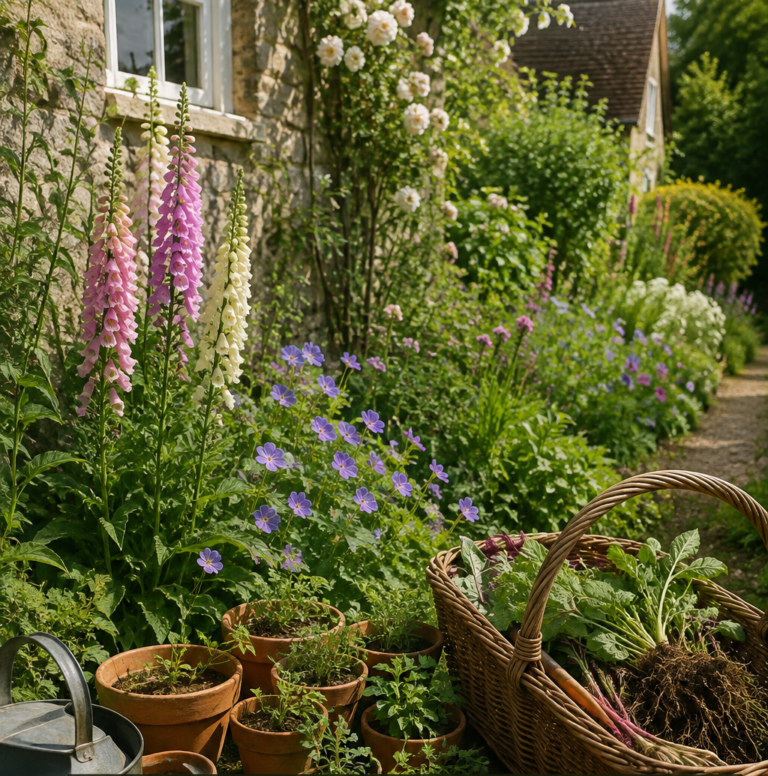
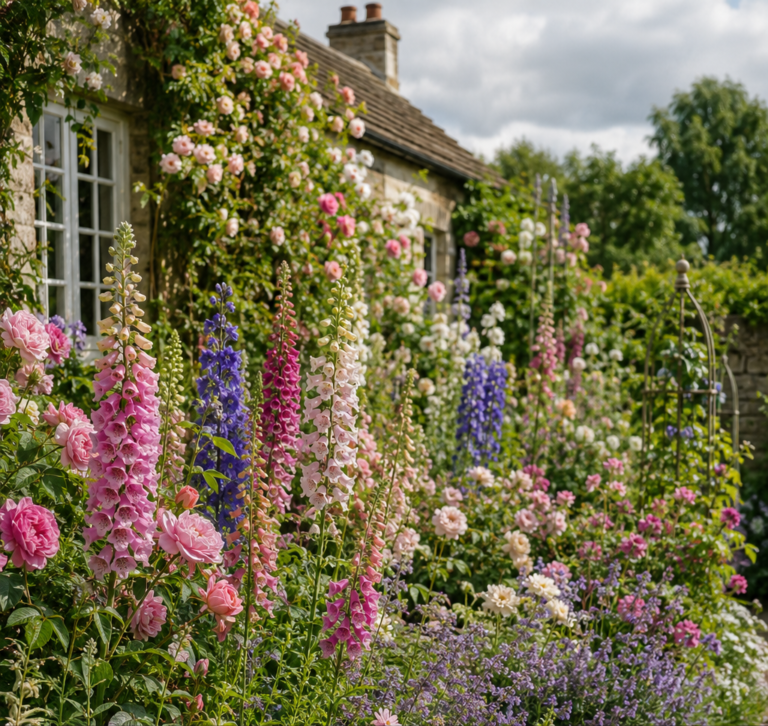
There is something almost alchemical about a well-made cottage garden. At first glance it looks like nature has simply spilled over the fence — foxgloves leaning into roses, lavender threading between runner beans, clematis clambering up whatever it can reach. Look closer, and you begin to see the hand behind it all. Every seemingly accidental tumble of colour was planted with intention. Every gap in the border was filled with purpose. The cottage garden is, at heart, a beautiful deception: it looks wild, but it is secretly very well planned.
This guide is for anyone who wants to create that magic in a British garden — whether you’re starting from scratch on a blank plot, gradually transforming a tired lawn, or trying to bring together a collection of beloved plants that have never quite cohered into a proper garden. Cottage gardening suits the UK climate extraordinarily well. Our cool, damp summers are practically made for peonies, delphiniums, and sweet peas. Our long autumn light is perfect for asters and dahlias. The style itself — abundant, productive, and alive with wildlife — feels native to these islands in a way that formal clipped gardens never quite do.
We’ll cover everything here: how to think about space and soil, how to design a planting scheme that creates that signature layered effect, which plants earn their place in a British cottage border, and how to maintain the whole glorious thing without it taking over your life.
What Is a Cottage Garden, Really?
Before a trowel goes into the ground, it’s worth understanding what you’re actually trying to create — because “cottage garden” covers a multitude of interpretations.
Forged & Grown
Garden pieces, printed to order
3D printed planters and garden accessories, made in the UK. Self-watering designs, sculptural shapes, colour options — each one made when you order it.


The style has its roots in the working gardens of rural England. Historically, cottage gardens were productivity-first: herbs for medicine and flavour, vegetables for the table, fruit trees and berry bushes squeezed between flowering plants that also happened to keep pest populations in check. Ornament was incidental, born out of the natural beauty of useful plants doing their job. Roses climbed the gate post because they were there, not because someone had consulted a design book.
The Modern Cottage Garden Aesthetic
Today’s cottage garden has evolved considerably, but the core principles remain the same: dense planting, a relaxed informal structure, and a deliberate mixing of flowers, herbs, edibles, and climbers. What distinguishes it from a chaotic, weedy mess is not visible tidiness but invisible structure — clear layers of height, a considered colour palette, and a carefully chosen cast of plants that weave together over long seasons.
The aesthetic goal is abundance. Bare soil should be almost invisible by midsummer. Paths should have plants spilling over their edges. Borders should look full enough that a newcomer couldn’t identify where one plant ends and another begins. This generosity of planting is both what makes the style beautiful and what makes it surprisingly low-maintenance once established — densely planted beds suppress weeds more effectively than formally spaced borders.
It is also worth noting that cottage gardens are not exclusively floral. The tradition of mixing ornamental and productive planting is one of the style’s most interesting and distinctive qualities, and one that is enjoying a well-deserved revival. Runner beans on a wigwam can look as beautiful as any ornamental climber. A row of artichokes provides dramatic architectural height at the back of a border. Fruit trees in small gardens can be trained as fans or espaliers against walls, giving you blossom in spring, fruit in autumn, and an elegant structural element year-round.
Start with Space, Soil, and Sun
Every garden has its own personality — its own pockets of shade and sun, its own soil type, its own microclimates shaped by walls, fences, and neighbouring trees. Getting to know yours is the essential first step before committing to any planting plan.
How Much Space Do You Need?
The short answer is: whatever you have. Cottage gardens scale beautifully, from a tiny front garden in an urban terrace to a sprawling country plot. The key to making a small space feel abundant rather than crowded is to use vertical space aggressively and to choose your plants carefully. In a compact garden, every plant should earn its place — ideally offering two or three seasons of interest rather than one brief flush of colour.
In smaller gardens, think about widening borders at the expense of lawn. A strip of grass three metres wide between two generous planted borders will feel far more like a cottage garden than a large central lawn with narrow beds around the edges. Paths made of brick, reclaimed stone, or compacted gravel give the informal character the style needs; straight edged concrete or block paving immediately works against the romantic atmosphere you’re trying to create.
Reading Your Soil
Cottage garden plants are tolerant, but they do have preferences — and getting the soil right before you plant makes an enormous difference to how quickly and enthusiastically everything establishes.
Crafting Her Blooms
Cottage Garden Soil Guide
How to improve your soil & which cottage plants suit it best
Not sure of your soil type? A simple soil test kit from any garden centre will give you the answer in minutes.
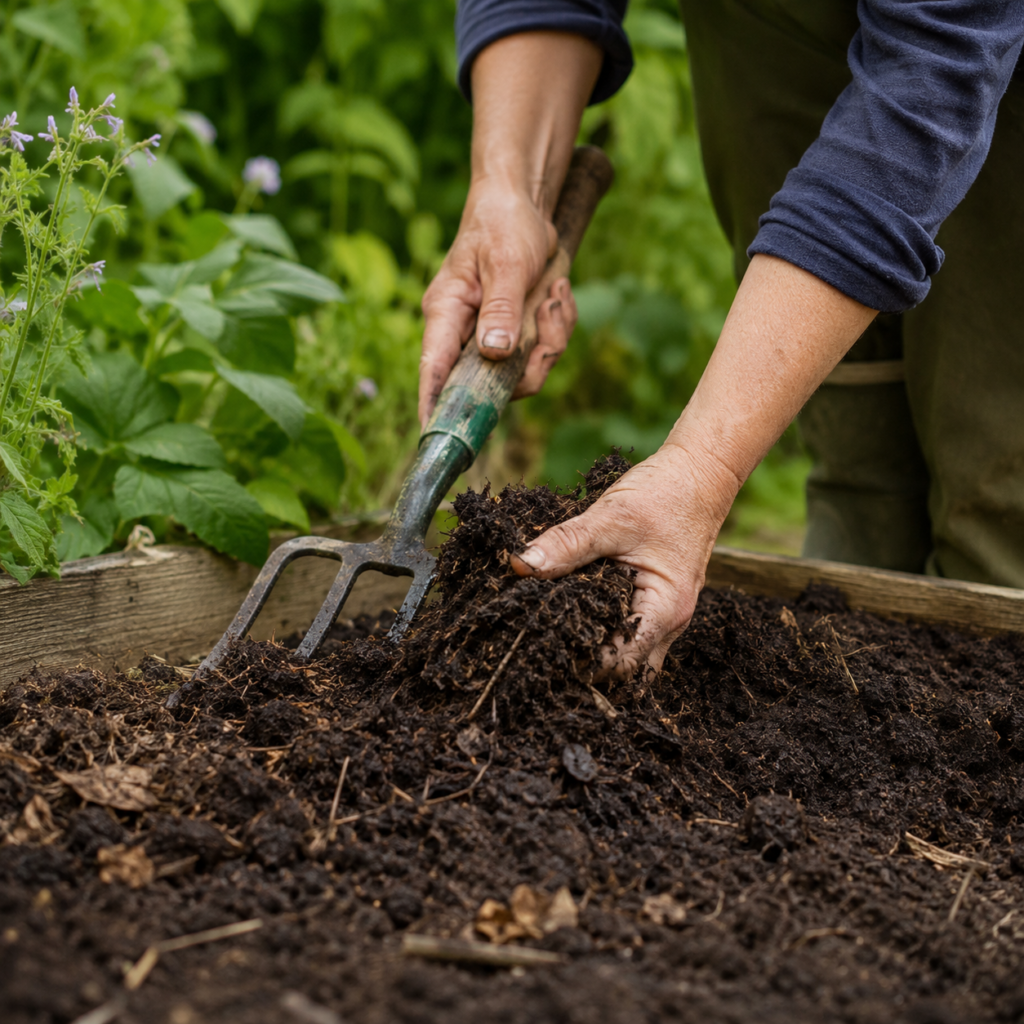
Most cottage border plants prefer fertile, moist but well-drained soil. In practice, this means that heavy clay soil needs improving with horticultural grit and generous organic matter (well-rotted garden compost or leaf mould) to open up the structure and prevent waterlogging. Light sandy soil, on the other hand, drains too quickly and benefits from bulking up with compost to improve its ability to hold moisture and nutrients.
It’s also worth acknowledging that most gardens contain several different soil conditions rather than one consistent type. A south-facing border at the base of a warm brick wall will be much drier and sunnier than a north-facing corner beneath a large tree. Rather than fighting these variations, the most successful cottage gardeners lean into them — planting lavender and salvias where drainage is sharpest, tucking astilbes and hostas where moisture lingers. Our guide to understanding soil types goes into the detail of what grows best where.
UK Sunlight and Regional Climate
Sunlight is the other critical variable. Most classic cottage garden plants — roses, lavender, delphiniums, foxgloves — prefer a position with at least four to six hours of direct sun per day. In practice, many will manage with less, but they’ll be leggier and produce fewer flowers.
Regional climate matters too. Gardens in the South and South West of England benefit from slightly longer growing seasons and milder winters, making it feasible to include slightly tender plants — certain salvias, for example, will overwinter outside in Cornwall that would struggle in Yorkshire. Northern England and Scotland gardeners will often need to adjust timing, prioritising hardier selections and expecting the season to start two to three weeks later than it would further south. Throughout this guide, where timing is given, we’ll note relevant regional differences.
Designing the Layout: Structure Beneath the Romantic Chaos
Here is the paradox that experienced cottage gardeners understand and beginners often miss: the loosest, most spontaneous-looking gardens are frequently the most carefully planned. The abundant profusion that makes people stop and stare on a village lane is the result of deliberate choices about structure, height layering, and seasonal sequencing — choices made before a single plant went in the ground.
Starting with Beds and Paths
Before you think about plants, think about the bones of your design. In a cottage garden, curving borders feel far more natural than straight lines and right angles. If your current garden is mostly geometric lawn with narrow borders around the edges, the single most transformative thing you can do is draw new curved bed lines that bring more of the lawn into productive planted space.
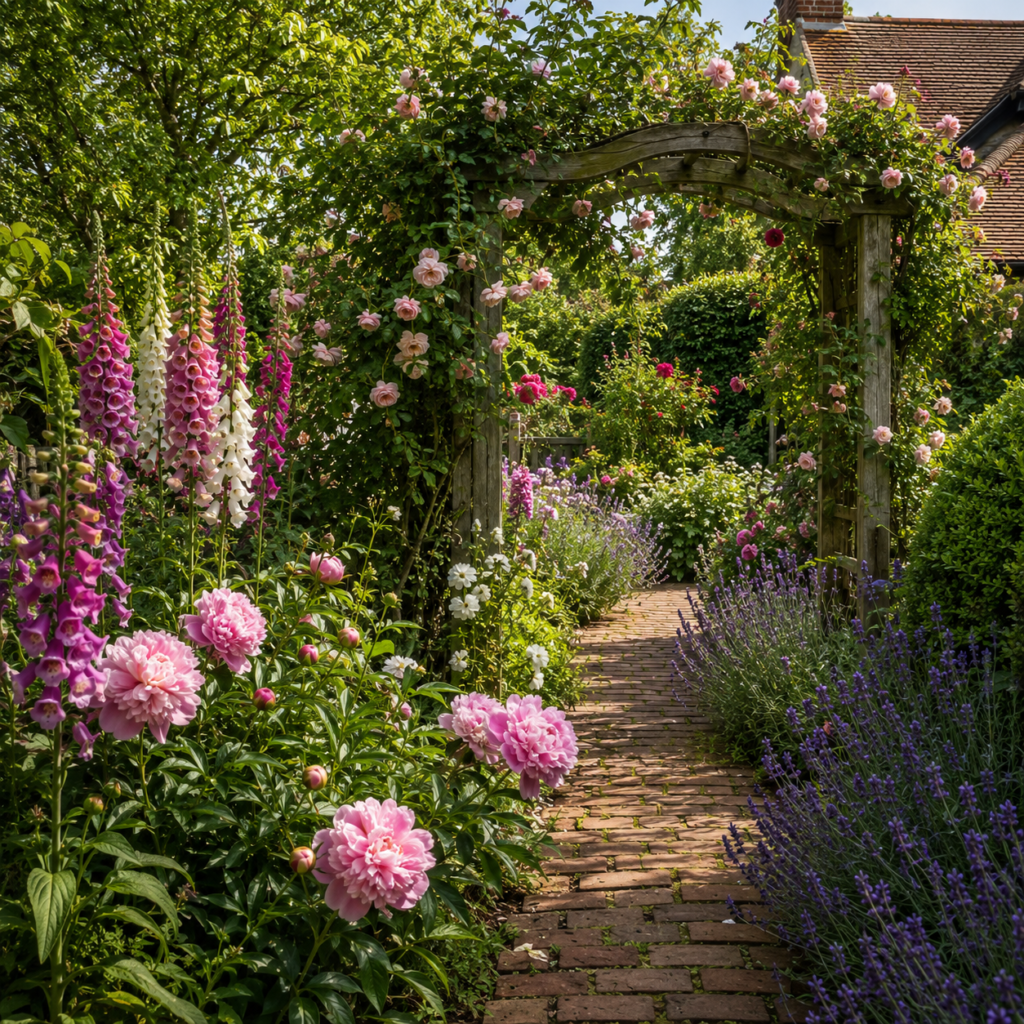
Paths should wind rather than march. They don’t need to be particularly wide — enough for one person to pass through comfortably — but their surface should reflect the character you’re aiming for. Old brick in a herringbone pattern, tumbled cobbles, reclaimed Yorkshire stone, compacted hoggin gravel: all of these work. The path is part of the garden’s character, not just a functional connection between two points.
The Three Layers of Cottage Planting
Think of your borders as having three distinct layers, each playing a different role in creating the characteristic sense of lush depth.
Crafting Her Blooms
Cottage Garden Plant Chooser
Find the right plants for every position in your border
All plants suitable for UK conditions · Heights are approximate at maturity
The upper layer provides height and drama — the tall spires of foxgloves and delphiniums, the arching canes of shrub roses, the trained branches of fan apple or pear trees against a wall. These are your exclamation marks, the plants that draw the eye upward and create the peaks and dips in a border’s skyline. Without this layer, everything sits at the same height and the planting looks flat, like a blob rather than a landscape.
The middle layer is where much of the colour and seasonal interest lives — peonies, phlox, hydrangeas (particularly the older mophead varieties in sheltered spots), hardy geraniums, lupins, and the cottage classics that return reliably year after year. This is also where compact fruiting shrubs and currant bushes earn their productive-ornamental place.
The front layer spills and softens, creeping over path edges and blurring the transition between planted border and hard surface. Lady’s mantle (Alchemilla mollis) is perhaps the definitive front-of-border cottage plant — its scalloped leaves hold water in perfect spheres after rain, and its frothy lime-yellow flowers work with almost everything. Low herbs like thyme and creeping rosemary, trailing violas, and the shorter hardy geraniums all do the same job beautifully.
Reducing Lawn
One of the most commonly given and most consistently resisted pieces of advice in garden design is to reduce the lawn. The British attachment to lawn is deep-seated and largely sentimental — most lawns in domestic gardens are simply underused green carpets that require considerable maintenance in exchange for relatively little reward. If you want to create a cottage garden, the lawn is your primary source of new planting space. Even taking just a metre off each border’s width can transform the character of a small garden. If you’re managing moss on an existing lawn, our guide to lawn moss control offers practical UK-specific advice on improving the turf you’re keeping.
Must-Have Plants for a UK Cottage Border
The plant palette is where cottage gardening gets both easiest and most complicated. Easiest, because the style is inherently generous and forgiving — there is no formal plant list, and many combinations will work. Most complicated, because the sheer range of options is overwhelming, and it’s easy to end up with a random collection of individual plants rather than a cohesive planting.
Tall Back-of-Border Anchors
A cottage border without vertical drama is just a flower bed. The tall plants at the back provide the structure around which everything else is arranged, and in UK conditions, several perform brilliantly.
Foxgloves (Digitalis purpurea) are arguably the most quintessentially British of all cottage garden plants. Their tall spikes of tubular flowers — purple, pink, white, cream, or the extraordinary peachy-apricot of the ‘Sutton’s Apricot’ variety — appear in June and July and absolutely transform a border. They are biennials, sowing themselves into the spaces between perennials and appearing where they please. This self-seeding habit is one of the cottage garden’s great gifts: the planting shifts subtly year to year without any effort on your part.
Delphiniums are high-maintenance but spectacular. In a sheltered spot with rich soil, they produce towering spires of electric blue, purple, or white in June that nothing else quite replicates. They need staking — a job worth doing in April before the stems get tall — and they’ll sometimes produce a second flush if cut down after the first flowering. The RHS Award-winning ‘Pacific Giants’ series is a reliable starting point for UK growers.
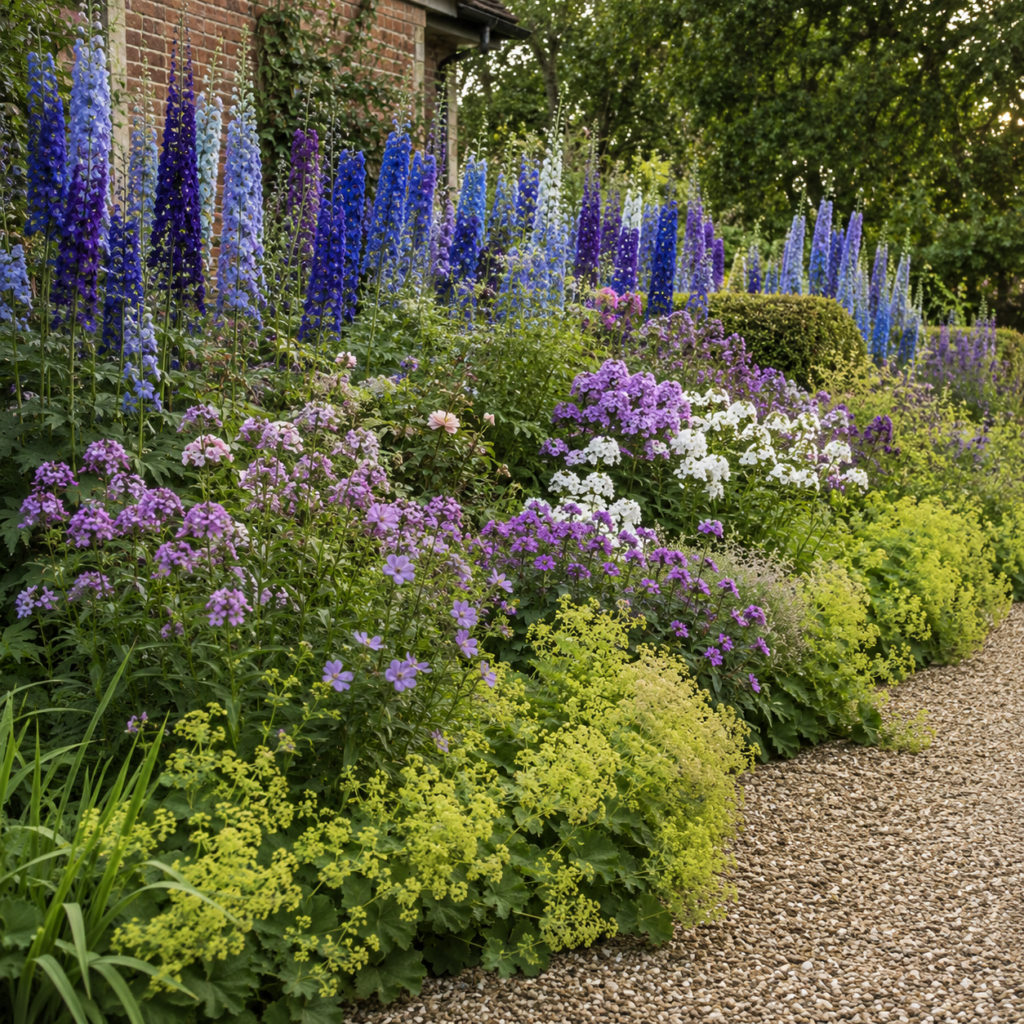
Hollyhocks (Alcea rosea) love a warm, south-facing wall and produce their fat, crepe-paper flowers in every shade from palest blush to near-black throughout summer. They’re biennial or short-lived perennials, but like foxgloves they self-seed with enthusiasm. Climbing and rambling roses provide the upper layer in a more permanent way — Rosa ‘Zéphirine Drouhin’ for a shaded arch, ‘Gertrude Jekyll’ for a fence, ‘Paul’s Himalayan Musk’ for a tree or very large structure.
The Perennial Workhorses
The middle layer is built from dependable perennials that return and expand slightly each year, filling the border with increasing confidence. Peonies are one of the greatest investments in cottage gardening — they take a couple of years to establish but then return reliably for decades, producing enormous, fragrant flowers in May and June. ‘Sarah Bernhardt’ (pink) and ‘Duchesse de Nemours’ (white) are two of the finest varieties for British gardens.
Hardy geraniums (cranesbills, not to be confused with the tender Pelargoniums often sold as “geraniums” at garden centres) are workhorses in the best possible sense. They cover ground, suppress weeds, produce clouds of pink, purple, blue, or white flowers for weeks, and largely look after themselves. Geranium ‘Rozanne’ is perhaps the most useful variety in any cottage garden, flowering from June right through to October.
Phlox provides powerfully fragrant flower heads in a range of pinks, whites, and purples in late summer, extending the season beyond the June-July peak. Lupins add dramatic spires and nitrogen-fixing root systems in early summer. Astrantia produces its curious pincushion flowers in white, pink, and deep wine from June onwards and is invaluable for shadier, moister spots. All of these reward generous planting — groups of three or five of the same variety create far more impact than single specimens dotted about.
Herbs and Fragrant Edging Plants
Herbs belong in a cottage garden, both for their scent and for their practical value. Lavender is indispensable — ‘Hidcote’ for a compact, formal-ish edging, ‘Grosso’ for a more billowing effect, ‘Vera’ if you want the best-scented cutting lavender. Our comprehensive guide to growing lavender in the UK covers everything from variety selection to harvesting.
Rosemary, sage, and thyme all enjoy the freedraining, sunny conditions typical of front-of-border cottage planting and produce flowers that are as attractive to pollinators as they are fragrant in the kitchen. Borage self-seeds everywhere and is excellent for both bees and gin. Growing a full range of herbs alongside your ornamental plants is one of the most distinctively cottage-garden things you can do, and the practical rewards are constant.
Climbers: Vertical Planting at Its Best
Climbers transform a cottage garden by taking the planting upward — over arches, up obelisks, along fences, and through the branches of larger shrubs and trees. Clematis is the most versatile: there is a clematis for every aspect, from the small-flowered C. montana (which will cover a large wall in a matter of years) to the spectacular large-flowered hybrids like ‘The President’ or ‘Nelly Moser’ for a sunny fence.
Honeysuckle (Lonicera periclymenum) is the cottage garden climber of childhood memory — that intense, sweet scent on warm summer evenings is practically inextricable from the idea of a rural English garden. Sweet peas (Lathyrus odoratus) are annual climbers that must be grown every year from seed, but their scent and their long vase life make them an essential cottage garden crop. Sow them in October or November for the earliest flowers the following spring, or in February-March indoors to plant out in May.
Productive Elements: The Potager Spirit
Incorporating edibles into a cottage border is not a compromise or an afterthought — it’s a return to the style’s original purpose. Runner beans on a wigwam of bamboo canes look absolutely beautiful in a border, their scarlet flowers as decorative as anything else in June and July. Artichokes provide dramatic silvery architectural foliage and can tower to six feet or more. Currant bushes — red, white, and blackcurrant — are compact enough for most borders and produce gorgeous jewel-like fruit.
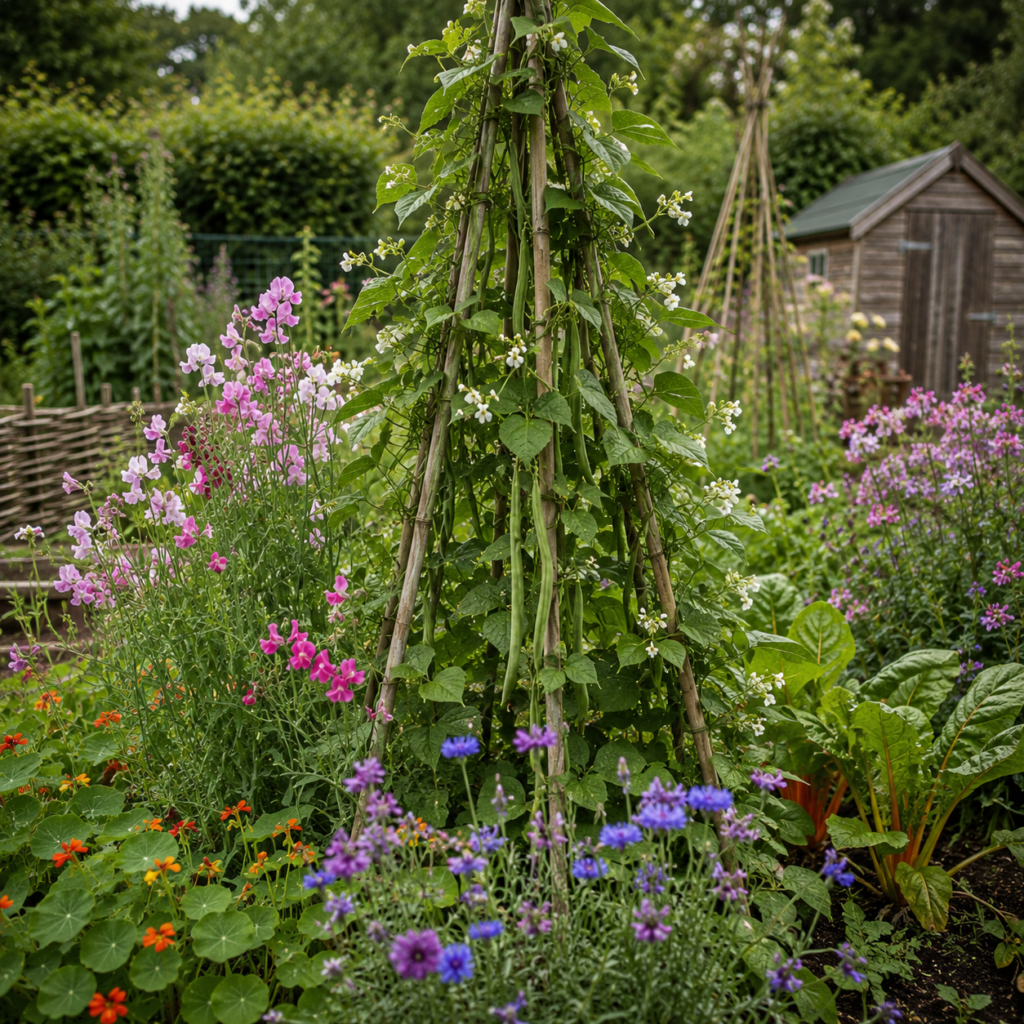
For the back of a wall or fence, fan-trained apples and pears are among the most rewarding choices in a small cottage garden. They provide spring blossom, summer green, and autumn fruit while taking up very little lateral space. Our guide to growing your own raspberries covers one of the easiest and most productive cottage garden fruits.
Planting Style: Creating That Signature Abundance
Knowing which plants to buy is one thing; knowing how to arrange them to create that flowing, abundant look is another. Cottage garden planting style has a handful of guiding principles that, once understood, make the whole thing far less daunting.
No Bare Soil
The rule of thumb in cottage gardening is that bare soil is a weed opportunity, and bare soil is to be avoided. The densely-planted, space-filling approach means using every layer simultaneously — tall plants at the back, mid-height in the middle, ground-covering at the front — and supplementing with self-seeding annuals like love-in-a-mist (Nigella damascena), pot marigolds (Calendula officinalis), and opium poppies where gaps appear.
This is where annual plants earn their keep in the cottage garden. While perennials build slowly in their first year or two, annuals fill the spaces immediately, giving the border a full, established look from the very first season.
Repetition and Rhythm
Individual specimen plants dotted about without repetition create the “dotty” look that experienced cottage gardeners consciously avoid. The eye finds it restful to follow a colour or a plant form through a border — the same pale pink appearing in three different places, or a single variety of hardy geranium threading between different companions at regular intervals. This doesn’t mean identical blocks of colour; it means planting in informal groups of three or five, then repeating those groups further down the border.
Colour Palette
The traditional cottage garden palette is soft: pastels, creams, pinks, mauves, and the blue-purples of salvias and delphiniums. This is not a rule — hot colour schemes using deep reds, rich oranges, and burnt yellows are perfectly valid and can look spectacular — but the palette needs to be a conscious choice rather than the result of buying whatever is on offer at the garden centre.
A useful discipline is to decide early on whether you’re working warm (peach, salmon, copper, gold, cream) or cool (pink, lilac, white, silver, blue) and to mostly stick with it. The exceptions — a deep plum-red that bridges warm and cool, a bronze grass that works with everything — are where the real artistry of planting design lives.
A Seasonal Overview: Beyond the Instagram Moment
One of the most important things to plan for in a cottage garden is what happens outside the peak midsummer moment. It’s easy to create something spectacular in late June and July; the more interesting challenge is maintaining interest and beauty from February through to November.
Crafting Her Blooms
Cottage Garden Seasonal Calendar
Key tasks & blooms month by month · UK timing
February
🌱 Sow sweet peas indoors
✂️ Prune roses (South only)
🌼 Snowdrops, hellebores
Scotland/North: wait until March
March
🌱 Sow annuals: nigella, calendula
✂️ Cut back ornamental grasses
🌼 Narcissus, early tulips
Apply first mulch to borders
April
🌱 Plant hardy annuals outside
✂️ Stake delphiniums early
🌼 Tulips, forget-me-nots, wallflowers
Last frost risk in most regions
May
🌱 Plant out sweet peas, dahlias (South)
🌸 Alliums, aquilegia, peonies begin
🪴 Divide established perennials
Chelsea chop option for late perennials
June
🌸 Roses, foxgloves, peonies — peak bloom
✂️ Deadhead regularly
🌱 Sow biennial foxgloves & hollyhocks
Begin watering in dry spells
July
🌸 Sweet peas, delphiniums, lavender
✂️ Cut lavender as flowers open
✂️ Deadhead roses & phlox continuously
Feed containerised plants weekly
August
🌸 Dahlias, phlox, late roses
🌱 Plant biennials raised in June
✂️ Trim lavender after flowering
Order spring bulbs for autumn planting
Sept
🌸 Asters, sedums, rudbeckia
🌱 Plant bulbs: alliums, narcissus
✂️ Divide perennials
Oct
🌱 Plant tulip bulbs now
🌿 Apply autumn mulch
✂️ Leave seedheads for birds
Nov
🌱 Plant bare-root roses
🌱 Sow sweet peas in pots
🌿 Plan next year’s borders
Dec–Jan
✂️ Winter prune roses (mild days)
🌿 Order seeds & bare-root plants
🌱 Hellebores, snowdrops emerge
Timings are approximate for UK conditions. South/SW England runs 2–3 weeks ahead of Scotland & Northern England.
Spring
The cottage garden starts earlier than most people realise. In February and March, bulbs planted the previous autumn begin the show — tulips in May borders, narcissus threading through emerging perennial growth, fritillaries scattered in the lawn beneath fruit trees. Flowering shrubs like forsythia, lilac, and the extraordinary flowering quince (Chaenomeles) provide colour before most herbaceous plants have properly woken up.
This is also when the first weeding of the year is most important — getting in early before self-seeded annuals and the real weeds become impossible to distinguish. Getting to know your soil in spring also helps you decide where to start a vegetable garden or add new productive elements.
Summer
June to August is the cottage garden’s moment of peak glory. Roses, delphiniums, foxgloves, peonies, and sweet peas overlap and tumble over each other in a display that seems almost too good to be entirely natural. Regular deadheading — removing spent flowers to encourage further blooming — is the primary summer maintenance task. For roses, it can make the difference between a single flush and continuous flowering from June to October.
Autumn and Winter
The best cottage gardeners resist the impulse to cut everything back in September. Many plants that look “finished” are providing important structure and food for wildlife — rose hips for birds, seedheads for finches, hollow stems for overwintering insects. Grasses added to the cottage border specifically for autumn interest — Miscanthus, Pennisetum, Stipa — provide movement and warmth in the low autumn light. Asters extend the flowering season right into October.
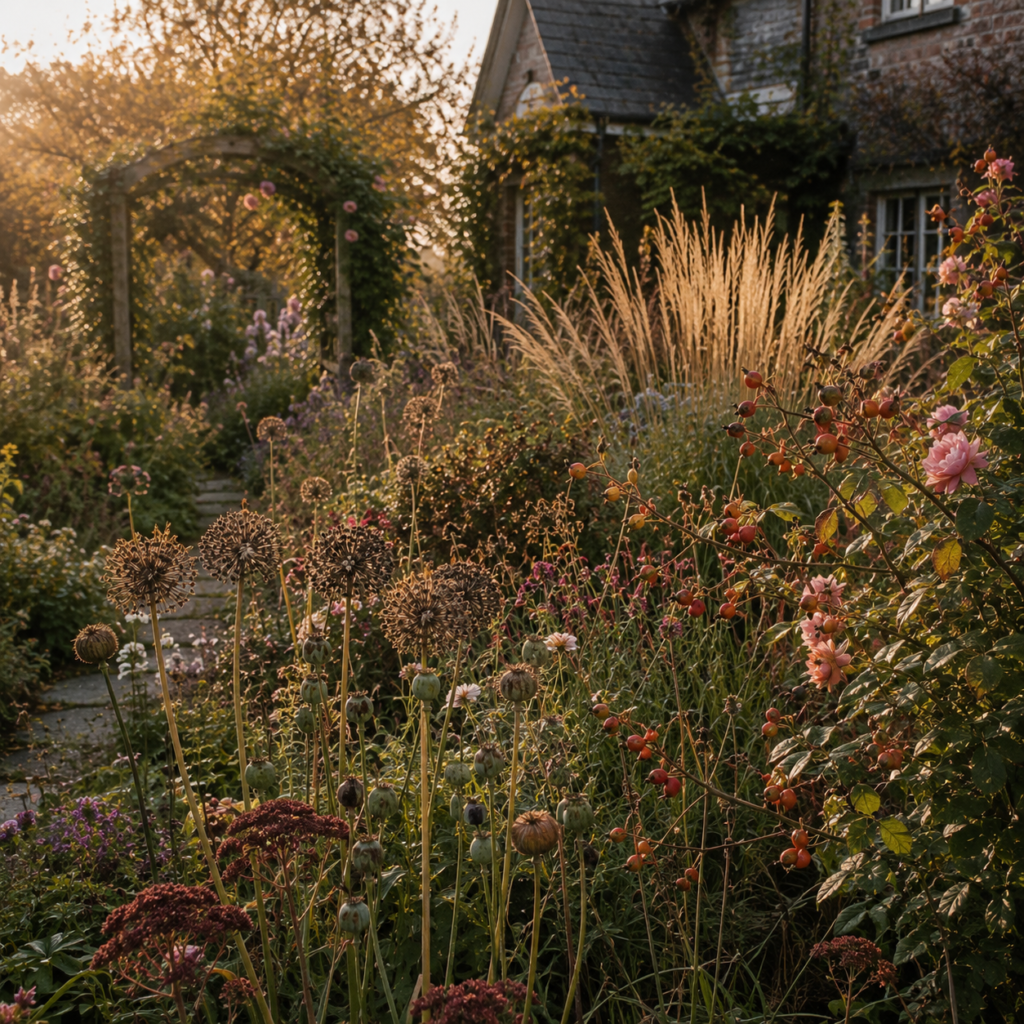
In winter, the structural bones of the garden become visible again: the arching canes of unpruned roses, the bare fan of a trained apple, the evergreen mounds of herbs. This is the time to plan the next season, to order bulbs and seeds, and to think about whether the design is working as you hoped.
Making It Wildlife-Friendly
One of the great privileges of a cottage garden is that it essentially creates a wildlife habitat almost by accident. The diversity of plant species, the range of flower shapes accessible to different pollinators, the seeds and berries produced by fruit and ornamental plants, the sheltering cover provided by dense planting — all of this supports an extraordinary range of creatures.
There are simple things that make the garden even more valuable to wildlife: avoiding all pesticides and letting natural predator-prey relationships do the pest management work, leaving a log pile or rough corner for overwintering hedgehogs and beetles, including a small pond even if it’s only a container sunk into the ground, and choosing plants specifically for their nectar and pollen value. Single-flowered varieties — the simple dog-rose rather than the multi-petalled floribunda, the open-centred cranesbill rather than a double one — are dramatically more accessible to bees and hoverflies than their heavily-bred counterparts.
Many of the best cottage garden plants are also some of the best plants for wildlife. Borage, phacelia, single dahlias, foxgloves, lavender, and herbs in flower are all outstanding for pollinators. The companion planting approach — using flowering herbs and plants strategically to support beneficial insects — fits naturally into the cottage garden philosophy.
Keeping It Low-Maintenance: Practical Truths
There is a persistent myth that cottage gardens are either effortlessly self-managing or catastrophically labour-intensive, depending on who you ask. The truth is somewhere more nuanced: established cottage gardens, well planted and well mulched, can be remarkably low-maintenance. Getting to that state, however, requires investment in the first two or three years.
Crafting Her Blooms
Cottage Garden Maintenance Checklist
Seasonal tasks to keep your garden thriving · UK timing
Spring
Feb – Apr
Summer
May – Aug
Autumn
Sept – Nov
Winter
Dec – Jan
Planting
☐ Sow sweet peas indoors (Feb)
☐ Sow hardy annuals outside (Mar–Apr)
☐ Plant container-grown perennials
☐ Divide clumps of hardy geraniums
Pruning & Structure
☐ Prune roses (Feb–Mar)
☐ Cut back ornamental grasses
☐ Stake delphiniums before they grow
☐ Trim shrubs that flower on new wood
Soil & Feeding
☐ Apply spring mulch to all borders
☐ Feed roses with specialist rose food
☐ Top up raised beds with compost
Planting
☐ Plant dahlias after last frost (May)
☐ Sow biennials: foxgloves & hollyhocks (Jun)
☐ Fill gaps with plug plants or annuals
☐ Plant biennials in final positions (Aug)
Maintenance
☐ Deadhead roses, phlox, sweet peas
☐ Cut lavender as flowers begin to open
☐ Cut delphiniums to ground after flowering
☐ Tie in climbing roses and clematis
Feeding & Watering
☐ Water newly planted specimens deeply
☐ Feed pots and containers weekly
☐ Second rose feed after first flush
Planting
☐ Plant tulip bulbs (Oct–Nov)
☐ Plant alliums, narcissus (Sept–Oct)
☐ Plant bare-root roses (Nov)
☐ Divide overgrown perennial clumps
Cutting Back
☐ Leave seedheads for birds & insects
☐ Cut back dahlias after first frost
☐ Remove only diseased foliage
☐ Leave hollow stems for overwintering insects
Soil Care
☐ Apply thick autumn mulch to all beds
☐ Add compost to vegetable areas
☐ Check for vine weevil in pots
Planting
☐ Continue bare-root planting (mild days)
☐ Sow sweet peas in pots (Nov–Jan)
☐ Order seeds & bulbs for spring
☐ Plan new borders on paper
Pruning
☐ Winter prune roses (mild spells)
☐ Prune wisteria (Jan)
☐ Hard prune buddleja if overgrown
☐ Remove dead wood from shrubs
Tools & Prep
Print this checklist or save it for reference · UK timing throughout · North of England & Scotland: add 2–3 weeks to spring tasks
Mulching Is Everything
A thick layer of organic mulch — well-rotted compost, bark chips, or mushroom compost — applied every autumn to the surface of the beds does more good than almost any other maintenance task. It suppresses weeds, conserves moisture, slowly improves the soil structure as it is incorporated by worms, and makes the garden look cared-for even in the depths of winter. Apply it when the soil is moist (not in a drought or a hard frost) to depths of five to ten centimetres, keeping it away from the crowns of plants.
Grouping by Water and Sun Needs
Planting according to ecological need — putting all the sun-lovers and drought-tolerant plants together, keeping the moisture-lovers in shadier or lower spots — makes watering and management much simpler. Trying to water a mixed border containing both lavender (which hates wet feet) and astilbe (which sulks in dry soil) is a losing battle. If you’re working in a small urban garden where water management is particularly important, our piece on climate-friendly gardening and water conservation has practical advice tailored to UK conditions.
Choosing Self-Sufficient Plants
Not all plants are equally demanding. Hardy geraniums, alchemilla, astrantia, and most herbs essentially look after themselves once established. Delphiniums and tall roses require more intervention — staking, pest monitoring, regular feeding. For a lower-maintenance approach, bias your planting toward the former group and use the more demanding plants sparingly as accent pieces rather than backbone plants.
Once a cottage border is properly established — dense, mulched, and filled with robust self-sufficient perennials — weeding time often drops dramatically. The plants do the work of covering the ground; the mulch handles what they miss.
Getting Started: Your First Steps
If you’re starting from scratch, the temptation is to design everything on paper and then implement it all at once. In practice, cottage gardens grow better when they are built incrementally — beginning with a few strong structural plants and building the planting out around them over successive seasons.
Start with your soil: dig it over, remove perennial weeds thoroughly (couch grass and bindweed in particular must be removed root and all, or they will reappear), and incorporate a generous amount of compost. Then establish your structural plants — your roses, any trained fruit, any large shrubs. Give them a full season to establish while you fill around them with annuals. The following year, add your perennial backbone. In year three, the self-seeding begins in earnest, and the border starts to feel like itself.
Above all, remember that a cottage garden is never truly finished. It shifts and evolves with the seasons, with the self-seeded volunteers that appear in unexpected places, and with your own growing knowledge of what works in your particular garden. That quality of perpetual becoming is not a flaw — it is precisely what makes the cottage garden the most living, most personal of all garden styles.
If you’re building your cottage garden from the ground up, planning your planting in detail before the season starts can save considerable effort later — our guide to how to plan a vegetable garden applies many of the same principles to the productive elements of your border.
Continue Your Journey
Growing Roses in the UK — A deep dive into choosing, planting, and caring for cottage garden roses, from bare-root planting to deadheading and winter protection.
How to Grow Lavender — Everything you need to know about the cottage garden’s most indispensable herb, including variety selection for UK conditions and harvesting for dried arrangements.
Companion Planting for a Better Garden — How to use the cottage garden’s tradition of mixed planting to support beneficial insects and reduce pest pressure naturally.
Growing Raspberries in the UK — An essential productive element for the cottage garden, covering summer and autumn-fruiting varieties, support systems, and pruning.
Understanding Soil Types — Know what you’re working with before you plant — this guide covers all the major UK soil types and which plants thrive in each.
Which plants are you most excited to include in your cottage garden? Share your plans in the comments — I’d love to hear what’s growing in your corner of the country.
Want more seasonal planting inspiration delivered straight to your inbox? Sign up for the Crafting Her Blooms newsletter for monthly guides, plant recommendations, and garden updates.