The Best Plants for Autumn Pollinators in a UK Garden
I sometimes use affiliate links in content. This doesn’t cost you anything but I may make a commission payment from anything you buy through these links. As an Amazon Associate I earn from qualifying purchases. All opinions remain my own.
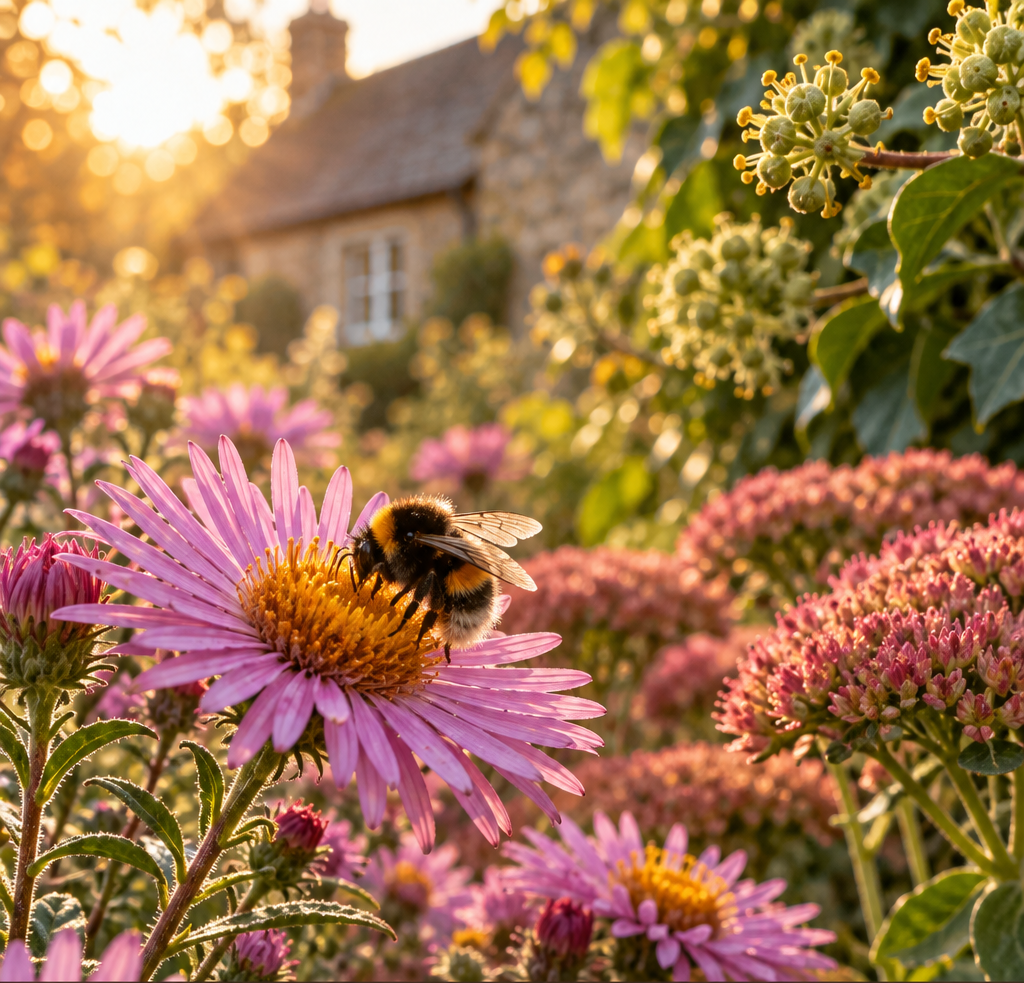
By mid-October the garden has a hush about it. The borders are tipping over, the swallows have gone, and most of us have started thinking about bulbs and bonfires rather than bees. But look closely on a mild, sunny afternoon and you will still find life at the flowers: a worn bumblebee clinging to a daisy, a hoverfly working a sedum, a red admiral warming its wings on a stem of ivy.
These late visitors are running out of time, and the flowers you grow now decide how well they fare. This is the third post in our seasonal pollinator series, following the best plants for spring pollinators and the best plants for summer pollinators. Autumn is the quietest chapter, and the one where one good plant can matter most.
🍂 Why Autumn Forage Matters
Between September and November, flowers become scarce just as insects need fuel. Queen bumblebees are building up fat reserves before hibernation. Hoverflies and butterflies are fuelling up for migration or for the winter ahead. Some insects are still raising young.
Ecologists call this the nectar gap. Spring has blossom and summer has meadows, but autumn depends on a short list of reliable late bloomers. Fill that gap and you are offering real help at a pinch point in the year.
Forged & Grown
Garden pieces, printed to order
3D printed planters and garden accessories, made in the UK. Self-watering designs, sculptural shapes, colour options — each one made when you order it.


I would not call this a rescue mission, and no single garden will change a species’ fortunes. But a patch of the right plants is one of the simplest, most useful things a UK gardener can do.
🐝 Who Is Still Flying in Autumn?
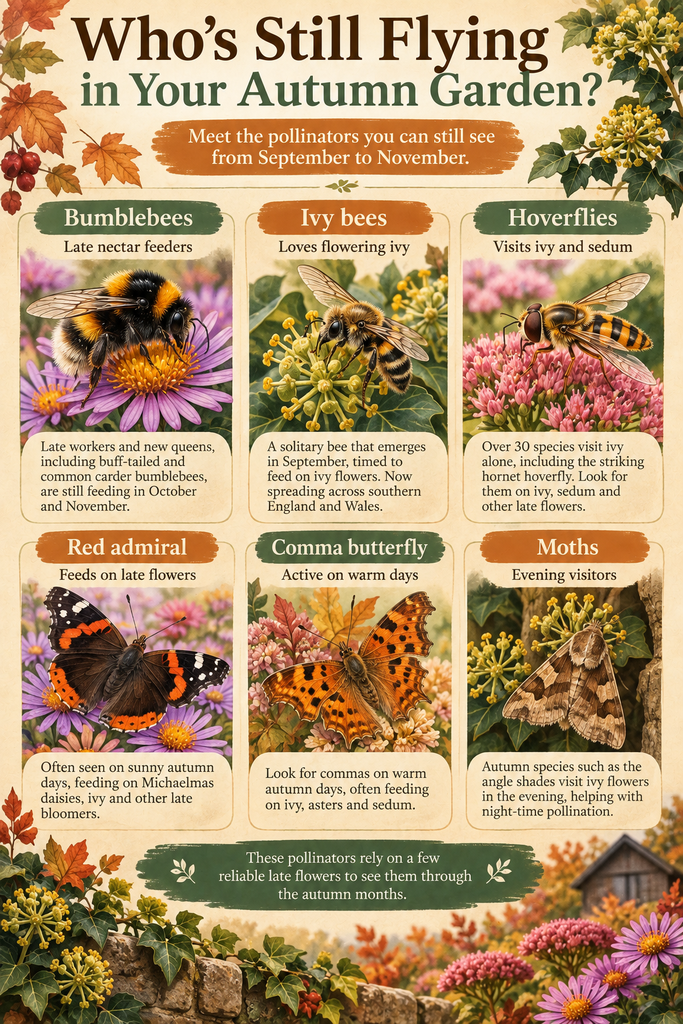
The cast list is longer than you might expect. Here is who you can realistically see between September and November:
- Bumblebees: late workers and new queens, mostly buff-tailed and common carder bumblebees, still feeding in October.
- Ivy bees: a solitary bee that emerges in September to time itself with ivy flowers, now spreading across southern England and Wales.
- Hoverflies: over 30 species visit ivy alone, including the striking hornet hoverfly.
- Butterflies: red admirals and commas, which like a warm, sheltered flower on a sunny day.
- Honeybees and wasps: both use late flowers heavily, and wasps are among the most frequent ivy visitors.
- Moths: autumn species such as the angle shades work ivy flowers in the evening.
Some buff-tailed bumblebees now stay active through winter in milder parts of the UK, foraging from October into March. That is a good reason to think about what comes after autumn too, and we touch on that at the end.
🌿 Ivy: The Star You Were Told to Cut Off
If you only act on one thing in this post, let it be ivy. Ivy (Hedera helix) flowers from late summer through late autumn, long after nearly everything else has finished. It is probably the single most valuable late food source in a UK garden.
The catch is that ivy only flowers once it matures. Juvenile ivy, the lobed kind that creeps along walls, never blooms. The flowers appear on the upright, adult stems, which have simpler, unlobed leaves.
That means a tightly clipped ivy hedge or wall never gives pollinators a thing. If you have ivy on a fence, a tree or a shed wall, let a section grow out and flower. Trim in late winter or early spring, after the berries have fed the birds.
Ivy is also tough enough for dry shade, where little else will grow. If you are building habitat from scratch, our beginner’s guide to creating a wildlife garden shows where ivy fits in the bigger picture.
🌼 The Best Late-Flowering Plants, by Flowering Window
Here are the plants worth growing, grouped by when they come into their own. Dates are typical for most of the UK and will shift with your region and the weather.
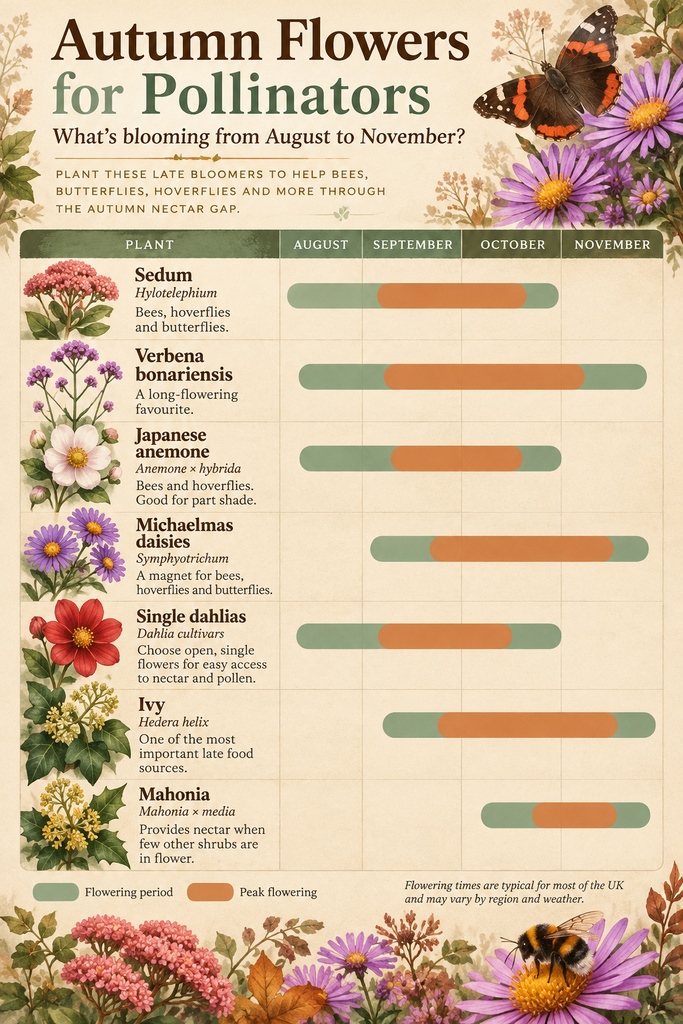
Late summer into early autumn (August to October)
Sedum or ice plant (Hylotelephium) is the classic. The flat heads open in late summer and stay busy with bees, hoverflies and butterflies into October. It likes sun and sharp drainage, and it copes with drought. ‘Herbstfreude’, often sold as ‘Autumn Joy’, is the one most UK garden centres stock.
Verbena bonariensis carries purple pom-poms on tall, see-through stems. It flowers from summer until the frosts and seeds around freely. It is one of the plants we recommend in our guide to resilient perennials for a wobbling climate.
Japanese anemone (Anemone × hybrida) brings cool, open flowers to part shade from August to October. Pick single forms such as ‘Honorine Jobert’, where the central stamens are easy to reach.
Sneezeweed (Helenium) glows copper and gold at the back of the border. It keeps going after the main summer peak, and it needs a stake in exposed spots.
Peak autumn (September to November)
Michaelmas daisies (Symphyotrichum) are the workhorse of the season. Hoverflies, bees and butterflies queue up on them. Choose cultivars with fewer petal layers, which provide more nectar, and check the label for mildew resistance.
Autumn sage (Salvia greggii and S. microphylla) flowers well into autumn in a warm, free-draining spot. The tubular flowers suit longer-tongued bees. In colder gardens, give it winter protection or take cuttings as insurance.
Single dahlias are a gift to late pollinators, but only the open-faced types. The RHS highlights ‘Bishop of Llandaff’ for its simple blooms and exposed pollen. The pompom and cactus types look lovely in a vase and are close to useless for insects.
Devil’s bit scabious (Succisa pratensis) is a native for informal borders and meadows. It flowers from late summer into autumn and is easy to grow from seed. It sits happily in a rough corner or a wildflower patch.
Hardy plumbago (Ceratostigma plumbaginoides) gives a low carpet of intense blue at the front of a border. It suits sun or part shade, and it is drought tolerant once settled.
Cyclamen hederifolium pops up under trees in September and October with pink flowers and silver-marbled leaves. Its pollinator value is modest, so treat it as a bonus layer in shade rather than a main feeder.
Bridging into winter (October onwards)
Mahonia and strawberry tree (Arbutus unedo) flower from autumn into winter. These are named by the Bumblebee Conservation Trust among the key food plants for winter-active bumblebees. If you have the space, one of them makes a sound long-term investment.
🪴 Plants That Work in Pots and Small Gardens
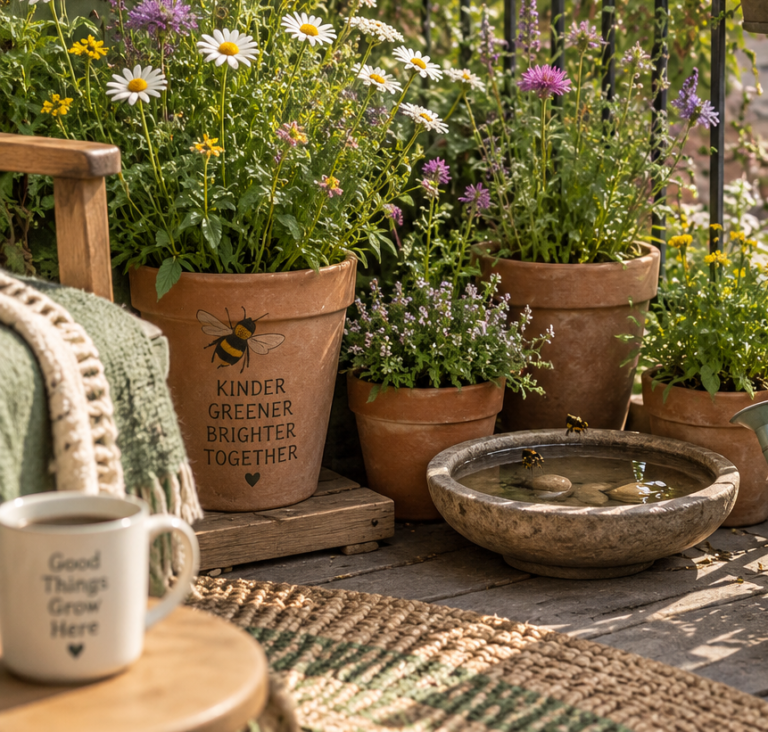
You do not need a border to help. Several of the plants above do well in containers, which suits balconies, patios and small urban plots.
Compact Michaelmas daisies, dwarf sedums, autumn sage and a single dahlia in a large pot all earn their space. Use a free-draining, peat-free compost, and group two or three pots together so insects find them quickly.
We covered mixing nectar plants in one container in detail in our bee and butterfly buffet planters post. For tiny spaces more broadly, see how to garden for wildlife in a small urban garden.
If it is autumn colour and styling you are after, our fall flower pots guide is the place to start. Just check each plant against the next section before you buy.
🔍 Single or Double? How to Spot Flowers Pollinators Can’t Use
This is the quiet trap in garden centres. Breeders have turned many flowers into frilly doubles, where stamens become extra petals. They look generous, but the nectar and pollen are buried or gone.
A quick test works every time. Look into the centre of the flower. If you can see a clear, open middle with visible stamens or a flat disc of tiny florets, an insect can land and feed. If it is packed with layers of petals, move on.
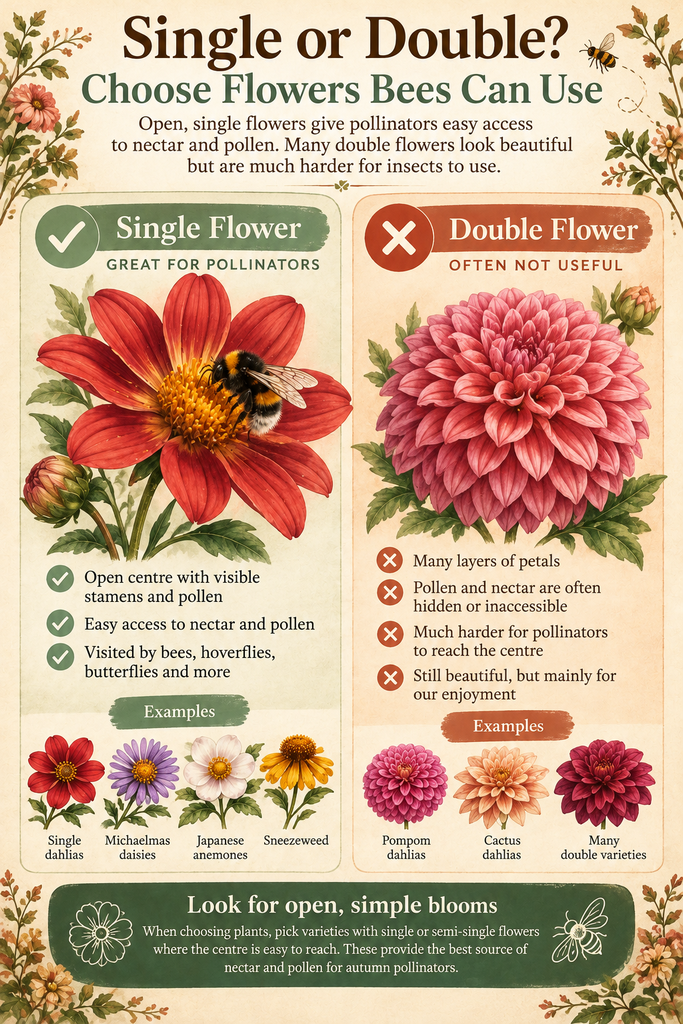
Here is a short checklist to take shopping:
- Choose single or semi-single forms with an open centre.
- Prefer daisy-type flat heads and simple cups over pompoms.
- Check the label for “RHS Plants for Pollinators”, which marks plants good for insects.
- Avoid bedding with double, ball-shaped heads, however colourful.
🌱 Autumn Planting and Care
Autumn is one of the best times to plant hardy perennials. The soil is still warm and the rain is on its way, so roots establish before winter without needing much watering.
Plant perennials from October while the ground is workable. If your soil is poor, a dusting of mycorrhizal fungi on the roots can help new plants settle in. Mycorrhizal root treatments are inexpensive and easy to use at planting time.
Tender plants such as autumn sage and dahlias want a little protection. Mulch the crowns with bark or compost in November, and lift or cover dahlia tubers in cold gardens.
Leave the seed heads
Resist the urge to tidy everything away. Sedum, Michaelmas daisy and scabious seed heads feed birds and shelter overwintering insects. Hollow stems make winter homes for small solitary bees and ladybirds.
Cut back in late winter instead, once new growth starts. If you do want to divide congested clumps in autumn, a sharp pair of budget secateurs makes light work of woody crowns.
Light deadheading
A little deadheading goes a long way. Removing spent flowers on salvia and single dahlias encourages another flush. Stop in late October, though, and leave the final heads to set seed.
🗺️ Timing Across the UK
Flowering windows slide with latitude and microclimate. In Southern England, sedum and Michaelmas daisies may peak in September and fade by late October. In the Midlands and East Anglia the display usually runs a couple of weeks later.
Further north, in Northern England, Wales and Scotland, the first hard frost arrives sooner and cuts the season short. Choose the hardiest options there, such as sedum, scabious, Japanese anemone and ivy, and plant early in autumn so roots settle before the cold.
A sheltered, south-facing wall or fence buys you extra weeks almost anywhere. That is where to put your tender salvia or dahlia.
✅ A Simple Plan for This Weekend
You do not need to redesign the garden to help. Pick three small jobs and do them before the clocks change:
- Find your ivy and let one section flower and fruit.
- Walk the garden at midday and note any gaps in autumn colour.
- Plant one sedum, one Michaelmas daisy and one single dahlia or salvia in the sunniest spot you have.
Three plants will not transform a garden, but they will give late visitors somewhere reliable to feed next October.
🔗 Where This Fits in the Series
Spring, summer and autumn each ask for different plants, so it helps to think of your garden as a year-round buffet. If you have not read the other two, start with spring pollinator plants and summer pollinator plants.
The next step is winter. Winter-flowering shrubs and bedding keep the buffet open for those winter-active bumblebees, and our guide to winter bedding plants for UK gardens is a good place to begin planning.
❓ Quick Questions
Should I cut my ivy back this month? Not if it is flowering. Wait until late winter or early spring, after the berries have been eaten.
Can I plant these in November? Yes, as long as the soil is not frozen or waterlogged. Water in well and mulch.
Will these plants work in the north of England or Scotland? Most of them will. Sedum, Michaelmas daisy, scabious and Japanese anemone are hardy across the UK. Treat autumn sage and dahlias as tender in colder gardens.
🌸 Continue Your Journey
- October Garden Jobs UK: Complete Food Growing Guide
- The Ultimate Guide to Creating a Wildflower Meadow in a UK Garden
- Purposeful Planting: How to Design a UK Border That Hums With Life
- How to Create Wildlife Habitats in a Small UK Garden
- How to Plant a Native Hedge for Wildlife in a UK Garden
Want seasonal garden notes sent straight to your inbox? Join the Crafting Her Blooms newsletter and never miss a planting window.