
The Best Plants for Spring Pollinators in a UK Garden

I sometimes use affiliate links in content. This doesn’t cost you anything but I may make a commission payment from anything you buy through these links. As an Amazon Associate I earn from qualifying purchases. All opinions remain my own.
There is a window in the British gardening calendar that most people overlook entirely. It sits between the last days of winter and the full flush of spring — roughly February through to May — and it is, for many of our most important pollinators, a matter of survival. Bumblebee queens emerge from hibernation as early as February, burning through their fat reserves and desperately searching for food. Solitary bees follow through March and April. And yet, in the average UK garden, there is almost nothing for them to eat.
This is what ecologists call the hunger gap: the weeks before the great wave of spring flowers arrives, when pollinators are already active but garden plants are still dormant, lawns are still mown short, and hedgerows are only just beginning to stir. Getting this window right — planting specifically for February, March, April, and into May — is one of the most genuinely useful things a UK gardener can do for local wildlife. It is also, happily, not difficult at all.
This guide is a practical UK action plan for that early-season window. We will cover the bulbs, shrubs, perennials, and even the so-called “weeds” that make the biggest difference during the hunger gap, with month-by-month advice on what to plant and when, and the regional timing differences that matter enormously across Britain’s varied climates.
Why the Hunger Gap Matters More Than You Think
To understand why spring planting for pollinators is so critical, it helps to think about what a bumblebee queen is actually going through in February. She has spent the winter in a small underground chamber, surviving solely on stored fat. When temperatures nudge above about 10°C, her body clock tells her it is time to emerge and begin the exhausting task of founding a new colony. She must find nectar and pollen immediately — not eventually, but within hours — or she will not survive long enough to lay a single egg.
Forged & Grown
Garden pieces, printed to order
3D printed planters and garden accessories, made in the UK. Self-watering designs, sculptural shapes, colour options — each one made when you order it.


The same pressure applies to early solitary bee species such as the hairy-footed flower bee (Anthophora plumipes), which appears in March, and the red mason bee (Osmia bicornis), which typically emerges in April. These species have evolved alongside early-flowering plants, and they are highly dependent on those plants being present and accessible. A garden that waits for summer bedding misses the entire critical period.
The UK Climate Complicates Things Further
Britain’s geography creates enormous variation in when the hunger gap actually falls. In sheltered coastal gardens in Cornwall and the Isles of Scilly, crocuses can flower in January, and early bees may be active by mid-February. In the Scottish Highlands, meanwhile, the same plants may not flower until April or even May, and bumblebee queens may not emerge until late March. The East Midlands and East Anglia sit somewhere in between, while upland Yorkshire and Wales can still experience late frosts in April that set everything back by two to three weeks.
This matters for your planting decisions. If you garden north of a line roughly from Leeds to Carlisle, push the planting windows described in this guide back by three to four weeks. If you are in a sheltered town garden in London, Birmingham, or Bristol, you may be a week or two ahead. The advice that follows uses middle-England timings as the baseline, with regional notes where the differences are most significant.
The Bulbs That Open the Season
Bulbs are the single most reliable way to guarantee early flowers for pollinators, because they do their preparation work underground while you wait. Plant them in autumn and they will deliver without fail the following February, March, and April — often before you have done anything else in the garden.
Crocus: The Bumblebee’s First Breakfast
Few plants reward early pollinators as reliably as crocus. The early species types — Crocus tommasinianus, C. chrysanthus, and the various snow crocuses — open their flowers in late January or February in mild years, and by March they are often carpeted with feeding bumblebees. Crocus pollen is vivid orange and extremely nutritious, making it precisely what an emerging queen needs.
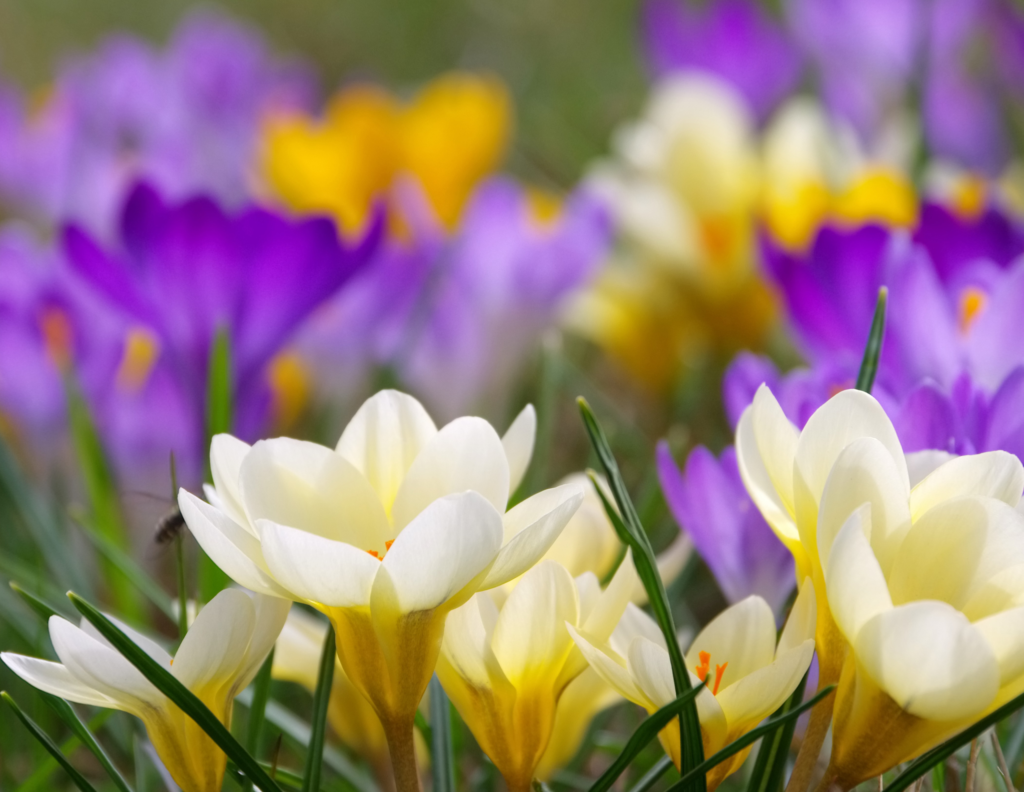
The trick is to choose the right varieties. Garden centres often sell mixed crocus collections aimed at spring colour, but these are usually the large Dutch crocus (C. vernus), which flower later and — critically — have petals so wide that bumblebees can crawl inside and close the flower around themselves, making it hard to access the pollen. For maximum pollinator value, choose the smaller, more open species types: Tommy crocuses (C. tommasinianus), which naturalise readily in grass and are available from most UK bulb specialists, or C. chrysanthus varieties such as ‘Cream Beauty’ or ‘Blue Pearl’. Plant them in drifts of 50 or more under deciduous trees or in short grass, where they will spread over the years with minimal effort.
In northern gardens — Scotland, Northumberland, Cumbria — Tommy crocuses are the best bet because they are more resilient to cold snaps and will still flower once settled, even if the timing shifts to March rather than February.
Scilla and Muscari: The Blue Wave
Following close behind the crocuses, Siberian squill (Scilla siberica) and grape hyacinths (Muscari armeniacum) extend the early season through March and April with dense spikes of blue-purple flowers. Both are excellent bee plants: the tubular flowers of muscari are particularly valuable because they are accessible to long-tongued bumblebees like the garden bumblebee (Bombus hortorum), which struggle with flat, open flowers.
Scilla naturalises beautifully under shrubs and at the base of hedges, spreading via self-seeding to create a low-maintenance blue carpet. Muscari is slightly more formal and works well in pots, in borders, or tucked along the base of a south-facing wall. Both are inexpensive, widely available from UK suppliers such as Peter Nyssen and Sarah Raven, and require nothing more than being planted at twice their own depth in autumn. By the time they finish flowering in late April or May, your garden’s other pollinator plants should be coming online.
Snowdrops: Worth Mentioning, with a Caveat
Snowdrops (Galanthus spp.) are often cited as early bee plants, but they deserve an honest mention here. While they do provide some nectar and pollen, and are visited by very early bumblebee queens on warm days, they are not as productive as crocuses for pollinators. Their main value is in milder years when they coincide with bumblebee activity in January and February. In colder or northern gardens, snowdrops often finish flowering before many pollinators have emerged. They are worth having for their beauty and their modest contribution, but crocus should be your priority purchase if budget is limited.
Shrubs That Carry the Season
While bulbs deliver the earliest colour, a well-chosen suite of early-flowering shrubs extends the hunger gap window dramatically and provides a much larger foraging resource for pollinators.
Rosemary: The Herb That Feeds Bees for Months
Rosemary (Salvia rosmarinus, formerly Rosmarinus officinalis) is one of the single best shrubs a UK gardener can plant for pollinators, and it is chronically undervalued in this role. A mature rosemary plant in a sunny spot will begin flowering in February in southern gardens, with flowers continuing into May or June — often providing nectar on warm winter days too. It is particularly valuable for early bumblebees, hairy-footed flower bees, and honeybees.
The fact that rosemary is also one of the most useful growing outdoor garden herbs for cooking makes it an obvious dual-purpose plant for any UK garden. For maximum pollinator value, choose forms with open, accessible flowers: the traditional upright rosemary varieties work well, as does the prostrate form for walls and banks. Avoid very heavily double-flowered ornamental varieties, which can be less accessible to pollinators.
Plant rosemary in full sun and well-drained, slightly alkaline soil — conditions that suit our lavender too, as we will see — and it will reward you with decades of reliable early flowering. It is notably more cold-tolerant than many people assume, performing well through most of England and into sheltered parts of southern Scotland.
Heather: The February Carpet
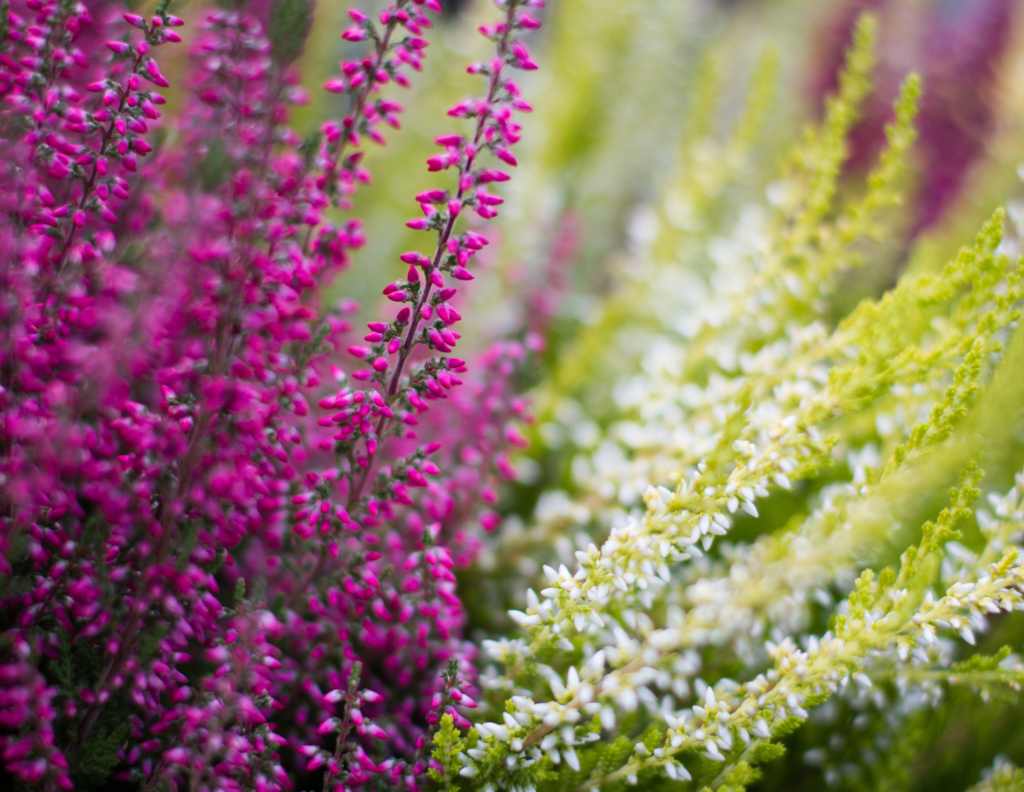
Ling heather (Calluna vulgaris) is most associated with late summer, but the winter-flowering heathers — particularly Erica carnea (winter heath) and its varieties — are among the most important pollinator plants for February and March in the UK. Unlike many early spring plants, Erica carnea flowers reliably through cold spells and even light snow, providing a consistent nectar source when almost nothing else is available.
Good varieties for UK gardens include ‘Springwood White’, ‘Myretoun Ruby’, and ‘Vivellii’. They prefer acidic to neutral soil and perform particularly well in northern and western Britain, where conditions naturally suit them. For gardeners on chalky or limey soils, growing winter heather in a container of ericaceous compost is a perfectly viable option.
Pussy Willow: Exceptional for Early Bees
Pussy willow (Salix caprea) deserves a special mention, particularly for gardeners with larger plots or who are willing to manage a shrub or small tree. The catkins appear in February and March, and they are extraordinary for pollinators: the bright yellow anthers carry huge quantities of protein-rich pollen, making pussy willow one of the most important spring plants for bumblebee queens building up their colonies. It is also a crucial food source for early butterflies, including brimstones and small tortoiseshells.
For smaller gardens, the compact cultivar Salix caprea ‘Kilmarnock’ (Kilmarnock willow) grows as a weeping standard and can be maintained at around 1.5 metres — manageable even in a medium-sized border. It flowers reliably every February and requires nothing more than occasional light pruning after the catkins finish to keep its shape.
Mahonia: An Underused Winter Gem
Mahonia × media and its cultivars (particularly ‘Charity’ and ‘Winter Sun’) produce long racemes of small yellow flowers from November through to February, bridging the absolute dead zone of winter and carrying pollinators almost up to the hunger gap proper. The flowers are visited by buff-tailed bumblebee queens, which are increasingly active in mild winter periods. Mahonia is tough, shade-tolerant, and largely evergreen — useful in corners of the garden where little else would perform.
Early Perennials for April and May
As the hunger gap transitions into early spring, perennials come into their own and take the baton from bulbs and shrubs.
Pulmonaria: The Woodland Gem for Shady Gardens
Pulmonaria (lungwort) is one of the best plants a UK gardener can grow for spring pollinators, and it thrives in the shaded, slightly damp corners that many other early plants dislike. It flowers from March through to May, producing pink, red, violet, or blue tubular flowers that are perfectly matched to the long tongue of the garden bumblebee. Varieties with blue flowers — ‘Blue Ensign’, ‘Sissinghurst White’ — are particularly attractive to pollinators.
Pulmonaria establishes readily, spreads slowly over the years, and requires almost no care beyond dividing every few years to maintain vigour. It is an excellent choice for gardens with deciduous trees, where dappled shade prevents most other early perennials from performing well.
Hellebores: Early and Beautiful
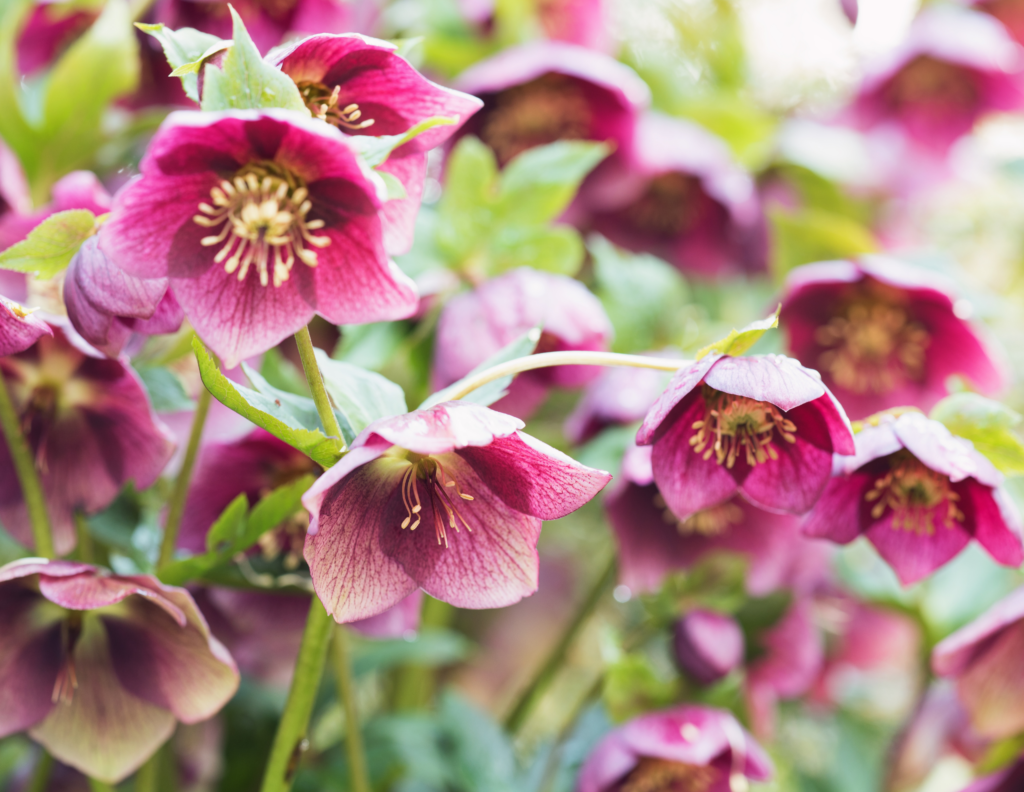
Hellebores flower from February through to April, and while their nodding flower heads can make it slightly harder for pollinators to access the pollen, a warm day in March will typically see bumblebees hanging upside down inside the cups to feed. The single-flowered forms are more accessible than the doubles. Orientalis hybrids are the most widely available and perform well across the UK, tolerating cold, shade, and most soil types with equanimity.
Bugle and Ground Ivy: Overlooked Ground-Layer Heroes
At ground level, two plants do exceptional work for pollinators in April and May, and neither receives anything like the attention it deserves. Bugle (Ajuga reptans) is a low-spreading native perennial that produces short spikes of deep blue flowers beloved by bumblebees. It is genuinely useful in lawns or as ground cover under shrubs, and it does double duty as a habitat plant. Glechoma hederacea (ground ivy) is technically a weed, but an excellent one: its small purple flowers appear in March and are visited by very early bumblebees before most other plants have stirred.
If you are developing a more wildlife-focused planting scheme alongside this guide’s recommendations, our full post on eco-friendly gardening ideas and wildflower meadows explores how these ground-layer plants fit into a wider habitat strategy.
The Honest Truth About “Weeds”
No guide to spring pollinators would be complete without an honest look at the plants most gardeners reflexively remove. The weeds of the early spring garden are, in many cases, genuinely important for pollinators — and understanding this can change how you manage your outdoor space.
Dandelion: Accept the Gold
The common dandelion (Taraxacum officinale) is one of the most valuable early pollinator plants in the British flora. Its flowers open reliably from March onwards, they contain abundant pollen and nectar, and they are accessible to almost every bee species active at that time of year. Dandelion pollen is famously rich in protein, making it particularly valuable for bumblebee colonies trying to raise their first workers.
Allowing a patch of dandelions to flower in a less-visible area of the garden — the edges of a vegetable patch, a strip under the hedge — costs you almost nothing and provides meaningful help to early pollinators. If you are interested in dandelions beyond their role as bee plants, you may find our post on edible weeds worth reading: dandelion leaves, flowers, and roots are all edible and have a long history in British cooking.
White Dead-Nettle and Red Dead-Nettle
Both species are common “weeds” of disturbed ground, and both are excellent for long-tongued bumblebees and white-tailed bumblebees in particular. Red dead-nettle (Lamium purpureum) flowers remarkably early — sometimes in February — while white dead-nettle (Lamium album) follows from March. If you have a rough patch, a compost heap margin, or any disturbed corner, tolerating these plants through the early season is a simple and cost-free way to improve your garden’s pollinator value.
A Word on Lawn Management
The biggest single change many UK gardeners can make for spring pollinators is adjusting when they mow. Leaving areas of lawn unmown through February to April allows ground ivy, dandelions, lesser celandine, and bulbs naturalised in grass to flower fully. Even if you mow the main lawn regularly, leaving a strip along a fence or under a hedge unmown from February to June makes a real difference.
Month-by-Month: What to Plant and What’s Flowering
Planning for the hunger gap requires thinking across the whole February-to-May window. Here is a practical breakdown, with regional notes throughout.
February
What’s flowering (southern/central England): Tommy crocuses, snowdrops, winter heathers, mahonia, rosemary in mild spots, pussy willow catkins beginning in sheltered gardens.
What’s flowering (Scotland/north England/Wales uplands): Snowdrops, possibly winter heather. Very little else outdoors.
What to plant now: Plug plants of pulmonaria, hellebores, and bugle are often available from garden centres in February and can go straight into the ground in mild spells. Hardy spring bedding such as Bellis daisies and sweet violas (good short-term pollinator plants) can be planted out in mild southern gardens. Pot up muscari bulbs indoors if you missed the autumn planting window — they will still flower late.
Don’t do this: Mow. February is too early to mow any area you want to use for naturalised bulbs or early-flowering ground cover.
March
What’s flowering (southern/central England): Crocuses peak, muscari beginning, scilla in full flower, heather, rosemary, pulmonaria, pussy willow, dandelions, red dead-nettle, hellebores. Hairy-footed flower bees emerging.
What’s flowering (Scotland/north England): Tommy crocuses just beginning, snowdrops finishing, winter heather still good. Bumblebee queens just emerging in warmer spells.
What to plant now: Bare-root fruit trees can still be planted in mild spells through mid-March, and fruiting trees such as apple and cherry are excellent for pollinators in April and May. Sow hardy annual wildflowers direct — California poppy, phacelia, borage — which will flower later in the season but need early sowing. Begin what to plant in April planning if you are also thinking about your vegetable garden this spring.
April
What’s flowering: Muscari, scilla, pulmonaria, bugle, dandelions, ground ivy, white dead-nettle, willow, fruit tree blossom (cherry, plum, pear), early flowering shrubs. In northern gardens, crocuses still going, heather finishing.
Particularly important: April is when the widest variety of pollinator species becomes active in the UK — bumblebees, solitary bees, hoverflies, early butterflies — and it is critical to have maximum floral diversity. The fruit tree blossom flowering through April is extraordinarily valuable: a single mature apple tree in full flower can support thousands of pollinators over a two-week period.
What to plant now: Plant out plug plants of hardy perennials — geraniums, alliums, catmint, penstemons — which will flower from May onwards. Lavender can be planted now in southern gardens; it will begin flowering in June or July and remain one of the most important late-spring/summer pollinator plants through to August. Our detailed guide to growing lavender in the UK covers the best varieties and planting conditions for different regions.
May
What’s flowering: Alliums, catmint, aquilegia, geraniums, red clover, white clover, hawthorn blossom, apple blossom, forget-me-nots, bluebells in more natural settings. The hunger gap is officially over by mid-May in most of the UK.
Northern gardens: In Scotland and upland areas, early May may still feel very lean — the hunger gap extends by several weeks, and the crocuses-to-alliums bridge plants described above become even more important. If you garden in northern Britain, focus especially on ensuring continuous flowering through May rather than treating it as “the season’s begun” territory.
What to plant now: Plant warm-season edibles and annuals, but keep the pollinator planting going strong. The what to plant in May guide covers the kitchen garden side of things; ensure your ornamental planting keeps pace with abundant early summer flowers alongside the vegetables.
Combining Pollinators and Edibles
One of the most rewarding approaches for UK gardeners is treating the spring pollinator garden and the kitchen garden as interconnected rather than separate. Many of the best early pollinator plants are also edible or have culinary uses; many kitchen garden plants are also excellent for bees.
Rosemary, as noted, is a premier example — it feeds bees all through winter and early spring while providing one of the most versatile herbs in the British kitchen. Borage (Borago officinalis), sown in March, produces vivid blue star-shaped flowers from May that are beloved by bees and hornets, and its flowers and young leaves are edible. Phacelia (Phacelia tanacetifolia), sown from March, is one of the single highest-value pollen plants for honeybees and bumblebees and, while not edible, doubles as an excellent green manure when dug in before flowering.
For herbs that bridge pollinator value and kitchen use across the season, our guide to growing outdoor garden herbs covers the full range of options and their cultivation requirements — from thyme and chives (both excellent bee plants) through to more tender summer herbs that take over as the season warms.
Creating a Hunger Gap Border: A Simple Framework
You do not need a large garden or specialist knowledge to create a genuinely useful spring pollinator border. A patch of 2–3 square metres, ideally in a sunny, sheltered spot, planted with the following mix would provide nearly continuous flowering from February through to May:
Backbone planting for the border might include a dwarf rosemary, one or two Erica carnea winter heathers, and a small clump of pulmonaria. These provide the structure and earliest flowers. Into the spaces between, add autumn-planted bulbs: Tommy crocuses naturalised in a wide drift at the front, muscari behind them, and scilla under the shrubs. Leave a small bare patch at the back for self-seeding plants: borage sown in spring will colonise it happily.
If the border faces south or south-west and is backed by a fence or wall that retains heat, you will find hairy-footed flower bees visiting reliably from March onwards, bumblebee queens from February, and by April the range of visitors will surprise you. A few solitary bee nesting boxes fixed to the fence or wall will complete the picture, as many solitary species need both nesting sites and foraging habitat to establish in a garden.
For a broader perspective on making your garden work for the full range of British wildlife, our wildlife gardening for beginners guide is a good companion to this post, covering habitat as well as planting.
Frequently Asked Questions
What is the single best plant for spring pollinators in the UK? If you can only choose one, make it Crocus tommasinianus. It flowers reliably in February and March, provides outstanding early pollen, naturalises and spreads without effort, and is inexpensive enough to plant in the hundreds. Plant at least 50 to make a meaningful food source.
Do pollinators need plants throughout the season or just in spring? Both — pollinators need continuous food from February through to October, and the spring hunger gap is simply the most critical bottleneck. Addressing the hunger gap is the highest-impact thing you can do, but pairing it with good late-summer planting (lavender, phacelia, borage, Verbena bonariensis) creates a genuinely wildlife-rich garden year-round.
Is it too late to plant for spring pollinators this year? Not if you are reading this in April. Plug plants of pulmonaria, bugle, hellebores, and hardy geraniums can go in now and will begin contributing this season. Borage and phacelia can be sown directly in April and will flower from May to June. For bulbs, the window closes in late autumn — but start planning for next February now.
Does it matter what colour flowers are? Not significantly for bumblebees, which have good colour vision across the spectrum. For certain specialist pollinators — such as the red mason bee, which seems to prefer yellow and blue flowers — a mix of colours is helpful. Practically speaking, choosing a range of flower shapes and sizes is more important than colour.
Can I grow pollinator plants in pots if I only have a patio? Absolutely. Crocuses and muscari in deep pots work beautifully. Rosemary and winter heather in large containers thrive on a sunny patio. Borage and phacelia can be grown in pots of at least 20 litres. A collection of well-chosen pots on a south-facing terrace can provide a meaningful foraging resource for pollinators in an otherwise flowerly-barren neighbourhood.
A Small Act with a Large Impact
The hunger gap is, in some ways, a quiet emergency that plays out in gardens and urban spaces across Britain every February and March — invisible to most gardeners, but acutely felt by the insects trying to survive it. The good news is that addressing it requires no specialist knowledge, minimal expense, and a relatively small amount of effort. A bag of crocus bulbs planted in October. A rosemary in a sunny spot. A patch of winter heather in a container. The decision to mow a little later and allow the dandelions a few weeks of flowering.
These are small acts, but they compound across a neighbourhood, a village, a city — and their effects are measurable in the bumblebee populations that make it through the winter and the solitary bees that manage to raise a new generation. Starting this spring, even with just one or two of the plants in this guide, is genuinely worth doing.
Continue Your Journey
How to Create a Wildflower Meadow in a UK Garden — extend your pollinator planting into a wilder, more natural approach that works through the whole season.
Growing Lavender: The Complete UK Guide — one of the best late-spring and summer pollinator plants, grown well across most of Britain.
What to Plant in April in the UK — the kitchen garden companion to this guide, covering what to sow and plant in the vegetable garden right now.
What to Plant in May in the UK — keep the growing season momentum going as the garden comes fully to life.
Edible Weeds: The Plants You’re Pulling Up That You Could Be Eating — a fresh look at dandelions, ground ivy, and other spring volunteers.
Growing Herbs Outdoors: The Complete UK Guide — rosemary, thyme, chives, and other dual-purpose bee and kitchen plants.
Which spring pollinator plant are you adding to your garden this year? Drop a comment below — I’d love to know what’s already flowering for you and what’s bringing the bees in!
If you found this guide useful, consider subscribing to Crafting Her Blooms — I send out practical, UK-focused gardening advice each week, timed to whatever is actually happening in the garden right now.


