Crop Rotation for UK Veg Gardens: A Simple Guide
I sometimes use affiliate links in content. This doesn’t cost you anything but I may make a commission payment from anything you buy through these links. As an Amazon Associate I earn from qualifying purchases. All opinions remain my own.
If you have ever pulled up a straggly, disease-spotted crop and wondered why last year’s star performer suddenly struggled, the answer is often sitting quietly in the soil rather than in the weather. Grow the same type of vegetable in the same patch of ground year after year, and you slowly build up exactly the pests, diseases and nutrient gaps that crop loves best. Crop rotation is the simplest fix gardeners have for this, and despite its reputation as something only allotment purists bother with, it works just as well on three raised beds as it does on a quarter-acre plot.
What Crop Rotation Actually Does
Moving your vegetable families around the garden each year interrupts three separate problems at once. Soil-borne diseases that build up around one crop, such as clubroot in brassicas or white rot in onions, have a much harder time establishing if their favourite host does not reappear in the same spot the following year.
Pests follow a similar pattern. Many overwinter as eggs or larvae in the soil close to where they fed, so moving next year’s crop elsewhere means they wake up with nothing to eat nearby.
Rotation also helps with nutrients. Different vegetable families take different things from the soil and, in the case of legumes, actually add nitrogen back in. Following a hungry crop with a generous one keeps the ground more balanced without leaning entirely on fertiliser.
Forged & Grown
Garden pieces, printed to order
3D printed planters and garden accessories, made in the UK. Self-watering designs, sculptural shapes, colour options — each one made when you order it.


None of this promises a pest-free or disease-free garden. Rotation reduces the odds of a build-up rather than eliminating risk altogether, and it works best alongside good soil care and sensible companion planting rather than instead of it.
Clubroot is a good example of why this matters in a UK garden specifically. Once it establishes in brassica ground, the spores can persist in soil for years, well beyond a single season’s rotation. Moving brassicas around the garden every year will not remove clubroot once it is there, but it dramatically slows how quickly it becomes a problem in the first place, which is really the honest promise rotation makes.
The Main Family Groups, and Why They’re Grouped
Traditional rotation plans sort crops into groups because plants in the same family tend to share the same pests, diseases and soil needs.
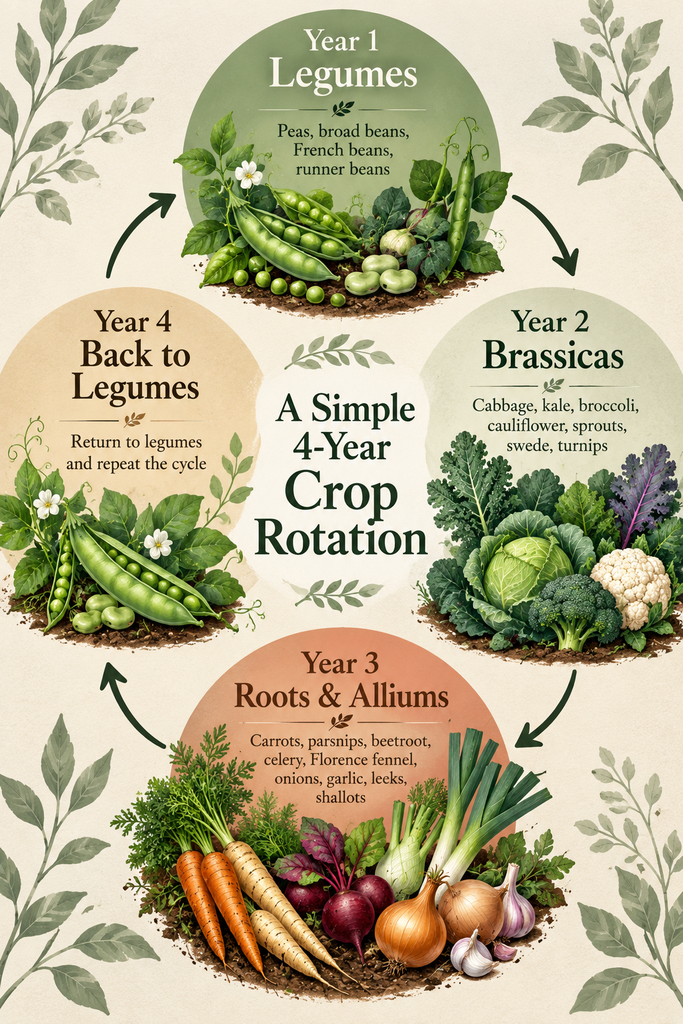
Legumes (peas, broad beans, French and runner beans) pull nitrogen from the air and fix it in the soil through their roots, leaving the ground richer than they found it.
Brassicas (cabbage, kale, broccoli, cauliflower, sprouts, and swede and turnips too) are hungry, particularly for nitrogen, which is exactly what makes following legumes with brassicas such a good pairing.
Roots (carrots, parsnips, beetroot, celery, Florence fennel) generally prefer ground that has not been freshly manured, since rich soil encourages forking rather than long, straight roots.
Alliums (onions, garlic, leeks, shallots) are their own group again, prone to their own soil-borne problems like white rot, and best kept apart from where they grew the previous year.
Potatoes and tomatoes get a mention too, since they share family-specific diseases like blight, but in a small garden they are easy to slot in wherever there is space rather than needing a dedicated rotation year of their own. That said, if you grow a lot of potatoes, it is still worth avoiding the exact same patch two years running, since blight spores and eelworm can linger in the soil in the same way clubroot does for brassicas.
Peppers and aubergines suffer from fewer soil-specific problems than potatoes and tomatoes, so they can genuinely go wherever there is a gap without much thought given to what grew there previously.
A Simple Rotation Plan for a Small UK Plot
The classic four-bed farm rotation, with one bed each for legumes, brassicas, roots and potatoes, was designed for people with four equal, rectangular plots and nothing else to fit in. Very few home gardens look like that, and there is no rule that says yours has to.
A more realistic approach for raised beds or an irregular plot is to think in terms of a three- or four-year cycle rather than a rigid grid:
- Year 1: legumes into a bed, adding nitrogen as they grow
- Year 2: brassicas into that same bed, taking advantage of the nitrogen left behind
- Year 3: roots or alliums into that bed, since they are lighter feeders
- Year 4: back to legumes, and the cycle repeats
If you only have two or three beds, you do not need a perfect fourth group. Simply avoid growing the same family in the same spot two years running, and lean on the UK vegetable growing calendar to slot successive sowings into whichever bed has just finished its current crop. A winter cover crop between rotations is also a good way to protect and feed a bed that would otherwise sit bare over the colder months.
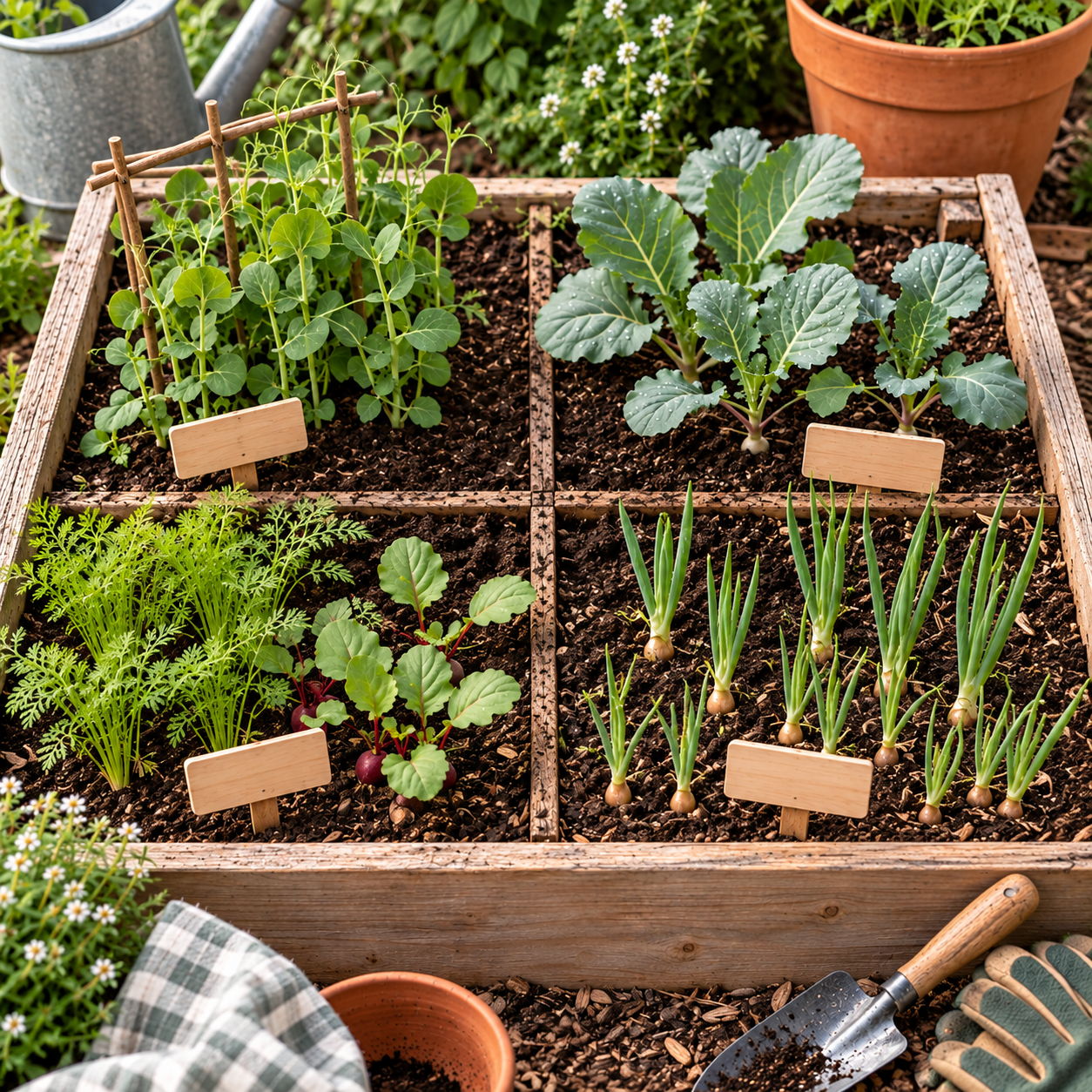
A worked example makes this easier to picture. Say you have three raised beds. Bed one grows broad beans in spring, followed by a late crop of leafy greens once the beans are cleared. Bed two grows cabbages and kale, benefiting from wherever the legumes sat the year before. Bed three grows carrots, beetroot and onions together, since roots and alliums are compatible neighbours and both prefer the leaner soil left after brassicas. The following year, everything simply shifts one bed along, and the sequence continues.
No Formal Beds? Adapting Rotation for Small Spaces
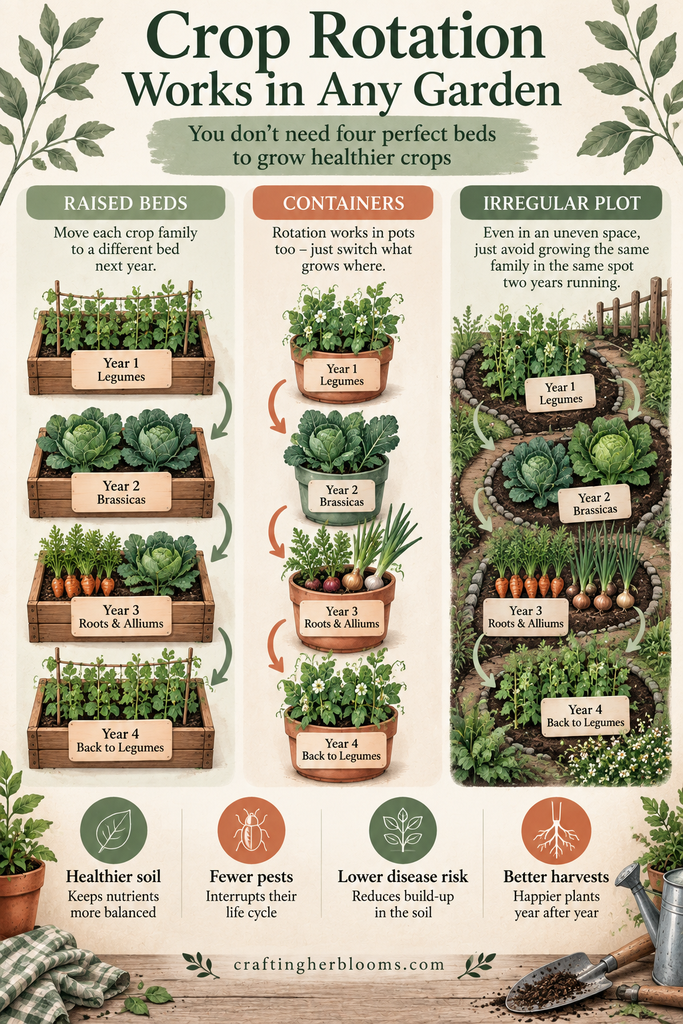
If your growing space is a scattering of containers, a couple of raised beds tucked against a fence, or a plot too irregular to divide neatly into quarters, formal rotation in the traditional sense simply is not realistic, and that is fine.
The underlying principle still holds even without a grid: avoid repeating the same crop family in the same spot or container two years in a row. In containers, this is easier than it sounds, since compost is usually refreshed between plantings anyway. If you are using containers for a lot of your growing, keep a rough note of what went in each pot last year and simply swap the family the next time you plant it up.
For an oddly shaped plot, treat each rough patch as its own mini rotation rather than trying to force the whole garden into four matching sections. Moving crops even a metre or two, or between raised beds of different sizes, still interrupts the pest and disease cycles that rotation is meant to address.
Common Mistakes, and the Plants That Break the Rules
The most common mistake is treating the four-bed system as gospel and then abandoning rotation altogether the moment a garden does not fit that shape. A loose, imperfect rotation followed consistently is worth far more than a perfect one that gets abandoned after a year.
The second common mistake is forgetting the crops that simply do not rotate. Perennial vegetables like asparagus and rhubarb are planted once and left in place for years, so they need a permanent spot outside the rotation system entirely rather than being squeezed into next year’s bed-swap.
The third is losing track of what actually went where. Memory alone is unreliable across a UK growing season that runs from February sowings through to late autumn harvests, particularly once a few different beds and successive sowings are involved.
A fourth, quieter mistake is rotating on paper but not in practice, planting a “quick catch crop” of something from the wrong family into a bed between main crops without thinking about it. A row of quick radishes or a late sowing of spinach tucked into a bed that just finished with brassicas or roots can quietly undo some of the benefit, so it is worth keeping half an eye on family groups even for filler crops.
Keeping Track: Simple Ways to Record Your Rotation
A rotation plan only works if you can actually remember it the following spring, so some form of record is worth keeping, even a rough one.
A page in a garden notebook works well for this: a simple sketch of your beds or containers with the crop family written on each one, dated by year, is often all you need. A spreadsheet does the same job if you would rather type than draw, and has the advantage of being easy to copy forward each year rather than starting from scratch. Dedicated garden planner apps exist too, though for most home gardens a notebook page is genuinely just as effective.
Whichever method you choose, the habit that matters most is updating it at planting time rather than trying to reconstruct it from memory months later.
Rotation does not need to be complicated to be worthwhile. Get the broad groups right, keep a simple record, and let your rotation flex around whatever shape your garden actually is rather than the textbook version of one.