
Winter Cover Crops for a UK Vegetable Garden: The Complete Growing Guide

I sometimes use affiliate links in content. This doesn’t cost you anything but I may make a commission payment from anything you buy through these links. As an Amazon Associate I earn from qualifying purchases. All opinions remain my own.
Empty vegetable beds over winter feel like a rest. For the soil underneath, they are closer to a slow leak.
Every downpour washes nutrients further out of reach, every bare patch invites next year’s weed seedlings, and heavy UK clay compacts harder with each frost. A winter cover crop is the fix gardeners in France and the Netherlands have used for generations, and it works just as well on an allotment in Yorkshire as it does on a market farm in Kent.
This is your last realistic window to get one in before the ground turns, and it is also the first real step toward a stronger, more workable bed come March. Sow now, and next spring’s digging gets noticeably easier.
What a Winter Cover Crop Actually Does for Your Soil
A cover crop, sometimes called a green manure, is a plant grown specifically to occupy soil rather than to be eaten. You sow it once a vegetable bed empties for the season, let it grow through autumn and winter, then dig it in or cut it down before spring planting begins.
Forged & Grown
Garden pieces, printed to order
3D printed planters and garden accessories, made in the UK. Self-watering designs, sculptural shapes, colour options — each one made when you order it.


Feeding the Soil While You’re Not Looking
Legume cover crops such as field beans, tares, and clover carry bacteria on their roots that pull nitrogen from the air and lock it into the soil. That nitrogen becomes available to next year’s hungry crops, particularly brassicas and sweetcorn, without a bag of fertiliser in sight. Non-legume types like rye and phacelia work differently: their roots scavenge nutrients that would otherwise wash out over winter and hold them in living tissue until you return them to the soil.
Either way, the organic matter left behind when a cover crop breaks down improves soil structure. On the heavy clay common across much of the Midlands and the south-east, that means better drainage and less of the backbreaking digging that clay demands every spring. On lighter, sandier soils in East Anglia, it means better water retention through a dry summer.
The Weed and Erosion Argument
A dense cover crop physically shades out the weed seedlings that would otherwise colonise bare soil by February. Roots also bind the soil together, which matters most on sloped allotments or exposed plots where winter rain can strip several millimetres of topsoil in a single wet season. If you have ever returned to a vegetable bed in March to find a carpet of chickweed and hairy bittercress, a cover crop is the most effective way to stop that happening again.
Cover Crops vs Other Winter Soil Protection
A cover crop is not the only way to protect bare soil over winter, and it is worth knowing how it compares to the alternatives before deciding what suits each bed.
Black plastic sheeting or old carpet keeps rain off the soil and suppresses weeds, but it does nothing to feed the soil and has fallen out of favour as gardeners grow more wary of microplastics shedding into growing beds over time. A thick mulch of well-rotted manure or garden compost feeds the soil directly and suppresses weeds reasonably well, but it does not hold soil together on a slope the way living roots do, and good compost is not always available in the quantity a full bed needs.
A cover crop does both jobs at once for the cost of a seed packet: living roots hold the soil in place through winter rain, and the plant itself becomes the feed when it is dug in or left as mulch in spring. The main trade-off is time. Mulch and sheeting work the moment you put them down, while a cover crop needs several weeks of growth before it earns its keep. For a bed you can plan ahead for, that trade-off usually favours the cover crop; for a bed you need protected immediately, a thick mulch is the faster fix.
When to Sow: UK Regional Timing
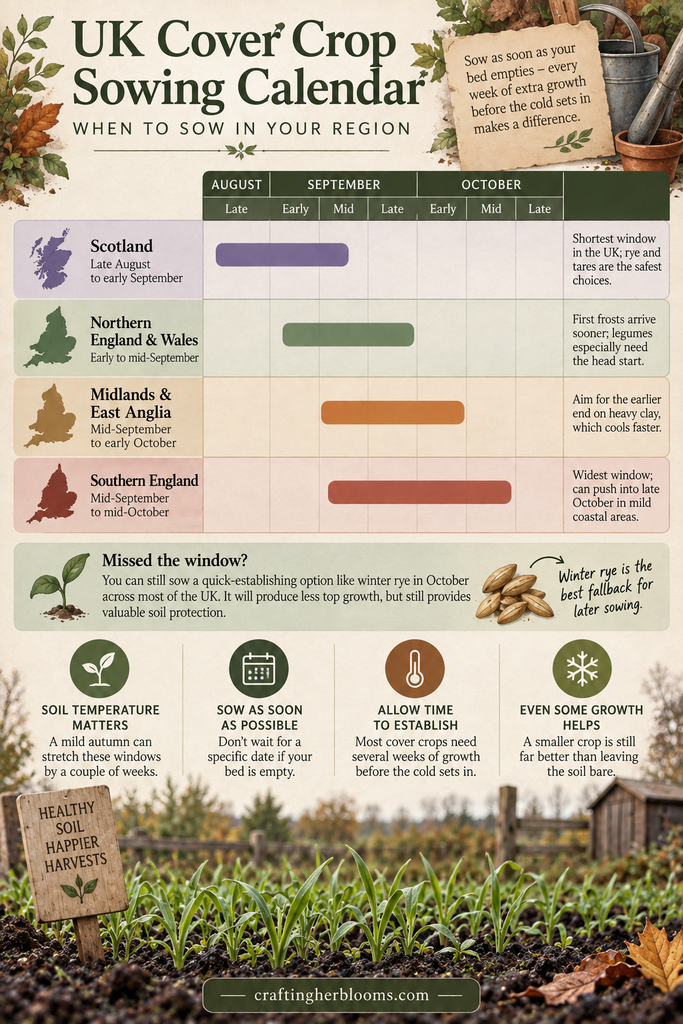
Timing matters more with cover crops than with almost anything else in the vegetable garden, because most need several weeks of active growth before the cold properly sets in. Sow too late and the crop barely germinates before frost stops it in its tracks.
| Region | Sowing window | Notes |
|---|---|---|
| Southern England | Mid-September to mid-October | Widest window; can push into late October in mild coastal areas |
| Midlands and East Anglia | Mid-September to early October | Aim for the earlier end on heavy clay, which cools faster |
| Northern England and Wales | Early to mid-September | First frosts arrive sooner; legumes especially need the head start |
| Scotland | Late August to early September | Shortest window in the UK; rye and tares are the safest choices |
If you have already missed these windows this year, don’t leave the bed bare. A quick-establishing option like winter rye can still be sown into October across most of the country and will simply put on less top growth before winter dormancy sets in. That is still a considerable improvement over nothing at all.
Soil temperature matters more than the calendar date, and a mild, late autumn can stretch these windows by a couple of weeks in any region. The safest approach is to sow as soon as a bed empties rather than waiting for a specific date, since every week of extra growth before the cold sets in makes a real difference to how well a cover crop performs.
Fitting a Cover Crop Around Your Rotation
Where a cover crop fits also depends on what grew in that bed over summer and what you plan to grow there next. Legume cover crops such as field beans and tares belong in a bed that will not grow peas or beans the following year, in the same way you would rotate any other legume crop. Mustard, being a brassica, should only go into a bed staying clear of cabbages, kale, and other brassica vegetables for the next season.
Rye and phacelia are more flexible, since neither belongs to a vegetable family grown widely in UK gardens, and both can be slotted into almost any bed regardless of what came before or what follows.
The Best Winter Cover Crops for British Vegetable Plots
Not every green manure suits every plot, and UK growing conditions rule a few options out entirely. The following are the varieties that consistently perform well in British gardens.
Hungarian Grazing Rye (Winter Rye)
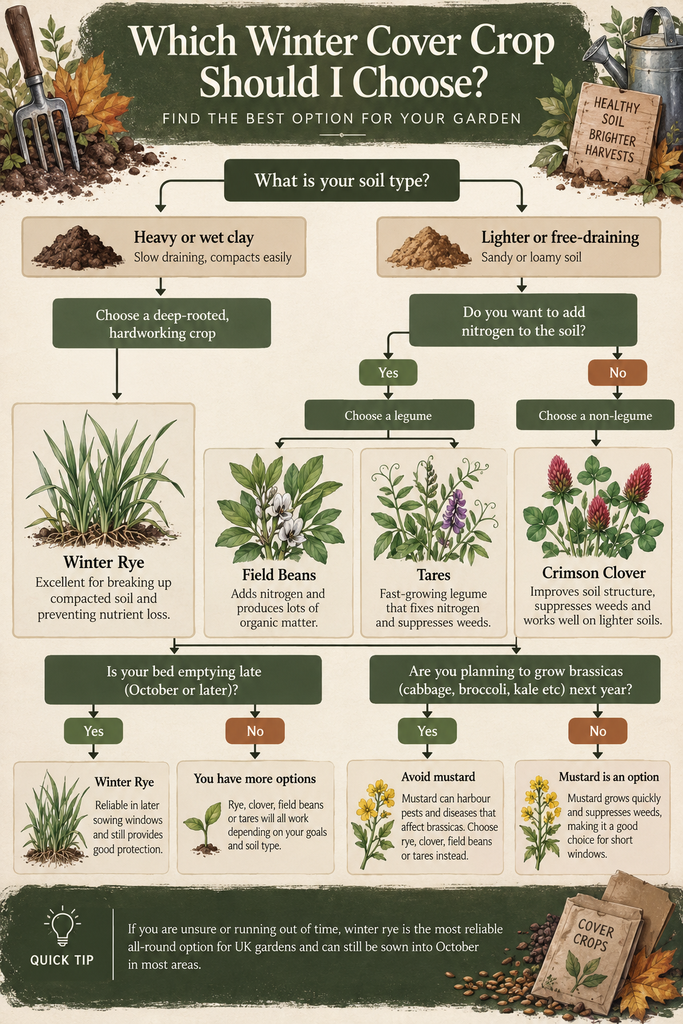
Winter rye is the workhorse of UK cover cropping, and for good reason. It germinates in cool soil down to around 4°C, tolerates the wettest and heaviest clay in the country, and keeps growing through all but the harshest cold snaps. Its dense, fibrous root system does more to break up compacted clay than almost any other cover crop available to home gardeners.
The trade-off is that rye needs digging in well before it sets seed in spring, and its tough roots take real effort to work into the soil by hand. Chop the top growth down first with shears or a strimmer, then dig or fork in the residue at least three to four weeks before you plan to sow spring crops in the same bed.
On a full-size allotment plot, rye is usually the safest default if you are only sowing one cover crop this year and want something that will succeed regardless of soil type or how late in the season you manage to get it in.
Field Beans and Winter Tares
Field beans (also sold as tic beans) and winter tares are the legume options most reliable in UK conditions, since true clovers can struggle in a wet winter. Both fix nitrogen and both tolerate frost well once established, though the RHS notes that legume green manures only actively fix nitrogen during periods of active summer-pattern growth, so a lot of the real benefit comes the following spring as roots break down. If you already grow broad beans in the vegetable patch, field beans will feel immediately familiar to sow and manage.
Sow tares and field beans a little earlier than rye where possible, since they establish more slowly. Both are worth keeping out of any bed that grew peas or beans that same year, to avoid concentrating legume-specific pests and diseases in one spot.
Field beans grow tall enough that a very exposed plot may see some wind damage over winter, though this rarely affects the roots or their soil benefit. Tares stay lower and more sprawling, which suits a smaller bed better and makes the eventual dig-in easier as well.
Crimson Clover
Crimson clover is the most ornamental cover crop option, with deep red flower spikes that pollinators visit heavily if you let it flower into spring rather than digging it in over winter. It fixes nitrogen well and suits lighter, free-draining soils better than the heaviest clay, where it can rot off in a wet winter. It is a strong choice for East Anglian sandy soils and for smaller beds where you want a cover crop that still looks deliberate rather than scruffy.
Phacelia
Phacelia is fast, cheap, and forgiving, which makes it a good option for a bed that has only just emptied in early autumn. It is not reliably frost-hardy across most of the UK, so treat it as a soil-holding stopgap rather than a full winter crop in the Midlands northward. Where it does survive mild winters, its dense purple flower spikes are excellent early forage for bumblebees emerging in spring.
Mustard
Mustard germinates and grows faster than almost anything else on this list, which makes it tempting for a late-emptying bed. It belongs to the brassica family, though, and carries the same club root risk as cabbages, kale, and other brassica vegetables. Only use it in a bed that will not grow brassica crops the following year, and rotate it out of your plan entirely if club root has ever been a problem on your plot.
How to Sow a Winter Cover Crop
Preparing the Bed
Clear the last of the summer or autumn crop and remove any obvious perennial weed roots, since a cover crop will not out-compete established bindweed or couch grass. A light rake to break up the surface is usually enough; skip deep digging, since disturbing the soil structure now works against the improvement you are trying to build. Firm the soil gently by treading it once, then rake it level again before sowing.
Sowing Rate and Method
Broadcast sowing, scattering seed evenly by hand across the whole bed, suits every cover crop on this list. Aim for roughly 20 to 30 grams of seed per square metre for rye, and slightly less for the smaller-seeded phacelia and clover, though exact rates vary by seed source and are usually printed on the packet. Rake lightly after sowing to cover the seed, then water well if the soil is dry, which it often is in a warm September.
Sourcing Seed
Cover crop seed is sold by weight rather than by the small packets used for vegetable seed, since you need considerably more of it to cover a whole bed. Garden centres stock small quantities of the more common types like mustard and phacelia, but a specialist green manure or cover crop seed supplier is worth seeking out for rye, field beans, and tares, and for ready-blended winter seed mixes. Buying in bulk works out considerably cheaper per square metre than small packets, and unused seed keeps well in a cool, dry place for sowing again next autumn.
Aftercare Through Winter
Once germinated, winter cover crops need almost no attention. Watch for slugs on young seedlings in a wet autumn, since a freshly sown bed of tender green growth is an easy target before plants toughen up. Beyond that, leave the crop to grow through winter and resist the urge to feed or water it further; the whole point is a plant that thrives on neglect while doing useful work below ground.
Bringing Your Cover Crop Back Out in Spring
Chop and Drop vs Digging In
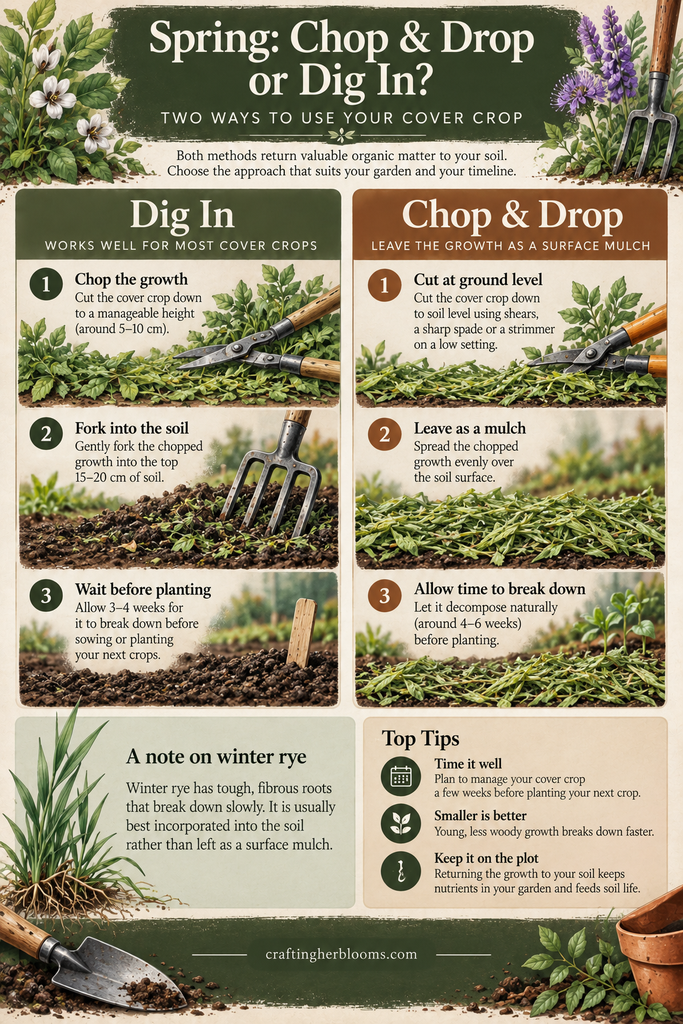
There are two main ways to end a cover crop’s life before spring sowing. Digging in involves chopping the top growth short, then turning it into the top 15 to 20cm of soil with a fork or spade, which works quickly but disturbs soil structure in the process. Chop and drop simply cuts the crop down and leaves the residue on the surface as a mulch, which suits a no-dig approach to the vegetable garden and lets worms do the incorporation work for you over several weeks.
Whichever method you choose, cut the crop down before it flowers and sets seed, or you risk it self-seeding into a weed problem of its own.
Timing It Against Your Spring Sowing Dates
Decaying plant material can temporarily tie up nitrogen and even suppress germination in the bed immediately after incorporation, so allow at least three to four weeks between digging in a cover crop and sowing directly into the same ground. That timing lines up neatly with UK sowing schedules: a bed cleared of its cover crop in early March is ready in good time for the hardy crops that go in from late February onward, and comfortably ready for the main flush of spring vegetable sowing in April.
The No-Dig Approach
If you already garden on a no-dig system, skip digging in entirely. Cut the cover crop down at ground level, leave the top growth on the surface as mulch, and plant or sow straight through the decaying residue once it has broken down enough to work with, usually within four to six weeks. Rye is the one exception worth digging in properly even on a no-dig plot, since its tough fibrous roots are slow to break down left on the surface alone.
Common Problems With UK Cover Crops
Waterlogging on Heavy Clay
Clover and tares can rot off in a genuinely waterlogged bed, particularly on the heavy clay found across much of the Midlands and south-east. If a bed regularly holds standing water over winter, rye is the safer choice, since it tolerates wet conditions far better than any legume option.
Slug Damage
A newly germinated cover crop is soft, tender growth in a season when slugs have few other options, and damage can be severe in a mild, wet autumn. Beer traps, torchlit evening checks, and encouraging natural predators like hedgehogs and ground beetles all help without resorting to anything harsher.
Overwintering Weeds Within the Crop
A thin or patchy cover crop leaves gaps that weeds exploit just as readily as bare soil would. If germination looks sparse a couple of weeks after sowing, oversow the gaps rather than waiting to see if the crop fills in on its own.
Patchy or Failed Establishment
Poor germination is usually down to one of three causes: seed sown too shallow and eaten by birds, soil left too dry after sowing, or seed sown into ground that was too cold for that particular variety. Rye is the most forgiving of the three on cold soil, which is why it remains the default choice for later sowings. A firm, level seedbed and a thorough watering immediately after sowing solves most establishment problems before they start.
Frequently Asked Questions
Is it too late to sow a cover crop if my beds only just emptied in October? Rye is your best option this late in the year across most of the UK, since it germinates in cooler soil than clover, phacelia, or field beans. You will get less top growth before winter dormancy, but the soil-holding and root benefits still apply.
Can I use a mix of different cover crop seeds together? Yes, and a rye and vetch or rye and tares mix is a popular combination in UK gardens, since it pairs rye’s cold tolerance and root structure with a legume’s nitrogen fixing. Ready-made UK winter green manure seed mixes are widely available and take the guesswork out of pairing compatible varieties.
Will a cover crop attract pests into my vegetable garden? The main risk is slugs sheltering in dense winter growth, which is worth watching for in a mild, wet season. Legume cover crops can also host the same pests as your pea and bean crops, so avoid sowing them in a bed that grew peas or beans that same year.
Do I need to dig cover crops in, or can I just leave them? Leaving a cover crop to flower and set seed will turn it into next year’s weed problem, so it needs cutting down before flowering regardless of whether you dig it in or leave it as a chop-and-drop mulch. The choice between digging in and chop and drop comes down to whether you garden on a dig or no-dig system.
Is mustard a good choice for a UK vegetable bed? Mustard germinates quickly and is useful for a late-emptying bed, but it belongs to the brassica family and carries the same club root risk as cabbages and kale. Only sow it in a bed that will not grow brassica crops the following year.
How much does cover crop seed cost compared to the benefit it provides? Seed for a standard-sized allotment bed typically costs only a few pounds, which is considerably cheaper than an equivalent amount of soil improver, mulch, or fertiliser bought separately. The labour saved on spring digging, particularly on heavy clay, is worth at least as much as the seed cost itself.
Can I grow a cover crop in raised beds or containers as well as open ground? Raised beds benefit just as much as open ground, particularly since raised bed soil tends to dry out and lose nutrients faster. Containers are less practical, since most cover crops need more root space than a typical pot provides to deliver a meaningful benefit.
What happens if I sow a cover crop and then need the bed earlier than planned? A cover crop can be cut down and dug in at any point once it has put on a reasonable amount of growth, even if that is only a few weeks after sowing. You will get a smaller benefit than leaving it the full winter, but even a short-lived cover crop reduces bare soil time and adds some organic matter back.
Do cover crops work in a small garden as well as a full allotment? Yes, and they are arguably more valuable in a small space, where every bed works harder and has less room to rest between crops. Even a single raised bed or a metre-square gap left by cleared summer vegetables is worth sowing rather than leaving bare.
Can I sow a cover crop around overwintering vegetables that are already in the ground? Sow it in the gaps between established overwintering crops like leeks or Brussels sprouts rather than right up against them, since a vigorous cover crop will compete for light and water if it grows too close. A thin sowing of phacelia in wider gaps works well for this, since it is easy to pull out by hand if it encroaches.
Winter cover crops are one of the lowest-effort, highest-return jobs in the UK vegetable growing calendar. A packet of rye or field bean seed costs little, takes an afternoon to sow, and hands back a noticeably better bed by the time spring planting begins.
Continue Your Journey
Ready to put your winter-improved bed to work? Our complete UK guide to growing your own vegetables covers the full year-round planting calendar this cover crop feeds into.
If nitrogen-fixing is what drew you to field beans and tares, our guide on companion planting in the UK explores more ways to put nitrogen-fixing legumes to work alongside your other crops.
For the crops that follow a cleared cover crop bed in the coming months, see what to plant in November and February as the growing year turns over.
Building a no-dig system around your cover crop routine? Our guide to living soil goes deeper into feeding soil biology rather than the plants directly.
And if you’re planting garlic in the same autumn window as your cover crop, our guide to growing garlic in the UK covers the other major fill-a-gap autumn job.
Have you tried a winter cover crop on your plot before? I would love to hear which variety worked best on your soil type in the comments below.
Want more UK-focused growing guides delivered straight to your inbox? Sign up for the Crafting Her Blooms newsletter and never miss a seasonal planting tip.


