
Mediterranean Herbs in UK Gardens: Can You Actually Grow Them?

I sometimes use affiliate links in content. This doesn’t cost you anything but I may make a commission payment from anything you buy through these links. As an Amazon Associate I earn from qualifying purchases. All opinions remain my own.
Every few years, rosemary bushes across the country turn brown and mushy over winter, and the question lands in every gardening forum at once: is this plant simply not hardy enough for Britain? The honest answer is more interesting than a straight yes or no, and it has almost nothing to do with how cold your garden actually gets.
Mediterranean herbs (rosemary, thyme, sage, oregano and bay chief among them) are sold everywhere in the UK, and most of them are perfectly capable of surviving a British winter. The real question isn’t whether our climate is cold enough to kill them. It’s whether your soil is dry enough to let them live.
🌦️ Why UK Winters Actually Kill Mediterranean Herbs
These plants evolved on hillsides around the Mediterranean, where winters are mild and wet weather drains away fast through thin, stony soil. What they never had to adapt to is a British winter’s particular combination: months of grey drizzle sitting on heavy clay that barely drains at all.
Rosemary is officially rated hardy down to about minus 10°C by the RHS, which sounds like it should shrug off anything the UK throws at it. In practice, though, many Mediterranean plants survive their stated hardiness rating in a dry continental climate and still rot in a UK winter at temperatures nowhere near that limit.
Forged & Grown
Garden pieces, printed to order
3D printed planters and garden accessories, made in the UK. Self-watering designs, sculptural shapes, colour options — each one made when you order it.


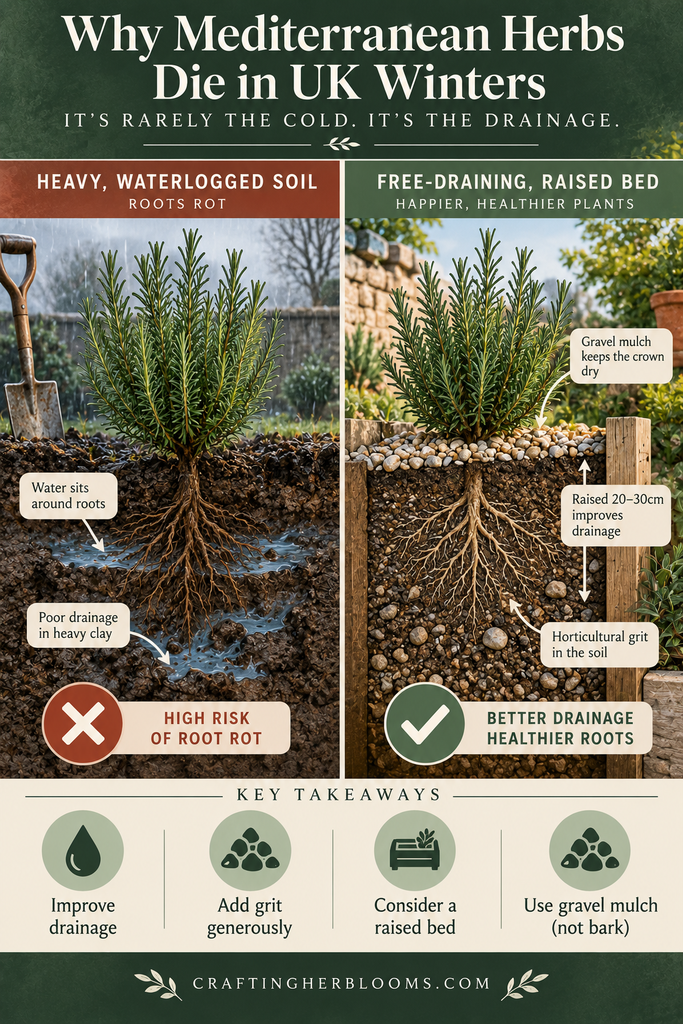
The mechanism is straightforward once you see it. Waterlogged soil around the roots for weeks on end starves them of oxygen and invites the fungal rot that actually kills the plant, and cold makes this worse only because it slows the soil from draining even further. A rosemary bush in free-draining soil can shrug off a hard frost that would finish off the same plant sitting in a puddle of wet clay.
This is why the same variety can thrive in one garden and collapse in the garden two streets away. It’s rarely about the thermometer. It’s almost always about what’s happening at root level while nobody’s watching.
🌿 The Per-Herb Verdict: What Survives, What Needs Help
Not every Mediterranean herb carries the same risk, so it’s worth treating them separately rather than lumping them all under one verdict.
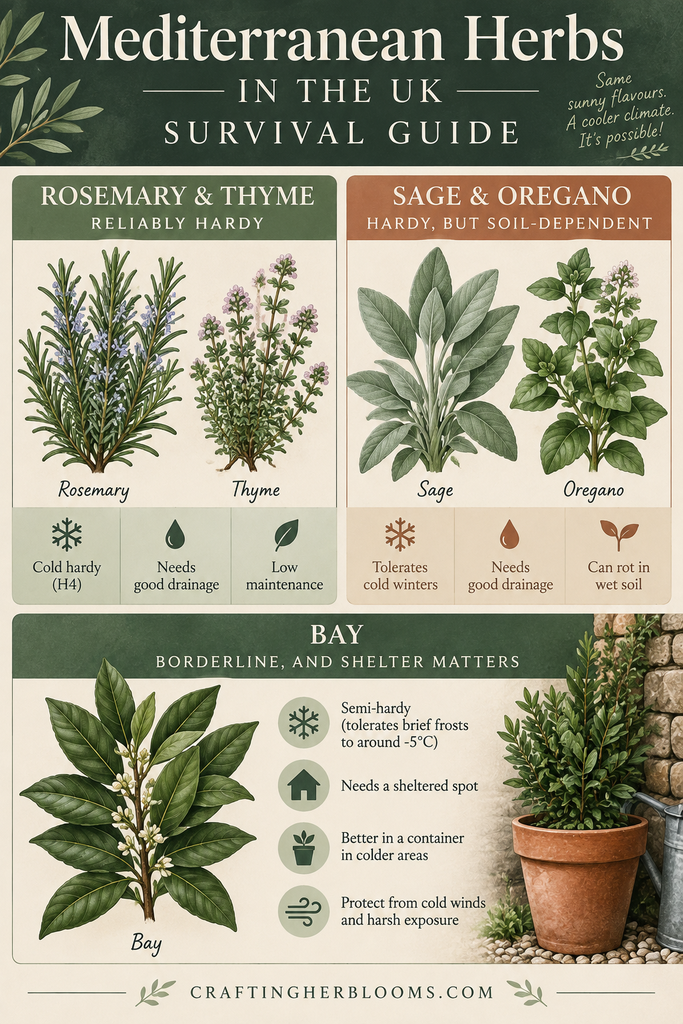
Rosemary and thyme: reliably hardy, given drainage. Both are RHS-rated hardy (rosemary H4, tolerant to around minus 10°C) and both are genuinely tough once their roots are dry. Get the drainage right and these two are about as low-maintenance as UK gardening gets, in the ground, all year round, in most of the country. If you’re weighing up which Mediterranean herbs to commit bed space to, our lavender growing guide covers a close relative with near-identical drainage needs, rather than repeating variety-specific planting detail here. Look for named varieties bred for resilience if you’re planting new stock: ‘Miss Jessopp’s Upright’ rosemary holds itself more compactly than sprawling forms and copes well with damp shoulder seasons, while thyme varieties such as ‘Silver Posie’ or common garden thyme are both reliably tough once established.
Sage and oregano: hardy, but soil-dependent. These two are a notch more soil-sensitive than rosemary and thyme. They’ll cope with a genuinely cold winter without complaint, but they sulk and eventually rot in soil that stays wet for long stretches, so the drainage advice below matters more for these two than for their tougher cousins. ‘Berggarten’ is a widely available, compact sage cultivar that copes reasonably well with a damp autumn provided it isn’t sitting in standing water, and it’s a sensible starting variety if you’re planting sage for the first time.
Bay: borderline, and shelter matters. Bay is only semi-hardy, tolerating brief frosts to around minus 5°C but suffering real damage below that, especially if the cold is sustained. It also struggles more in a pot than in open ground, since compost in a container freezes far faster than garden soil does. Treat bay as the one on this list that genuinely needs a sheltered spot, and in northern gardens, a container you can move under cover for the worst of winter.
Across all four, the pattern holds: cold tolerance is rarely the limiting factor. Drainage and shelter are what decide whether these plants make it to spring.
🧱 Fixing the Drainage Problem
If your soil is heavy clay, the good news is that you don’t need to give up on Mediterranean herbs, you need to change what’s around their roots.
- Raise the bed. Lifting the planting area 20 to 30cm above the surrounding ground level dramatically improves drainage, since gravity does most of the work for you. A simple raised bed or even a mounded ridge of soil is often the single biggest improvement you can make.
- Add grit generously. Working horticultural grit through the planting hole, roughly a quarter of the total volume, opens up heavy soil and stops water sitting around the roots. This matters more than almost any other single change for sage and oregano especially.
- Mulch with gravel, not bark. A gravel or grit mulch around the base keeps the crown of the plant dry and reflects a little extra warmth back up in winter, unlike a bark or compost mulch, which holds moisture against the stem.
- Pick a south-facing spot against a wall where you can. A sheltered, sun-baked position against a south or west-facing wall gives you both extra warmth and faster-draining soil, since walls shed rainfall outward and soak up heat during the day.
- Avoid low-lying corners. Frost pockets and the bottom of a slope are exactly where water collects and cold air settles, which is the worst possible combination for these herbs.
- Read what’s already growing. If nettles, buttercups or moss dominate a patch, that’s usually a sign of heavy, poorly-drained soil, and it’s worth prioritising that spot for improvement (or ruling it out for these herbs altogether) before you plant.
None of this needs to happen in one weekend. Even improving drainage around one or two plants a year, starting with whichever spot in your garden stays wettest longest, will noticeably shift your success rate.
🪴 When to Stop Fighting the Climate
Some gardens simply don’t have a well-drained spot to offer, heavy clay right across the plot, a naturally boggy corner, or no sunny wall to speak of. If that’s you, the honest answer is to stop trying to force these herbs into open ground and grow them in pots instead.
Container growing sidesteps the entire drainage problem, since you control the compost mix directly rather than fighting what’s already in the ground. It’s also the safer option for bay in colder parts of the country, since a pot can be moved to shelter when a hard frost is forecast. Our dedicated guide to growing herbs in pots covers compost mixes, pot sizing and watering in the detail this format doesn’t have room for.
A good pair of secateurs earns its keep here too, since potted Mediterranean herbs benefit from a firmer annual trim than their in-ground counterparts, both to stop them getting leggy and to keep the growth dense enough to shrug off wind chill.
A few signs it’s time to make the switch: a spot that’s still soggy a full day after rain, a previous rosemary or sage that rotted from the base despite reasonable care, or simply not having a south or west-facing wall anywhere in the garden. None of these are a failure on your part, they’re just information about what your particular plot can support.
🗺️ Does It Matter Where in the UK You Garden?
Yes, and it’s worth being specific rather than giving one blanket answer for the whole country. Splitting the UK into its usual four rough zones makes the picture much clearer.
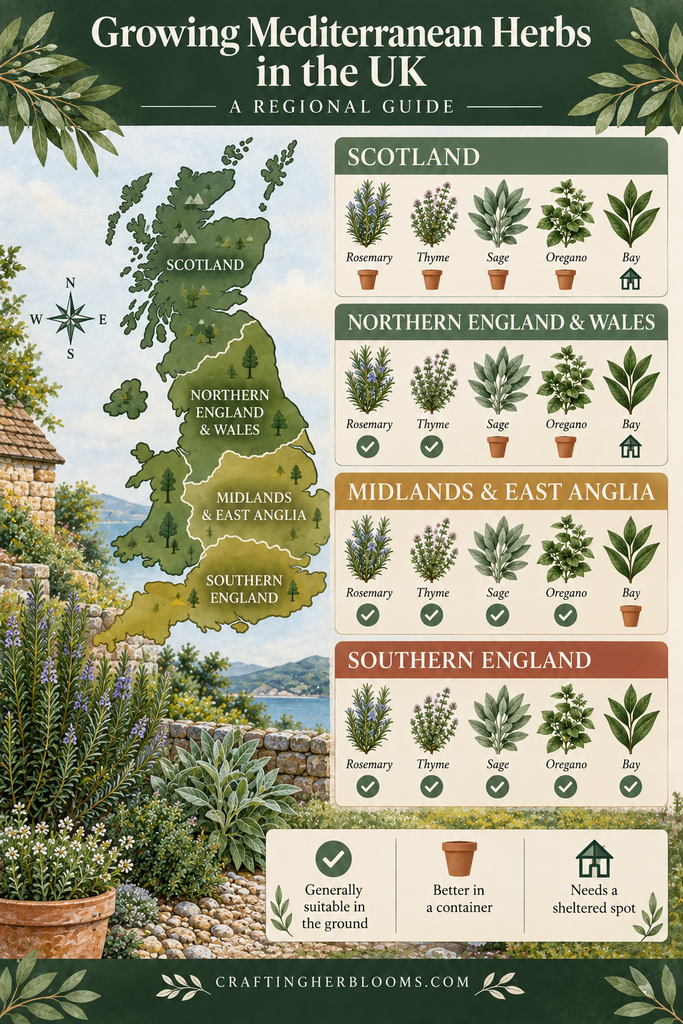
Southern England: the easiest zone by far. Rosemary, thyme and sage all grow reliably in the ground here without special protection in most years, and bay usually survives outdoors too if it has a reasonably sheltered spot.
Midlands and East Anglia: still generally reliable for rosemary and thyme in well-drained soil, though sage and oregano benefit from the extra drainage effort described above, and bay is safer in a pot that can be moved under cover during a hard frost.
Northern England and Wales: rosemary becomes genuinely borderline outdoors here, and treating it as a pot plant that overwinters in an unheated greenhouse or against a sheltered house wall is the more reliable approach. Thyme generally still copes in the ground if drainage is excellent, but sage, oregano and especially bay do better with active winter protection.
Scotland: the toughest zone for all five herbs. Thyme is usually the most forgiving of the group here, while rosemary, sage and bay are best grown in pots that can be moved to shelter, with bay treated as needing protection every winter rather than only in a hard one.
Coastal gardens, whichever of these zones they sit in, get their own quirk worth knowing about. Salt-laden wind can be harder on these herbs than inland cold is, so a windbreak hedge or fence often does more good than any amount of extra frost protection.
If you’re gardening somewhere genuinely exposed, whichever region you’re in, the resilient perennials for a wobbling climate guide has useful crossover advice on picking tougher plant choices generally.
❌ The Myth-Check: Fleece Isn’t the Fix You Think It Is
There’s a persistent piece of advice doing the rounds that wrapping Mediterranean herbs in horticultural fleece every winter will solve a hardiness problem. It won’t, at least not on its own, and leaning on it can actually make things worse.
Fleece is genuinely useful for a short, sharp frost snap, draped over foliage on the coldest nights and removed the next morning. What it does nothing for is wet roots, and a plant wrapped in fleece while sitting in waterlogged clay is still rotting from the roots up underneath that cosy-looking covering.
If you find yourself reaching for fleece every single winter just to keep a rosemary or sage plant alive, that’s usually a sign the real problem is drainage, not cold, and no amount of fabric is going to fix it. Solve the soil first, and fleece becomes an occasional extra for genuine cold snaps rather than a yearly life-support measure.
🌍 Getting the Foundations Right, Then Growing With Confidence
None of this is complicated once you know where to look. Mediterranean herbs fail in UK gardens far more often because of standing water than because of the cold, and the fix is almost always about what’s happening below the surface rather than what’s happening in the air.
Start with drainage wherever you’re planting, be honest about which spots in your garden genuinely offer that, and use pots for anything that doesn’t. Get that part right, and rosemary, thyme, sage and even a carefully sheltered bay can all earn a permanent place in a UK garden, wet winters and all.
For the full growing detail on getting each of these herbs established, our complete guide to growing your own herbs in the UK is the place to start, and our beginner’s tips for planning a herb garden is worth a look before you dig the first hole. A dose of mycorrhizal fungi worked into the planting hole also gives new specimens a stronger start in a freshly improved bed, helping roots establish before the first wet spell arrives.


