How to Grow Herbs on a Balcony in the UK: The Complete Guide
I sometimes use affiliate links in content. This doesn’t cost you anything but I may make a commission payment from anything you buy through these links. As an Amazon Associate I earn from qualifying purchases. All opinions remain my own.
There is something quietly satisfying about snipping fresh basil or crushing a sprig of thyme between your fingers before it goes into a pan — and the fact that you grew it yourself, on a balcony, makes it feel even better.
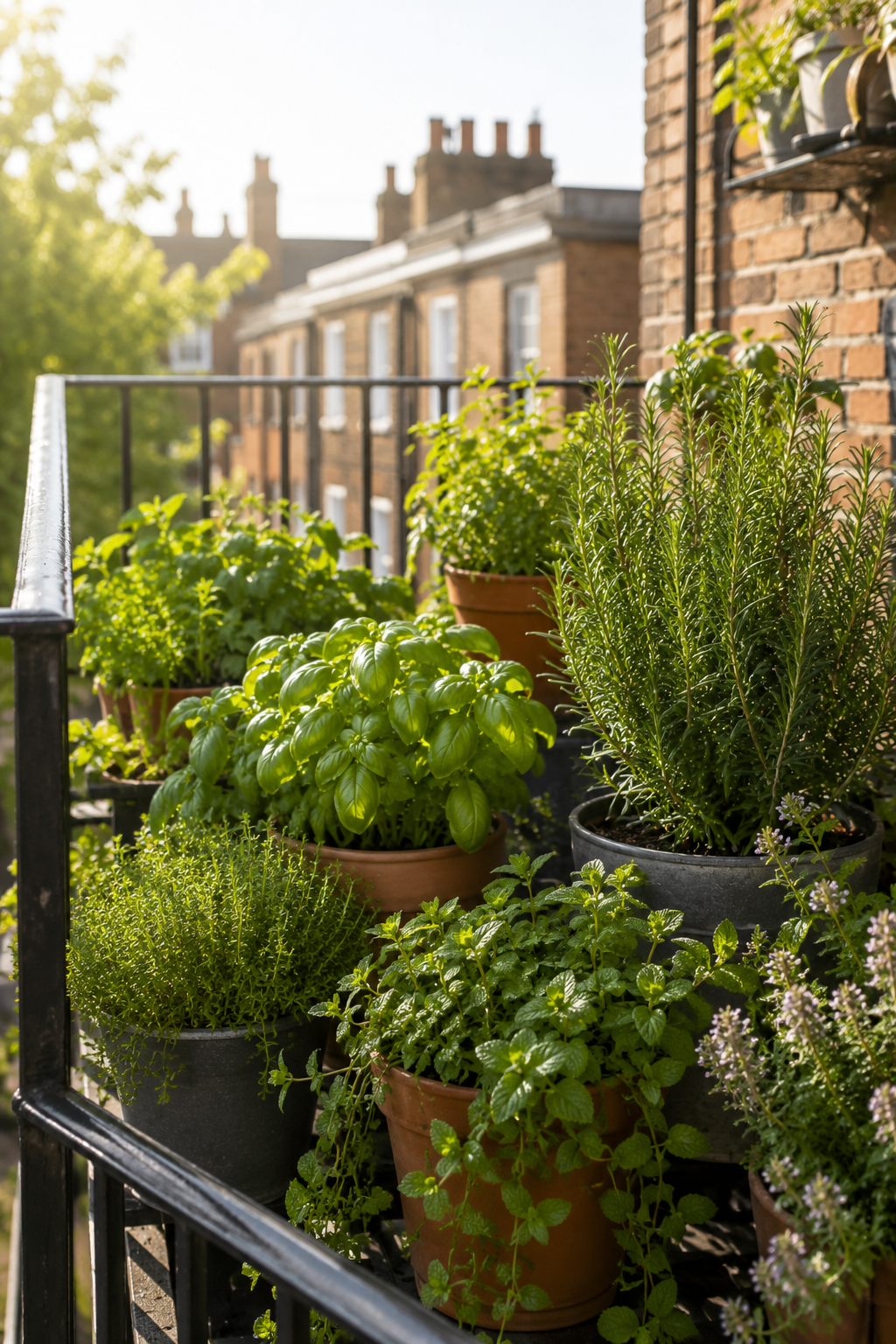
Balcony herb growing is one of the most accessible forms of food gardening in the UK, but it comes with its own set of challenges that no generic guide ever seems to mention: the wind that strips moisture from terracotta in hours, the south-facing sun trap that scorches mint by July, the north-facing corner where hardy perennials thrive but basil simply gives up. This guide is written for UK balconies specifically, from choosing varieties that suit the British climate to managing the watering rhythms that our unpredictable summers demand.
Whether you’re on the tenth floor of a Manchester apartment block or a Victorian terrace in Bristol with a narrow south-facing ledge, the principles are the same — and the rewards are real.

Why a UK Balcony Is Not the Same as a Garden
Most herb-growing advice is written with a garden bed in mind, and much of what’s available online originates from warmer, sunnier climates than ours. A UK balcony presents a genuinely different growing environment, and understanding its quirks is the first step to success.
Forged & Grown
Garden pieces, printed to order
3D printed planters and garden accessories, made in the UK. Self-watering designs, sculptural shapes, colour options — each one made when you order it.


Wind Is Your Biggest Enemy
High-level or exposed balconies experience significantly more wind than ground-level beds, even in sheltered spots. Wind causes rapid moisture loss from both the soil and the plant itself, and it can physically damage soft-stemmed herbs like basil and coriander within a single blustery day. The higher the balcony, the more pronounced this effect becomes. In UK cities where apartment living is concentrated — London, Manchester, Leeds, Birmingham — prevailing westerly winds can be relentless from autumn through spring.
The practical response is to group pots together to create a windbreak effect, position taller, sturdier plants (like rosemary or bay) on the windward edge to protect more delicate herbs behind them, and use heavier containers rather than lightweight plastic that tips over easily. Even a trellis panel fixed to the balcony railing with a few gaps for airflow will make a measurable difference to the microclimate inside your growing space.
Light and the Direction Your Balcony Faces
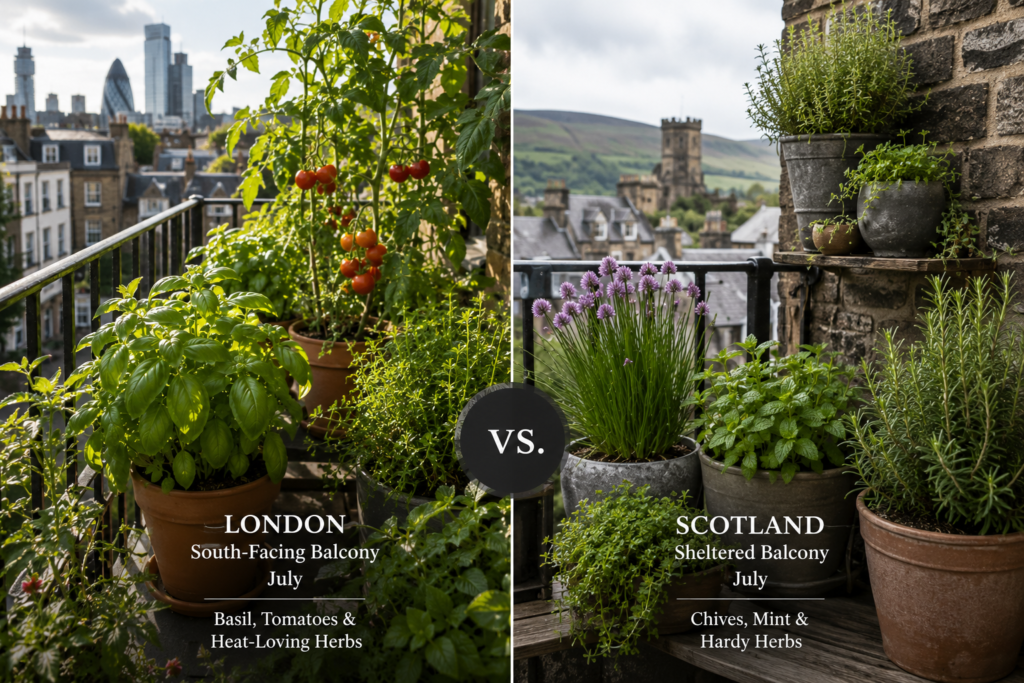
Light exposure determines almost everything about which herbs will thrive where you are. A south-facing UK balcony receives the most direct sun and can actually become too hot for some herbs in high summer — Mediterranean varieties like thyme, oregano, and rosemary will love it, but mint will wilt and basil may bolt early. A north-facing balcony receives little direct sunlight, which rules out most sun-hungry herbs but suits mint, chives, and parsley well. East-facing balconies get morning light and are gentle, well-suited to a broad range of herbs. West-facing balconies get afternoon and evening light, which works well for most culinary herbs.
Before buying a single pot, spend a few days noting how the sun moves across your balcony — or use a compass to establish the facing direction — and plan your selection accordingly.
The Container Drying Problem
A pot dries out far faster than garden soil, particularly on exposed balconies and during warm spells. In a UK summer, terracotta pots on a south-facing balcony may need watering every day. Compost quality matters enormously here: peat-free multipurpose compost mixed with some perlite or horticultural grit will retain moisture better than a dense, compacted growing medium while still draining freely enough to prevent root rot. Adding water-retaining gel crystals (available from most UK garden centres) to your compost mix before planting can reduce watering frequency significantly, which is worth doing for any herb that isn’t fully drought-tolerant.
Which Herbs Suit Your Balcony?
Select the direction your balcony faces to see the best herbs for your space.
From Crafting Her Blooms · Growing Herbs on a Balcony in the UK
Choosing the Right Herbs for Your Balcony
Not all herbs are equal on a UK balcony. Some are forgiving and will grow almost anywhere; others are demanding and will fail without the right conditions. Understanding this distinction before you buy saves a lot of frustration.
Hardy Perennials: The Reliable Backbone
These herbs survive UK winters outdoors, return each year, and generally cope well with exposed conditions once established. They form the foundation of any sensible balcony herb collection.
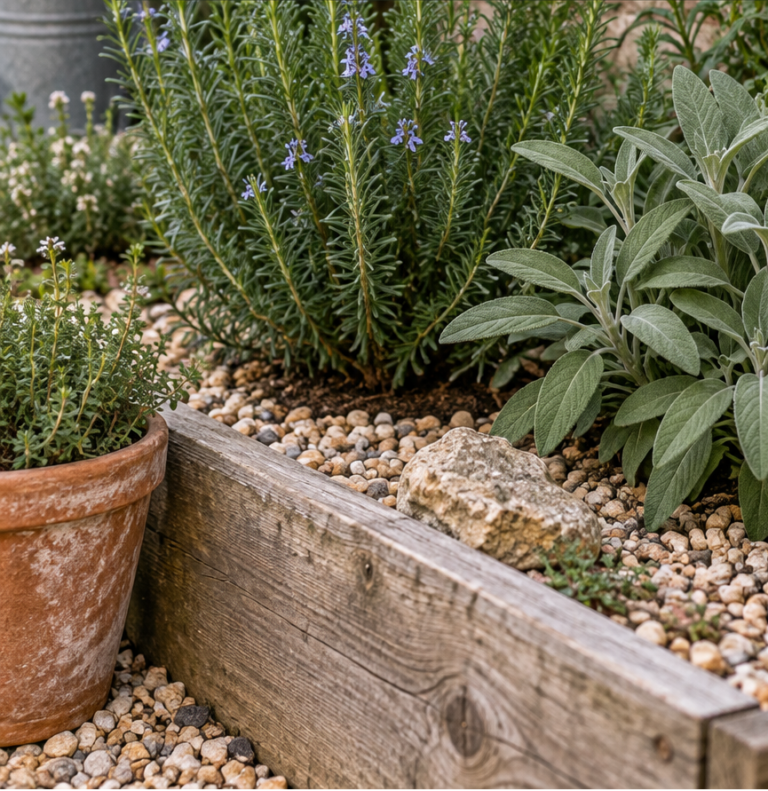
Rosemary is arguably the most balcony-friendly herb in the UK. It tolerates wind, drought, salt air (useful if you’re near the coast), and exposed positions. Give it a large-ish pot of gritty compost and a south or west-facing spot and it will reward you for years. ‘Miss Jessopp’s Upright’ grows tidily for smaller spaces; ‘Prostrate’ varieties trail beautifully over the edge of taller containers.
Thyme is similarly tough and handles neglect well. Common thyme (Thymus vulgaris) is the most useful culinary choice, but lemon thyme adds a wonderful citrus note that works brilliantly in fish and chicken dishes. Both are compact, low-maintenance, and attractive throughout the year.
Chives are one of the most under-appreciated balcony herbs. They grow happily in partial shade, tolerate wind, and produce edible purple flowers in late spring that are as beautiful as they are useful. They die back in winter and return reliably in March without any intervention.
Bay (Laurus nobilis) can grow to a considerable size, but kept in a container it’s naturally restricted and makes a striking architectural plant for a balcony corner. It’s slow-growing, hardy to around -5°C in most UK zones, and leaves can be harvested year-round.
Mint is a vigorous grower that prefers a shadier, moister position — which makes it ideal for north or east-facing balconies where other herbs might struggle. Always grow it in its own container, as it spreads aggressively and will overwhelm neighbours. Spearmint and peppermint are the most useful culinary choices; apple mint is lovely for drinks and adds a soft flavour to summer salads.
Annual and Half-Hardy Herbs: The Seasonal Stars
These herbs are planted fresh each year (or started from seed indoors) and bring the freshness that makes summer cooking feel alive. They’re more work, but the payoff is worth it.
Basil is the most popular and the most temperamental. It’s a Mediterranean plant that hates cold, wind, and overwatering — three things that a UK balcony can deliver all too easily. The key is to start it late (no earlier than mid-May outdoors in most of the UK; late May in the North and Scotland), protect it from wind, and never let it sit in cold water overnight. Sweet basil is the classic choice; ‘Genovese’ varieties have the best flavour for cooking. Thai basil is more robust and handles slightly cooler temperatures a little better.
Coriander is notorious for bolting — producing flowers and seeds before you’ve had a chance to harvest the leaves. On a balcony, this tendency is exacerbated by heat and drought stress. Choosing bolt-resistant varieties like ‘Calypso’ or ‘Confetti’ makes a real difference. Sow successionally from late April through June to extend the harvest, and keep it in a slightly cooler, shadier spot than your sun-lovers.
Parsley — both flat-leaf and curly — is a biennial that’s grown as an annual in most UK gardens. It’s relatively tough, grows well in partial shade, and is one of the easiest herbs to grow on a north-facing balcony where little else will thrive. Sow from seed in spring or buy young plants from a garden centre; it takes 6–8 weeks to establish before you can begin harvesting properly.
Dill is underused in UK herb gardens and works well on balconies in large, heavy containers where it won’t blow over easily. Use it fresh with fish, cucumber, and new potatoes for a classically British summer plate.
Herbs Worth Avoiding on Most UK Balconies
French tarragon (Artemisia dracunculus) is delicate and hates exposure; it rarely thrives in containers on windy balconies. Lemongrass needs more heat than a UK summer reliably provides unless you have a very sheltered south-facing spot in the Southeast. Most curry plant varieties similarly struggle without consistent warmth. It’s not that these can’t be grown, but they’re likely to disappoint when space and effort are limited.
Containers, Compost, and Getting the Setup Right
The physical setup of your balcony growing space matters more than most guides acknowledge. Getting containers and compost right is where many beginner balcony gardeners lose half the battle before they’ve even started.
Choosing Your Containers
Weight is a significant consideration on balconies, where structural load limits may apply — check with your building management if you plan to use a large number of heavy ceramic or stone pots. For practical purposes, a mix of lighter materials works well: fibreglass planters mimic the look of stone at a fraction of the weight, and good quality thick-walled plastic containers retain moisture better than terracotta while being much lighter.
Drainage is non-negotiable. Every container must have drainage holes, and pot feet or risers to elevate them off the balcony surface will further protect roots from sitting in pooled water and prevent staining the floor. If you’re buying saucers to catch drips, empty them after heavy rain rather than leaving herbs to stand in water overnight.
Window boxes fixed to balcony railings are excellent for a row of smaller herbs — chives, thyme, and trailing rosemary all work beautifully — and keep pot surface area away from the floor, which helps with weight distribution. Ensure they’re very securely fixed, as a box of wet compost is surprisingly heavy and any failure at height is dangerous.
The Right Compost Mix
Peat-free multipurpose compost has improved significantly in recent years and is now the standard recommendation for environmental reasons. For herbs, mix it roughly 3:1 with perlite or horticultural grit to improve drainage and aeration, as most culinary herbs — especially Mediterranean ones — resent sitting in soggy compost. For moisture-lovers like mint and parsley, the standard multipurpose mix without additional grit is fine.
Feed container-grown herbs from May through September with a general liquid feed every two to three weeks. Herbs grown in pots exhaust the nutrients in their compost much faster than garden plants, and yellowing leaves mid-season often indicate a feeding deficit rather than a watering problem.
Regional Timing: When to Plant Across the UK
One of the most valuable pieces of guidance any UK gardening resource can offer is regional timing, because the difference between Cornwall in early April and Aberdeen in mid-May is genuinely significant when it comes to tender herbs.
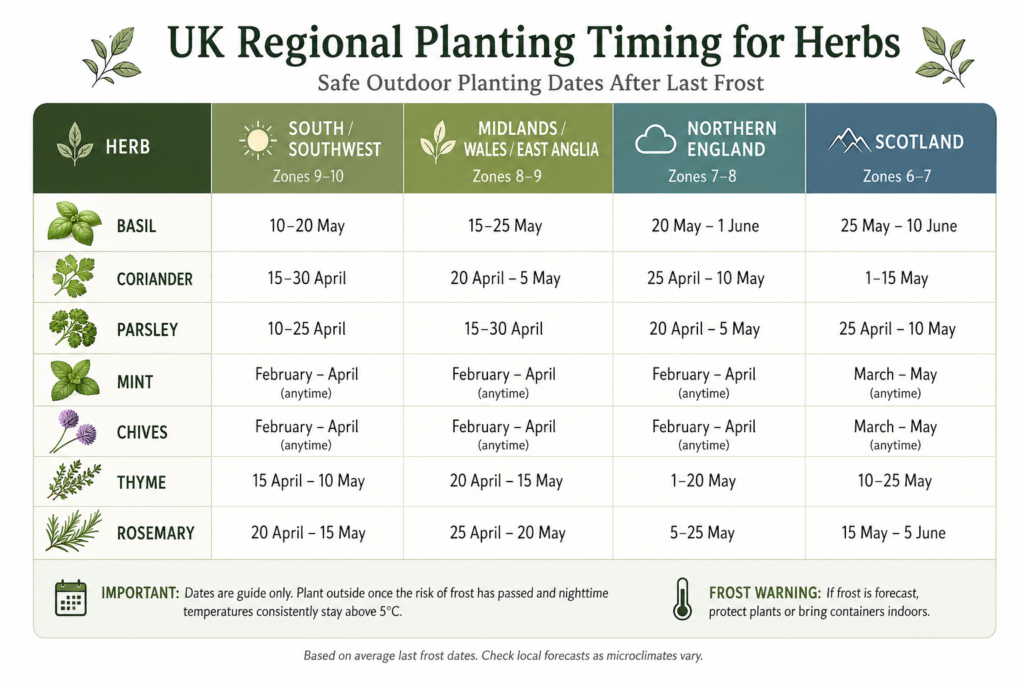
In the South of England and Southwest — Cornwall, Devon, Somerset, Kent, the Home Counties — the last frost risk typically passes in late March to mid-April. Tender herbs like basil can be moved outdoors in early to mid-May, and succession sowing of coriander can begin in April.
In the Midlands, Wales, and East Anglia, last frost dates vary considerably by elevation and local geography, but outdoor planting of tender herbs is generally safe from mid-May. Wait until soil temperatures are consistently above 10°C before putting basil out.
In Northern England — Yorkshire, Lancashire, the Northeast — last frosts can occur as late as mid-May in exposed or elevated areas. Basil is safest outdoors from late May, and a cloche or fleece kept to hand is wise throughout that month.
In Scotland, tender herbs really shouldn’t be put out until early June in most areas — and even then, having frost protection ready is sensible. The focus for Scottish balcony growers should lean more heavily on hardy perennials and cool-season herbs like mint, chives, and parsley, which cope far better with the shorter, cooler growing season.
For year-round harvests, bringing tender herbs indoors in September and growing them on a warm, bright windowsill extends the season significantly. Our guide on the best herbs for kitchen window gardens is a natural companion read for this transition.
Watering on a UK Balcony: Finding the Rhythm
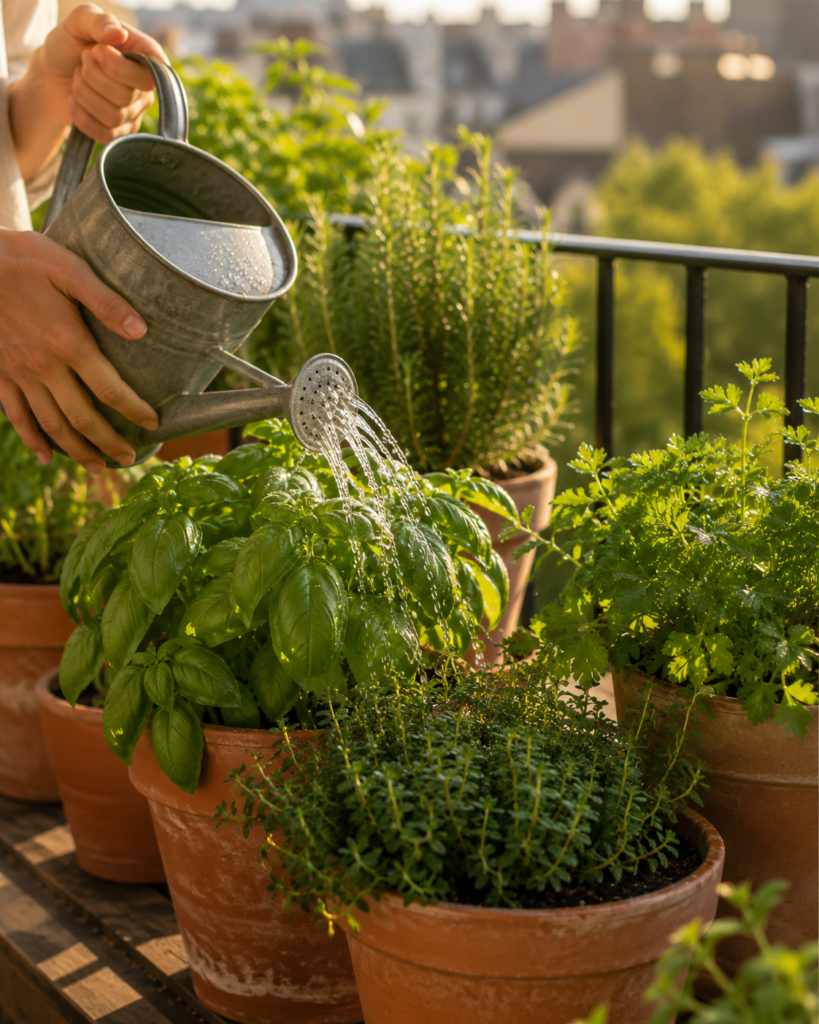
Watering is the task that trips up most new balcony growers, in both directions. Overwatering is genuinely common — it’s easy to assume a wilting herb needs water when it may simply be suffering from heat or cold shock — and underwatering during warm spells is an equally real problem on exposed balconies where compost dries rapidly.
The Simple Finger Test
The most reliable low-tech method is to push a finger 2–3 cm into the compost. If it feels damp, don’t water. If it feels dry, water thoroughly until it runs freely from the drainage holes. This single habit, done consistently, will prevent the majority of watering-related plant failures.
Morning Watering Is Best
Watering in the morning gives foliage time to dry before the cooler evening temperatures arrive, which reduces the risk of fungal problems. It also means water is available to roots during the warmest part of the day. Evening watering is the second-best option; midday watering in direct sun is the least ideal as moisture can evaporate quickly from the surface without penetrating to the roots.
The UK Summer Challenge
The unpredictability of UK summers means balcony gardeners need to be adaptive. A week of warm, dry weather in July can be followed by a fortnight of overcast, cool, rainy weather that demands no supplemental watering at all — and herbs that became accustomed to daily watering during the hot spell may actually suffer from the sudden abundance of moisture. Checking each pot individually rather than applying a blanket watering routine to all of them makes a genuine difference to plant health.
Irrigation Options for Busy Weeks
If you travel for work or take summer holidays, a basic drip irrigation system connected to an outdoor tap with a timer can be a straightforward and inexpensive solution. Products like the Gardena Micro-Drip System are widely available in UK garden centres and hardware stores. Self-watering containers — which have an internal reservoir the plant draws from — are another excellent option for those who can’t water daily.
Keeping a Balcony Herb Garden Productive
Growing herbs is only half the task; keeping them productive through the season requires a little ongoing attention that most beginners underestimate.
Harvest Little and Often
Regular harvesting is the single most important practice for productive herb plants. When you harvest frequently — taking no more than a third of the plant at any one time — you encourage the plant to produce new growth continuously. Herbs that are left to grow unchecked will divert energy into flowering and seed production (bolting), at which point leaf quality and flavour decline noticeably. This is especially true of basil, coriander, and dill.
When basil produces flower buds, pinch them off immediately. When coriander begins to bolt in heat, cutting the whole plant back hard may prompt a second flush of leaves — though once it’s genuinely committed to bolting, harvesting the seed for cooking is the more practical approach.
Dealing with Common UK Balcony Pests
Balconies are not pest-free environments, though they tend to have fewer problems than ground-level gardens. The most common issues on UK balconies are aphids, vine weevils, and slugs.
Aphids cluster on new growth and can be dealt with by a sharp spray of water or, for persistent infestations, an organic insecticidal soap spray. They’re particularly drawn to mint, basil, and dill in warm weather. Vine weevils — whose larvae eat plant roots from inside the container — are a serious issue in pots; the adults leave characteristic notched bites on leaf edges. Biological control using nematodes (available online and from garden centres) watered into the compost in spring and again in late summer is the most effective preventive measure. For more on organic approaches to garden pests, our piece on beating aphids naturally covers the broader picture.
Slugs can reach balconies, particularly those adjacent to walls or with neighbouring greenery. Copper tape around pot bases provides reasonable protection; slug pellets based on ferric phosphate are safe around edible plants and wildlife.
Overwintering Hardy Herbs
Rosemary, thyme, bay, chives, and mint all survive UK winters in containers, though the process is slightly more demanding than in open ground because containers freeze solid more quickly than soil, which can kill roots. Wrapping pots in bubble wrap or hessian during hard frosts provides meaningful insulation. Moving containers against a wall during the coldest months reduces exposure, and elevating pots off a wet, cold surface prevents the freeze-thaw damage that can crack terracotta.
Bay is the most vulnerable of the common hardy herbs to severe frost — temperatures below -5°C for extended periods can damage even established plants. In Scotland and the colder parts of Northern England, moving bay into a sheltered porch or an unheated greenhouse during January and February is a sensible precaution.
Making the Most of a Small Balcony Space
Even a very modest outdoor space can support a productive and attractive herb garden with some thoughtful planning. If balcony gardening has sparked your interest in getting more from a small space, our wider guide on maximising small outdoor spaces has plenty of ideas that apply directly to balcony setups.
Vertical growing is one of the most space-efficient approaches. A tall, narrow planter tower, a wall-mounted pocket planter, or a simple shelving unit against a wall can multiply your growing area considerably without adding to the floor footprint. The beginner’s tips for planning a herb garden go into more detail on layout and organisation principles that translate well to balcony contexts.
Companion planting — placing herbs near one another deliberately to take advantage of pest-repelling or beneficial relationships — works on balconies just as in garden beds. Basil planted near tomatoes is the classic combination; chives near other soft herbs help deter aphids. If you’re growing any edibles alongside your herbs, our companion planting guide is worth a read for planning your container groupings.
Consider the aesthetic dimension too. A balcony herb garden doesn’t have to look utilitarian. Mixing textures — the fine feathery leaves of dill alongside broad-leafed basil and the structural uprightness of rosemary — creates visual interest that rivals any ornamental planting. Adding edible flowers like nasturtiums or borage between your herb pots bridges the gap between beauty and usefulness, and both attract beneficial insects. Our piece on growing edible flowers has ideas that work beautifully in containers.
Frequently Asked Questions
Can I grow herbs on a north-facing balcony? Yes, with the right selection. Mint, chives, parsley, and even sorrel will grow well in partial shade. Avoid Mediterranean herbs like rosemary, thyme, and basil, which need direct sun to thrive. Opting for shade-tolerant varieties and ensuring your compost doesn’t become waterlogged (north-facing spots stay wetter) will keep your herbs healthy.
How do I stop my basil dying on the balcony? Basil fails on UK balconies for three main reasons: cold (it should not go out before mid-May in most areas, later in the North and Scotland), wind (position it in a sheltered spot behind taller plants), and overwatering (water only when the top layer of compost is dry and never let it sit in a full saucer overnight). Buying a mature plant rather than a small supermarket pot — which typically contains multiple overcrowded seedlings — also helps significantly.
What size pot do herbs need on a balcony? As a general rule, the larger the pot the better, as bigger containers retain moisture more evenly and give roots more room to develop. For individual herbs, a 25–30 cm pot is the practical minimum for perennials like rosemary and bay; smaller herbs like thyme and chives can manage in a 15–20 cm pot. For mixed herb containers, a 40+ cm trough or planter gives you the best results.
How do I store fresh herbs I’ve harvested? Most fresh herbs store well wrapped in a slightly damp piece of kitchen paper inside a container in the fridge for several days. Softer herbs like basil are better stored at room temperature with their stems in a small amount of water, away from cold draughts. For longer storage, many herbs freeze well — chives, parsley, and dill can be chopped and frozen in ice cube trays with a little water for easy portioning. Our guide on how to store fresh herbs from your garden covers all the methods in detail.
Do I need to feed balcony herbs? Yes — container-grown herbs need regular feeding because they quickly exhaust the nutrients in their compost. A general liquid feed applied every two to three weeks from May to September is sufficient for most herbs. Avoid high-nitrogen feeds that promote soft, leafy growth at the expense of flavour, especially for Mediterranean herbs; a balanced feed or one slightly higher in potassium is the better choice.
Can I grow herbs year-round on a UK balcony? Hardy perennials — rosemary, thyme, bay, chives, mint — remain on the balcony throughout the year and can be harvested even in winter, though growth slows significantly. Annual herbs like basil and coriander are seasonal. For true year-round herb harvests, the best strategy is to move tender herbs indoors onto a warm, south-facing windowsill from September onwards.
Your Balcony Herb Garden: Getting Started
Starting a balcony herb garden doesn’t require a large investment of money or time — it requires the right choices made from the outset. Begin with a small collection of reliable plants: rosemary, thyme, mint (in its own pot), and chives form a nearly foolproof quartet that suits most UK balcony conditions and provides genuine culinary usefulness across the year. Add parsley once you’re comfortable with the basics, then experiment with annual herbs like basil and coriander in your second season once you understand your balcony’s specific microclimate.
The mistakes most people make are growing herbs in too small a container, placing basil and other tender herbs out too early in the season, and failing to harvest regularly enough to keep plants productive. Avoid those three pitfalls and you’re already most of the way to success.
A balcony herb garden is one of the most direct connections you can make between growing and cooking — a few steps from pot to plate, your own soil, your own harvest. There’s no better way to start.
Enjoyed this guide? Sign up for the Crafting Her Blooms newsletter for seasonal growing guides, UK-specific gardening advice, and practical tips delivered straight to your inbox.
Continue Your Journey
- 27 of the Best Grow Your Own Herb Plants — a deep-dive into the most rewarding herbs to grow from seed or plant, with variety recommendations for UK growers
- The Best Herbs for Kitchen Window Gardens — extending the season indoors when the balcony cools down
- Beginner’s Tips for Planning a Herb Garden — layout, grouping, and design principles for any small growing space
- How to Store Fresh Herbs from Your Garden — make the most of every harvest, all year round
- Beginner’s Guide to Container Gardening — the broader skills and principles behind successful container growing
Do you grow herbs on your balcony? We’d love to hear which varieties have worked best for your space and which you’ve given up on — drop a comment below and share your experience with the Crafting Her Blooms community.