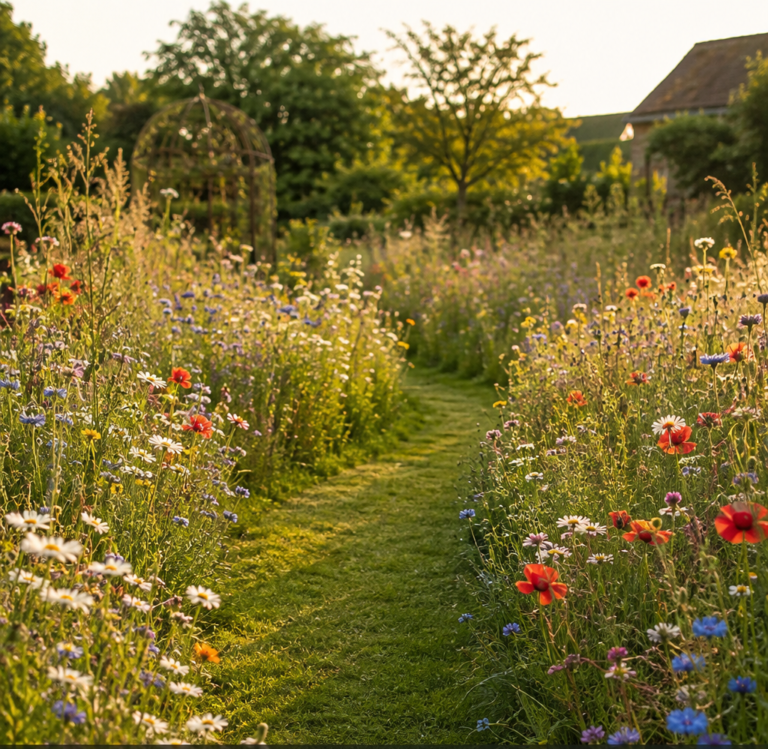
How to Make Your UK Lawn More Wildlife-Friendly (Without Digging It Up)

I sometimes use affiliate links in content. This doesn’t cost you anything but I may make a commission payment from anything you buy through these links. As an Amazon Associate I earn from qualifying purchases. All opinions remain my own.
You love your lawn. You also love the idea of bees humming across it, butterflies drifting through it, and hedgehogs rustling at its edges come dusk. The good news is that you don’t have to choose between keeping a lawn and supporting wildlife — you just have to rethink what a good lawn actually looks like.
The traditional British lawn — close-cropped, weed-free, uniformly green — is one of the least ecologically productive surfaces in the garden. But it doesn’t take a full meadow conversion or months of heavy digging to change that. Small, manageable shifts in how you mow, what you allow to grow, and how you treat the soil beneath can transform a sterile patch of grass into a genuinely thriving wildlife habitat. This guide walks you through every option, from a 30-minute tweak to a bigger seasonal project, so you can find the level that works for your garden, your schedule, and — crucially — your sense of what looks nice.
Why the Traditional Lawn Is Ecologically Limited
The British lawn has a well-polished reputation. It’s orderly, it’s green, and on a sunny afternoon in June there’s genuinely nothing better to sit on. But from a wildlife perspective, a closely mown monoculture of a few grass species offers almost nothing. No flowers for pollinators, no seed heads for birds, no structural variation for invertebrates to hide in, and no gaps in the turf for ground-nesting bees to find purchase.
Wildlife Gardening · Lawn Guide
Which Wildlife-Friendly Lawn Suits You?
Answer three quick questions to find your best starting point.
1. How much time can you spare to get started?
2. How visible is your lawn from the street or neighbours?
3. Do children or dogs use the lawn regularly?
Much of this comes down to inputs rather than the grass itself. Nitrogen-heavy fertilisers push the dominant grass species to outcompete everything else, leaving no room for the low-growing flowers — clover, selfheal, bird’s-foot trefoil, daisies — that naturally want to appear. Selective weedkillers do the rest, eliminating the very plants that pollinators depend on most. And the weekly mow cuts everything at the same height before any flower can complete its cycle.
Forged & Grown
Garden pieces, printed to order
3D printed planters and garden accessories, made in the UK. Self-watering designs, sculptural shapes, colour options — each one made when you order it.


This isn’t a guilt trip. Most of us grew up with lawns maintained this way, and the habits are deeply ingrained. But understanding why a conventional lawn struggles helps clarify what to change — and it turns out that many of the most effective changes are simply about doing less, not more.
What Wildlife Actually Needs From a Lawn
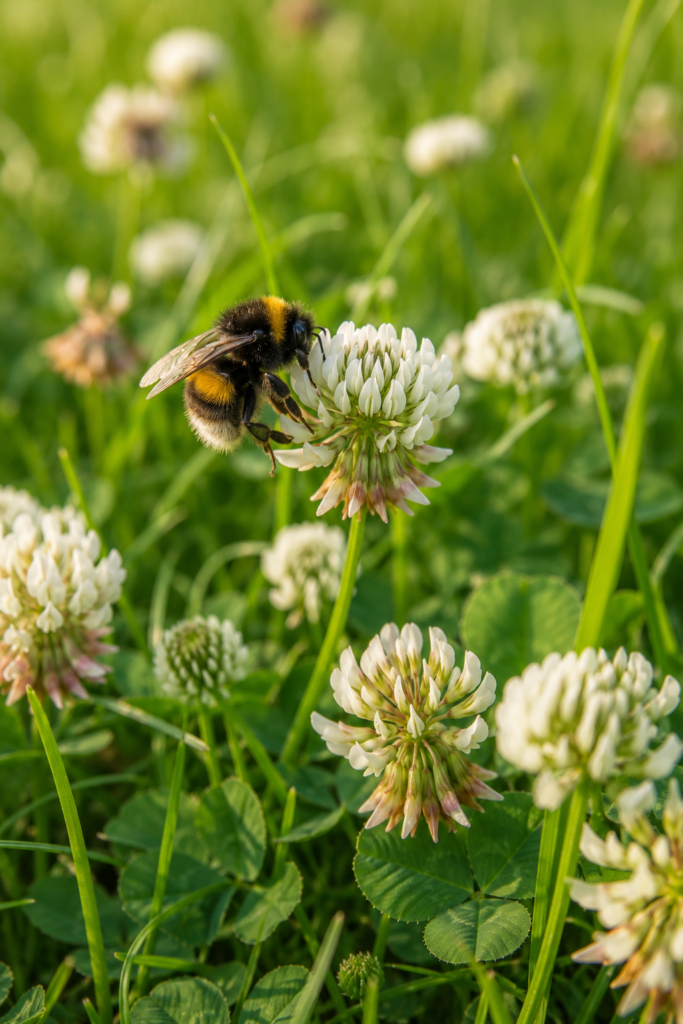
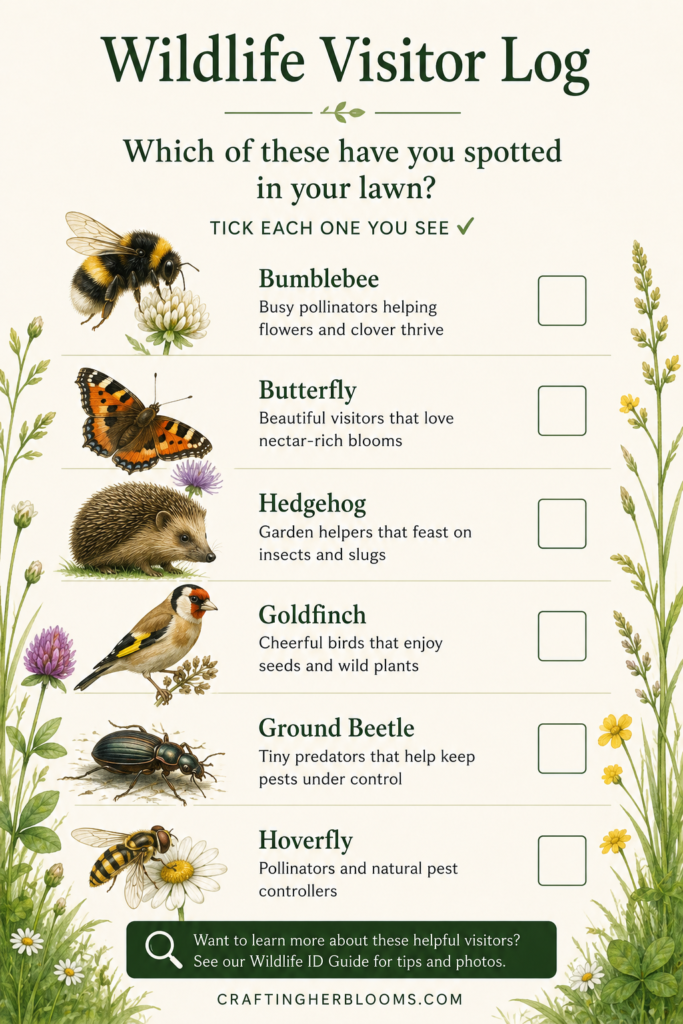
Different species need different things, but across the board a wildlife-friendly lawn delivers on three fronts: flowers for nectar and pollen, structure for shelter and nesting, and seed heads for overwintering birds and invertebrates. A lawn that provides even one of these — say, clover for bumblebees — is meaningfully better than one that provides none. A lawn that provides all three across different zones is quietly extraordinary.
The spectrum of what’s possible is wide. At one end, you’re simply mowing less frequently and stopping the fertiliser. At the other, you’re establishing a proper unmown strip with native plug plants and yellow rattle. Most gardens benefit most from landing somewhere in the middle — and that middle ground is exactly where this guide focuses.
The Spectrum of Options: From Minimal to More Committed
One of the most useful ways to think about wildlife-friendly lawns is as a spectrum rather than a binary. You don’t flip a switch from “conventional” to “wildlife garden.” You move along a dial, adjusting as your confidence, time, and garden allow. Here are the three main positions on that dial.
Option One: Relaxed Mowing
The lowest-effort, highest-impact change you can make is simply to mow less often and at a higher cut. Raising your mower deck to 5–7cm and moving to a fortnightly or monthly schedule allows flowers like daisies, clover, selfheal, and dandelions to bloom and set seed before they’re cut back. These aren’t weeds in any meaningful ecological sense — they’re vital sources of nectar for bumblebees, hoverflies, and early butterflies.
No Mow May — the annual campaign encouraging gardeners to skip mowing through May — has done a lot to popularise this idea. But the principle works beyond a single month. A “lazy lawn” approach, where you mow every three to four weeks through spring and summer rather than weekly, gives flowers enough time to complete their cycle and pollinators enough food to establish. If you want to retain a sense of neatness, mow a clear path or border weekly to frame the wilder grass — the contrast actually looks intentional, not neglected.
Option Two: The Clover Lawn
A clover lawn takes the relaxed mowing approach a step further by actively introducing white clover (Trifolium repens) into your existing grass. Clover fixes nitrogen from the air, reducing the need for fertiliser, stays green through dry spells where grass browns out, and produces a steady succession of flowers that long-tongued bumblebees — including some of our rarer species — depend on.
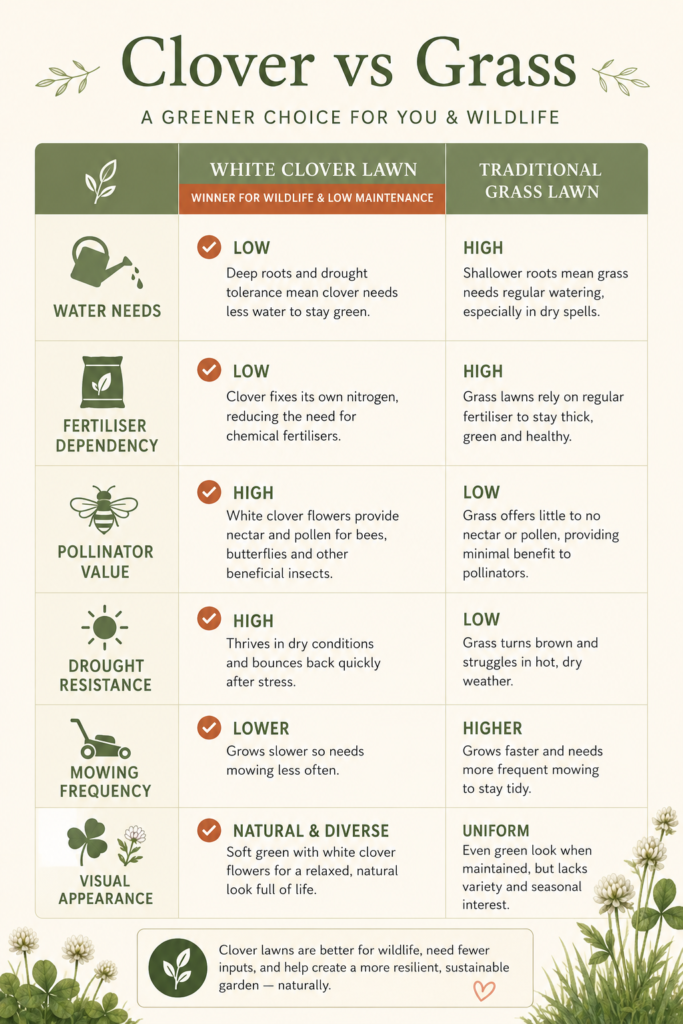
Overseeding with clover is straightforward: scarify the lawn lightly to expose bare soil, scatter white clover seed at around 1–2g per square metre in spring or early autumn, firm it in, and water during dry spells for the first six weeks. Good varieties for UK conditions include ‘Kent Wild White’, which stays low and blends well with grass. Once established, a clover lawn is mowable, walkable, and genuinely attractive — just significantly better for wildlife than a pure grass sward. The blossoms, when left unmown for a week or two, create a soft, meadow-like effect that many gardeners find they prefer.
Option Three: The Partial Meadow Strip
This is the most committed option short of a full lawn conversion, and it’s the one that tends to deliver the biggest visible wildlife benefit. Rather than transforming the whole lawn, you designate one section — an edge strip, the area around a tree, or a corner behind the shed — and manage it as a mini meadow. The rest of the lawn stays exactly as it is.
A partial meadow strip works because many wildlife species, particularly butterflies, moths, and their caterpillars, need undisturbed long grass for their life cycles. Areas left unmown until late July or August — after seeds have set and invertebrates have had time to move on — become genuinely productive habitat in a remarkably short time. You don’t need to plant anything: simply stopping the mower in that area often reveals what’s already dormant in the soil.
If you want to accelerate diversity, add native plug plants (cowslips, oxeye daisies, knapweed, field scabious) or scatter a suitable wildflower seed mix. When you do mow in late summer, cut low, collect all the clippings, and remove them from the area — this prevents the grass from becoming too dominant and keeps soil nutrient levels low, which is exactly what wildflowers prefer. Understanding your soil type before you begin helps enormously here, since wildflowers generally perform best in poor, well-drained ground rather than the enriched soil grass thrives in.
Practical Changes by Effort Level
Theory is useful, but most of us need to know what we’re actually doing on Saturday morning. Here’s what each level of commitment looks like in practice.
30 Minutes: The Quick Start
Stop applying fertiliser and weedkiller to the lawn — full stop. These two inputs do more to suppress lawn biodiversity than anything else, and stopping them costs nothing. From that baseline, raise the mower height to the highest setting your mower allows (usually 5–7cm) and switch to a monthly mowing schedule through the growing season.
If you have time, rake or scarify a small bare patch — even a square metre — scatter a packet of white clover seed or a low-growing wildflower mix over it, firm it down by walking on it, and water it in. You’re done. Clover in particular germinates quickly and will show results within a few weeks in warm weather.
Half a Day: The Clover Lawn or Mini Strip
Preparing the ground for a more deliberate clover lawn or mini meadow strip takes a bit more effort but only needs doing once. Mow the target area short, then scarify thoroughly with a garden rake or electric scarifier to remove thatch and expose the soil surface. Scatter your seed mix evenly, firm it in with the back of the rake or a light roller, and water well.
For a clover lawn, white clover seed is all you need. For a wildflower strip, choose a UK-native mix suited to your soil — avoid “wildflower” mixes containing non-native species, which look pretty but offer less value to wildlife. Plant plug plants of native perennials for faster results in the first year: cowslips, oxeye daisies, and selfheal all establish readily from plugs and begin flowering the same season. Compost all clippings you remove rather than leaving them on the surface.
The Bigger Project: Yellow Rattle and Bulbs
If you want to shift significant lawn space toward meadow habitat over time, yellow rattle (Rhinanthus minor) is your most powerful tool. This native annual is semi-parasitic on grass roots, weakening the dominant grass species and opening up space for wildflowers to establish. It must be sown fresh in autumn — ideally September or October — directly onto short-mown grass. Results take a season to show, but once yellow rattle establishes itself, the composition of your lawn can shift quite dramatically over two or three years.
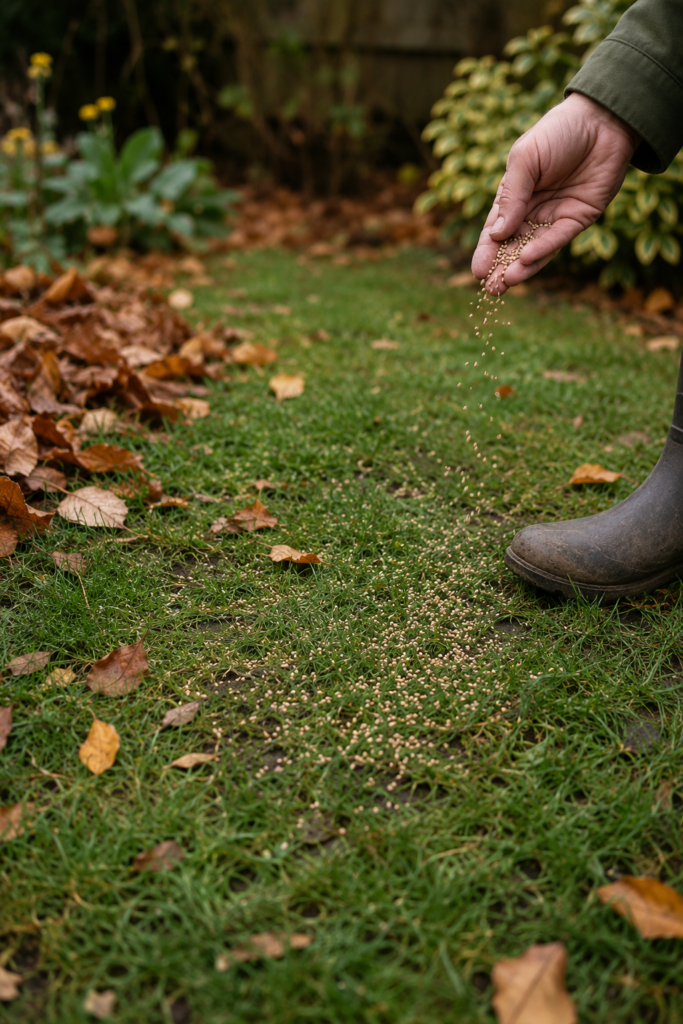
Autumn is also the time to naturalise spring-flowering bulbs into the lawn. Crocuses, snake’s-head fritillaries, and wood anemones all work well in grass, provided you can resist mowing until the foliage has died back — usually late May or June. They reward you with the earliest possible colour for pollinators emerging from winter torpor, and because they die back completely, the lawn can be managed normally for the rest of the summer.
Introducing Clover and Wildflowers Into Existing Grass
The most common question when overseeding is whether it’s really necessary to prepare the ground, or whether you can just scatter seed over existing grass and hope for the best. The honest answer is that preparation makes a significant difference, but even minimal disturbance helps.
Grass is highly competitive. Without bare soil contact, wildflower and clover seeds struggle to germinate because existing grass smothers them before they can establish. Scarifying — dragging a metal-tined rake firmly across the lawn to tear out thatch and scratch the surface — creates the conditions seeds need. You don’t need to remove all the grass, just disrupt it enough to expose patches of soil.
Timing Matters for UK Gardens
Spring (March to May) and early autumn (August to September) are both good windows for overseeding, but they suit different plants. Clover germinates well in warm spring soil and will establish by summer. Yellow rattle must go in fresh in autumn — late September is ideal — because the seed requires a period of cold before it will germinate. Native wildflower plug plants can go in at almost any time the soil is workable, though spring and autumn are least stressful.
Keep soil nutrient levels low if you’re aiming for wildflower diversity. This sounds counterintuitive, but most native wildflowers evolved in nutrient-poor conditions and are outcompeted by rank growth when soil is too fertile. If your lawn has been heavily fertilised over the years, don’t be discouraged — it may take two or three seasons of no feeding before wildflowers really start to thrive. Patience and low inputs are the two greatest tools you have.
What to Expect in the First Season
The first year of a wildlife-friendly lawn is typically the most underwhelming, and knowing this in advance saves a lot of anxiety. Grass is a survivor — it doesn’t give up its dominance easily, and wildflower seedlings can look distinctly unimpressive compared to the surrounding turf. This is normal.
What you will notice, even in year one, is wildlife responding to whatever blooms do appear. A patch of clover in full flower in June will have bumblebees working it within hours of opening. A dandelion left to set seed will bring goldfinches within a fortnight. The response is faster than you’d expect, and it’s one of the most genuinely cheering things about this kind of gardening — you don’t have to wait for the perfect end result before the benefits start arriving.
Mowing Strategy Through the First Season
In year one, mow the whole lawn relatively high (5–7cm) to give seedlings the best chance of establishing alongside the grass. Avoid mowing the designated wildflower or clover zones at all through the spring and early summer if you can bear it — or at least delay until after flowers have set seed. In late summer, cut those zones low, collect all the clippings, and then leave the area alone until spring.
Year two tends to be where things get genuinely exciting. Perennials root properly, yellow rattle (if sown) begins to suppress grass visibly, and the diversity of what appears in the lawn increases noticeably. If you’ve introduced your wildlife-friendly lawn as part of a broader habitat approach — adding a pond, log pile, or hedgerow plants elsewhere in the garden — you’ll see wildlife populations building meaningfully across the whole space.
“Can I Still Have a Nice-Looking Lawn?”
This is the real question for most of us, and the honest answer is: absolutely yes, and arguably a more interesting one.
The idea that a wildlife-friendly lawn must be a shaggy, unkempt mess is one of the most persistent myths in gardening. It comes from conflating “unmown” with “unmanaged” — but managed and mown aren’t the same thing. A lawn with a clearly edged, neatly mown path cutting through a wilder section looks deliberate and designed. A clover lawn is lush, green, and walkable. A partial meadow strip tucked behind a fence or along a boundary can be invisible from the street and transformative in its wildlife value.
The Neatness Principle
The key to a wildlife-friendly lawn that still looks good is contrast. Mown edges and paths signal intention — they tell visitors (and you) that this is a choice, not an accident. When the area around a tree base or the far corner of the garden is allowed to grow long, framing it with a clean-cut edge completely changes how it reads. You’re not neglecting the lawn; you’re curating it.
If you have neighbours who are likely to be concerned — or a landlord, or an active residents’ association — start with the least visible part of your garden. The strip along the back fence, the corner behind the shed, the edges beneath hedgerows. Once you’ve seen the results and gained confidence, you can expand from there. And it’s worth knowing that climate-friendly gardening is increasingly recognised as a positive rather than a sign of neglect — most people, when they see bees working a patch of clover, understand immediately why you’ve left it alone.
Managing Expectations for Different Garden Styles
A formal garden with clipped box hedges and geometric beds can absolutely incorporate a wildlife-friendly lawn — a clover-and-grass mix mown to a consistent height suits the style and adds ecological value without disrupting the aesthetic. A cottage garden benefits most from a partial meadow strip or unmown boundary, which complements the naturalistic planting elsewhere. A small urban garden might do best with a full clover lawn and a single unmown patch, maximising value in a limited space.
The point is that there’s no single wildlife-friendly lawn — there are dozens of interpretations, and you get to choose the one that works in your specific garden, for your specific lifestyle. The single non-negotiable is this: stop the fertiliser and weedkiller. Everything else is negotiable.
Regional Timing: When to Act Across the UK
The UK’s varied climate means that timing needs adjusting depending on where you garden, particularly when it comes to sowing seed and making cuts.
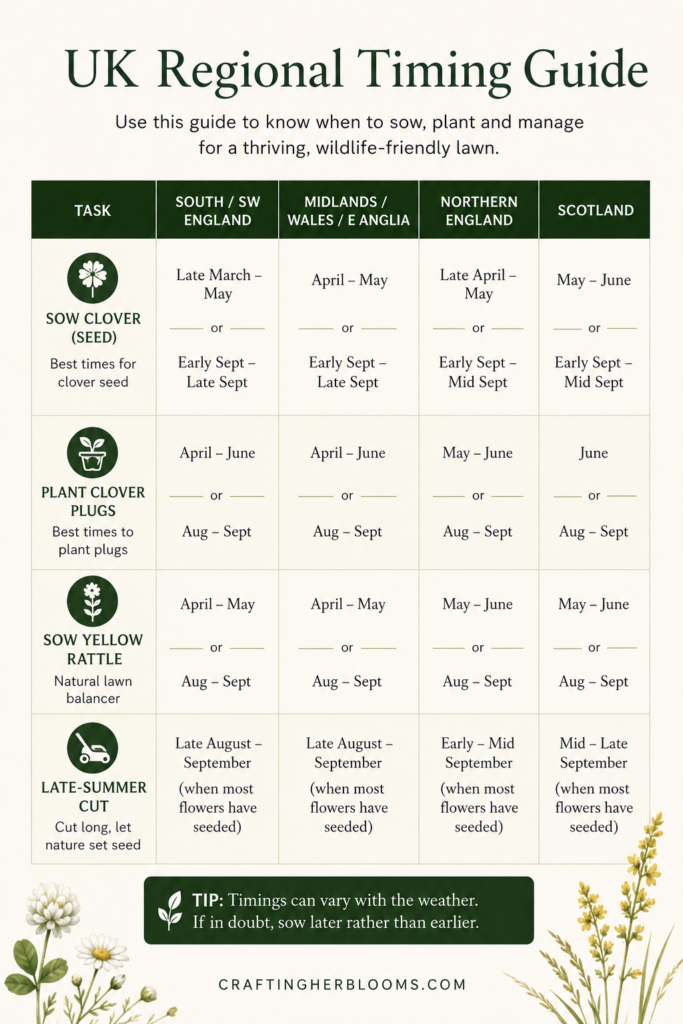
South and Southwest England can begin scarifying and overseeding from late March in most years. Spring comes earliest here, and soil temperatures warm sufficiently for clover germination by April. Wildflower plug plants establish readily from April onwards.
Midlands, Wales, and East Anglia should aim for mid-April as the starting point for spring overseeding, once the risk of hard frosts has passed and soil has warmed. September remains an excellent window for yellow rattle sowing across this zone.
Northern England is typically two to three weeks behind the south for soil warming, so late April or early May is a more reliable time to sow or plant. The longer summer days compensate with strong growing conditions from May through to August.
Scotland has the shortest reliable growing window, but wildflower meadow culture is well-established in Scottish gardens — native seed mixes suited to cooler, wetter conditions are widely available from specialist suppliers. Aim for May for spring work, and early September for autumn sowing.
Wherever you garden, the principle of following the soil rather than the calendar applies. A patch of grass that’s still cold and waterlogged in March won’t benefit from seed sown into it — wait until it’s genuinely warm and workable, and you’ll get far better results than rushing.
Frequently Asked Questions
Will a wildlife-friendly lawn attract more mosquitoes or pests? Long grass does provide shelter for some invertebrates, but it doesn’t meaningfully increase mosquito populations, which breed in standing water rather than in grass. The invertebrates that do shelter in longer grass — beetles, spiders, ground beetles — are actively predatory and help control pest species. A more biodiverse lawn tends to be more ecologically balanced overall, not more pest-prone.
What’s the minimum area that makes a difference? Even a square metre of clover or unmown grass makes a measurable difference to local pollinator populations. That said, the larger the area, the more species you can support — particularly for invertebrates that need territory to establish breeding populations. If you can dedicate even 10–15% of your lawn to wilder management, you’ll notice a significant change in the wildlife that visits.
Do I need to buy special wildflower seed mixes? Not necessarily. If you stop mowing and fertilising, you may find that wildflowers are already present in your lawn as dormant seeds and simply need the opportunity to appear. Daisies, dandelions, selfheal, yarrow, and clover are all common in UK lawns and will emerge on their own given the chance. Adding seed or plugs accelerates the process and introduces species that may not be present already, but it’s not a prerequisite for starting.
Is it too late to start if I’ve mown this week? Absolutely not. Stop the fertiliser now, raise the mowing height, and begin your preparation for clover or wildflower overseeding whenever the timing is right for your region. There’s no wrong time to start.
How does a wildlife-friendly lawn affect new grass seed or lawn repairs? If you’ve recently seeded a thin or bare patch, it’s worth letting that grass establish before overseeding with clover or wildflowers. Freshly germinated grass needs a full growing season to develop sufficiently — you’ll get better results if you wait until it’s properly established before introducing wildflowers alongside it. Understanding how often to water new grass seed through that establishment period sets you up for success.
What about lawn moss — will this make it worse? Moss thrives in compacted, shaded, or poorly drained soil rather than appearing as a direct consequence of reduced mowing. If your lawn has a moss problem already, dealing with the underlying cause — improving drainage, aerating, or addressing shade — is more useful than worrying about mowing frequency. Read more in our detailed guide to lawn moss control before making changes.
Your Wildlife-Friendly Lawn, One Step at a Time
The barrier to making a lawn work harder for wildlife has never been lower. You don’t need specialist knowledge, expensive equipment, or a willingness to live with a garden that looks like an abandoned field. You need to put the fertiliser away, raise the mowing height, and give the lawn a little breathing room.
Whether you’re drawn to the simplicity of a clover lawn, the quiet satisfaction of watching a partial meadow strip develop over a season, or simply the relief of mowing a little less often, the wildlife that lives in and around your garden will respond. Bumblebees, butterflies, beetles, birds — they’re looking for opportunities, and even a modest change in how you manage your grass creates them.
Start where you are. The lawn you have right now, today, is your starting point — not an obstacle. Give it less attention in the right places, a little more intention in others, and it will surprise you.
Continue Your Journey
How to Create a Wildlife Garden: The Complete UK Guide — The pillar post for this whole series, covering every habitat and approach from ponds to hedgerows to bird-friendly borders.
How to Create a Wildflower Meadow in a UK Garden — If this post has sparked the idea of going further, this guide covers the full meadow conversion process in detail.
Understanding Soil Types in Your UK Garden — Knowing whether you’re working with clay, sand, or loam shapes everything from seed germination to plant selection.
Lawn Moss Control: What Actually Works in UK Gardens — If moss is an issue before you begin, start here.
Climate-Friendly Gardening: How to Save Water and Support Nature — Reducing inputs and supporting biodiversity go hand in hand — this post explores the wider picture.
Are you letting part of your lawn grow wild this year, or planning to try clover? I’d love to hear how it goes — drop a comment below and let me know what you’re working with.
If you’d like more seasonal UK gardening guidance delivered straight to your inbox, sign up for the Crafting Her Blooms newsletter — practical, honest, and always timed to what’s actually happening in the garden right now.