The Complete UK Guide to Growing Your Own Vegetables

I sometimes use affiliate links in content. This doesn’t cost you anything but I may make a commission payment from anything you buy through these links. As an Amazon Associate I earn from qualifying purchases. All opinions remain my own.
There is something quietly transformative about eating a vegetable you grew yourself. The flavour is noticeably different — sharper, sweeter, more alive — and the satisfaction of harvesting something from your own patch of soil is genuinely hard to replicate. But beyond the romantic appeal, growing your own vegetables is eminently practical, particularly in the UK where food prices have risen sharply and garden centres are stocking an increasingly impressive range of seeds and young plants suited to our cool, wet climate.
This guide is designed to take you from a blank patch of ground (or a collection of pots on a patio) to a productive, well-planned vegetable garden. Whether you are a complete beginner working out where to start, or an enthusiastic grower looking to fill the gaps in your knowledge, you will find practical, UK-specific advice here for every stage of the process — from choosing where to grow and preparing your soil, through to harvesting, storing, and even keeping your plot productive through autumn and winter.
We cover the full cycle of the UK growing year, with a month-by-month planting calendar you can return to again and again. Let’s begin.

Why Grow Your Own Vegetables in the UK?
The case for growing your own is stronger than it has been in years. With supermarket vegetable prices considerably higher than they were a decade ago, even a modest raised bed growing salad leaves, courgettes, and a few rows of potatoes can make a meaningful dent in your weekly food bill over the course of a season. Homegrown vegetables also have a quality ceiling that commercial growing simply cannot reach — a tomato ripened on the vine in your greenhouse, or a handful of peas eaten straight from the pod, bears almost no resemblance to its shop-bought equivalent.
Forged & Grown
Garden pieces, printed to order
3D printed planters and garden accessories, made in the UK. Self-watering designs, sculptural shapes, colour options — each one made when you order it.


There is also a wellbeing dimension that UK growers are increasingly aware of. Time spent in the garden is broadly good for mental health, and the rhythm of a vegetable plot — sowing, tending, harvesting, resting — provides a satisfying structure to the year that many people find grounding. You are also doing something quietly valuable for the local ecosystem: vegetable plots that include a few flowers for pollinators, avoid synthetic pesticides, and build soil health through composting contribute meaningfully to urban and suburban biodiversity. If you are interested in gardening with nature in mind, you might enjoy our guide to eco-friendly gardening ideas alongside this one.
The UK climate — often dismissed as too grey and unpredictable — is actually well suited to a wide range of vegetables. Cool summers are ideal for brassicas, salad crops, root vegetables, and legumes. Our relatively mild winters mean some crops can be harvested year-round. The main challenges are late frosts in spring, slugs at almost every season, and the occasional summer that refuses to arrive — but none of these are insurmountable with a little planning.
Choosing Where to Grow
Before you order a single seed packet, it is worth spending time thinking honestly about your growing space and what it can realistically support. The RHS is clear that space is the greatest limitation when deciding what to grow, so crop choice should always match the area available. A small patio can support a surprisingly productive container garden; a modest back garden can yield a generous harvest from just one or two raised beds; an allotment plot opens up the full range of possibilities.
Allotments and Garden Plots
If you have access to an allotment or a dedicated kitchen garden area, you have the most flexibility. Full-sun, sheltered positions suit the widest range of vegetables — most crops want at least six hours of direct sun daily during the growing season. Avoid areas in permanent shade from buildings or trees, and be alert to frost pockets in low-lying spots where cold air pools on still nights.
A sheltered, sunny spot is the classic recommendation, and for good reason. Wind is a significant problem for taller crops like tomatoes, beans, and sweetcorn — staking and shelterbelts (low hedges, willow screens, or even a temporary windbreak net) make a real difference on exposed sites.
Raised Beds and Garden Borders
Raised beds have become the most popular format for home vegetable growing in the UK, and for understandable reasons. They allow you to build an ideal growing medium regardless of what lies beneath, they warm up faster in spring, they drain better in wet weather, and they keep the growing area clearly defined. A standard raised bed of around 1.2 metres wide allows you to reach the centre from both sides without stepping on the soil, which matters enormously for maintaining soil structure over time.
If your garden soil is heavy clay or very sandy, raised beds filled with a good-quality topsoil and compost mix will outperform anything you could grow in the native ground. Borders can also be pressed into service for vegetables — many crops look attractive and fit naturally alongside ornamental planting.
Containers, Grow Bags, and Window Boxes
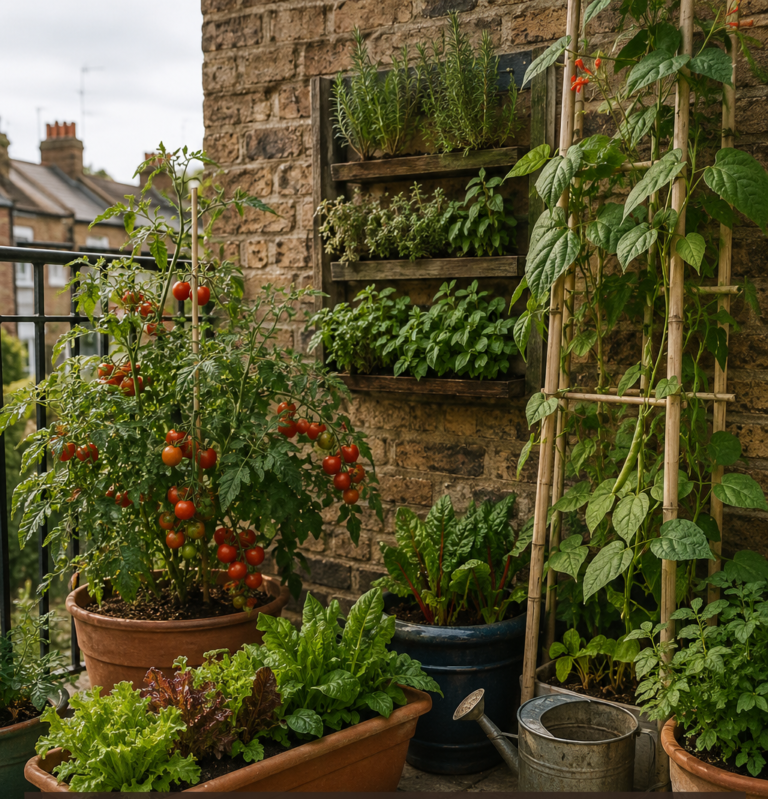
Container growing has expanded dramatically in scope over the past decade. A south-facing patio or balcony fitted with large pots, troughs, and grow bags can produce a genuinely impressive range of vegetables. Tomatoes, chillies, dwarf French beans, lettuce, radishes, beetroot, spring onions, herbs, and even compact courgette varieties all perform well in containers if fed and watered consistently. The key limitations are pot size (bigger is almost always better), watering frequency (containers dry out quickly in warm weather), and feeding (nutrients are exhausted much faster than in open ground).
Grow bags remain a practical choice for tomatoes and cucumbers in greenhouses or on sunny patios. Window boxes work well for cut-and-come-again salad leaves, spring onions, and herbs — a productive harvest from a small footprint.
Understanding Your Soil
Soil is the foundation of everything in a vegetable garden, and time spent understanding and improving it pays dividends for years. The good news is that most UK garden soils can be made productive with relatively straightforward interventions.
Soil Types
The UK has a wide variety of soil types, from the heavy clay soils common in much of the Midlands and south-east, to the lighter, sandier soils of East Anglia and parts of the south. Clay soils hold water and nutrients well but can be waterlogged in winter and baked hard in summer; sandy soils drain quickly and warm early in spring but dry out fast and need more feeding. The ideal vegetable garden soil — a fertile, well-structured loam — can be approximated in almost any soil type through consistent addition of organic matter.
Improving Your Soil
The single most effective thing you can do for a vegetable garden is add well-rotted compost or manure every year. Dig it in before planting, or use it as a mulch and allow worms to incorporate it over time. Organic matter improves drainage in clay soils, increases water retention in sandy soils, feeds soil microbes, and provides a slow release of nutrients for growing crops. Making your own compost is the most sustainable and cost-effective approach — kitchen vegetable scraps, garden prunings, cardboard, and coffee grounds all break down into a rich material that vegetable crops love. You can read more about building a compost system in our piece on wildlife-friendly composting.
Soil pH also matters. Most vegetables prefer a slightly acid to neutral soil, around pH 6.0–7.0. Brassicas (cabbages, broccoli, kale, cauliflower) prefer a slightly higher pH and benefit from liming if your soil is acidic. A simple soil pH test kit — available cheaply from any garden centre — will tell you where you stand.
Raised Bed Soil Mixes
If you are building raised beds from scratch, a good starting mix is roughly 60% topsoil to 40% well-rotted compost. Some growers add horticultural grit to improve drainage, particularly for root crops like carrots and parsnips that can fork in heavy soils. Avoid using subsoil or material dug from lower in the garden — it will compact and drain poorly.
Planning What to Grow
Good vegetable garden planning starts with honesty about two things: what you actually eat, and how much time you have available. There is little point in growing a large crop of leeks if your household does not eat them, or committing to time-intensive crops like celeriac when your schedule is already stretched.
Start with What You Eat
The RHS advises gardeners to grow only what they genuinely like, to avoid wasting space on crops they will not use. This sounds obvious but is easy to overlook when confronted with an exciting seed catalogue in February. Focus first on the vegetables your household eats regularly — salad leaves, tomatoes, potatoes, courgettes, and peas are all good starting points because they are widely enjoyed, genuinely improve in flavour when homegrown, and are relatively straightforward to manage.
Group Crops Sensibly
A useful planning framework is to group your crops by family or type, as this supports good rotation practice. The main groups relevant to most UK kitchen gardens are:
- Brassicas: Cabbage, broccoli, kale, Brussels sprouts, cauliflower, swede, turnips
- Roots and alliums: Carrots, parsnips, beetroot, onions, garlic, leeks
- Legumes: Peas, broad beans, French beans, runner beans
- Potatoes and tomatoes (Solanaceae): Potatoes, tomatoes, chillies, aubergines, peppers
- Salads and leaves: Lettuce, rocket, spinach, chard, oriental leaves
Rotating these groups around different beds each year reduces the build-up of soil-borne diseases and pests that target specific plant families. A simple three- or four-bed rotation — moving each group one bed clockwise each year — is manageable and effective.
Crop Rotation in Practice
Classic UK rotation runs: potatoes → brassicas → roots/onions → legumes, then repeat. This works because potatoes and brassicas are hungry, heavy-feeding crops that deplete nutrients, while legumes fix nitrogen back into the soil, and roots follow where the soil has been deeply dug. It is a logic that has been refined by generations of UK kitchen gardeners and holds up well in practice.
Best Vegetables for Beginners
The crops that tend to give beginners confidence are those that germinate reliably, grow quickly, produce a generous harvest relative to the effort invested, and are forgiving of occasional lapses in care. This list is a solid foundation.
Salad Leaves
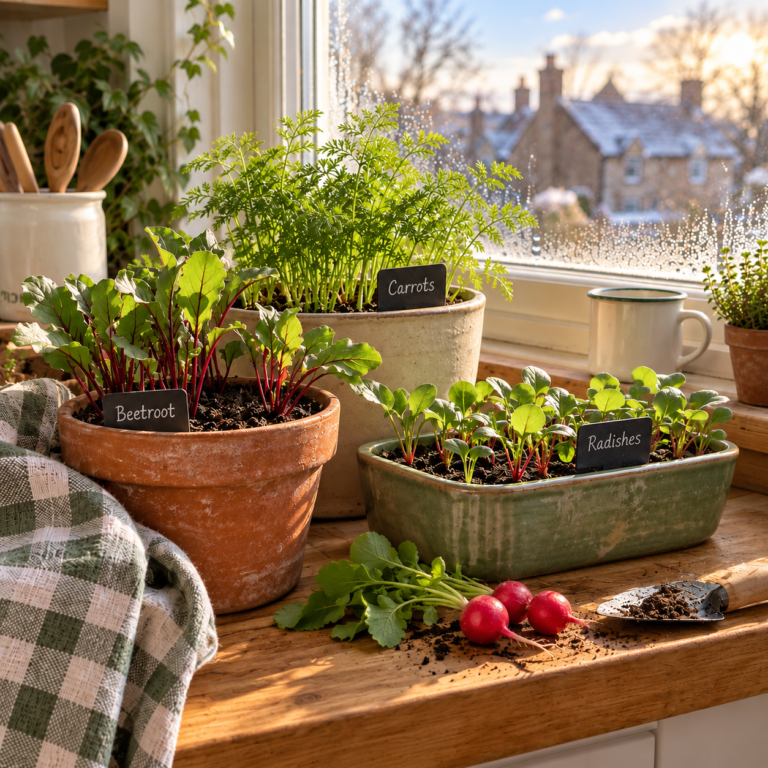
Salad leaves are the ideal starting point for any new vegetable gardener. Cut-and-come-again varieties of lettuce, rocket, spinach, and mixed leaf blends can be sown in small batches from March onwards, and will provide harvests within four to six weeks of sowing. Sow a small row every three weeks through spring and summer for a continuous supply. They perform brilliantly in containers, are fast enough to show results quickly, and can even be grown on a windowsill in winter. For more ideas on year-round indoor growing, our post on winter windowsill vegetables has plenty of inspiration.
Radishes
Radishes are perhaps the most instant-gratification crop in the vegetable garden — some varieties are ready to harvest just three weeks after sowing. They work well as a catch crop between slower-growing plants, and children tend to find them enormously satisfying to grow. Sow direct from March to August for a succession of harvests.
Beetroot
Beetroot is reliably easy in UK conditions. Sow direct or in modules from April onwards, thin to around 10cm apart, and harvest from July onwards. Roasted, pickled, or grated raw into salads, it is one of the most versatile homegrown vegetables. Varieties like ‘Boltardy’ are particularly reliable and bolt-resistant for early sowings.
Peas
Fresh garden peas are one of those crops where the flavour gap between homegrown and shop-bought is so vast that it almost feels like a different vegetable. Sow direct from March outdoors (or February under cover), provide a support of netting or sticks for the plants to climb, and harvest when the pods feel full but before they start to yellow. Mangetout and sugar snap varieties need no shelling and are equally easy.

Potatoes
Potatoes are deeply satisfying to grow because the harvest — lifting a nest of fresh tubers from the ground — feels genuinely exciting every time. Chit (pre-sprout) your seed potatoes on a windowsill in February, plant first early varieties in March (with frost protection ready), and harvest first earlies from June onwards. Maincrop varieties planted in April give a larger harvest from August onwards. Even a large tub or bucket can grow enough potatoes for several meals.
Courgettes
A single courgette plant can produce more fruit than a family can reasonably eat in a season, which makes them excellent value for the space. Sow indoors in April, harden off carefully, and plant out after the last frost — in most of the UK, late May is safe. Keep them well watered and feed weekly once they start flowering. Harvest regularly when the courgettes are still small for the best flavour and to keep the plant producing.
Tomatoes
Tomatoes are arguably the most rewarding crop in the UK kitchen garden, though they do need attention. Sow indoors in late February or March, grow on in warmth, harden off, and plant out in a greenhouse, polytunnel, or sheltered spot outdoors once all frost risk has passed (usually early June in most of England and Wales, later in Scotland). Choose varieties specifically bred for UK conditions: ‘Gardener’s Delight’, ‘Tumbling Tom’, and ‘Sungold’ are all reliable performers.
Growing from Seed vs Buying Plants
Both approaches have their place, and the right choice often depends on the crop, your growing space, and how much time you can dedicate to raising seedlings.
The Case for Seed
Seed is dramatically cheaper than buying young plants, and the range available — particularly from specialist UK seed companies like Real Seeds, Higgledy Garden, and Kings Seeds — is far wider than anything you will find at a garden centre. Starting from seed also means you control exactly when your plants are raised and can time them precisely to your conditions. For direct-sown crops like carrots, beetroot, parsnips, peas, and radishes, sowing straight into the ground is not just cheaper — it is actually the better method, because these crops dislike root disturbance.
When to Buy Young Plants
Young plants come into their own for crops where indoor propagation is genuinely tricky — aubergines, peppers, and celery, for instance, need a long growing season and specific warmth to develop well, and buying plug plants in May is a sensible shortcut. Young brassica plants are also widely available and convenient if you do not have space to raise trays of seedlings indoors. For beginners uncertain about their germination setup, buying a few young tomato or courgette plants in late spring is a perfectly reasonable way to guarantee a first harvest.
Module Sowing
Module sowing — raising seedlings in small individual cells rather than open trays — has transformed home vegetable growing because it produces sturdier plants with minimal root disturbance at transplanting. A heated propagator or even a warm windowsill is sufficient for most seeds. Brassicas, lettuce, leeks, onions, and many herbs all do well raised in modules.
UK Vegetable Planting Calendar
The UK growing year is largely governed by frost risk and soil temperature. In broad terms, the season runs from late February (under cover) to October (outdoors), with a productive autumn and winter for hardy crops. The table below gives a month-by-month overview of the key sowing and planting jobs.
Spring: The Main Growing Season Begins
March marks the true start of the outdoor sowing season for most UK gardeners. Soil temperatures are beginning to climb above 7°C — the minimum at which most vegetable seeds will germinate — and day length is increasing rapidly. Direct sow hardy crops: broad beans, peas, radishes, beetroot, spinach, rocket, and early carrots. Start tender crops like tomatoes, peppers, chillies, aubergines, courgettes, cucumbers, and sweetcorn indoors on a warm windowsill or in a propagator.
April brings the planting of early potatoes in most of England and Wales (later in Scotland and northern England). Outdoor sowing continues and expands: lettuce, spring onions, chard, kale, broccoli, and cauliflower can all go in. If late frosts are forecast — and in April they frequently are — keep fleece handy to cover vulnerable seedlings overnight.
May is the transition month: early in the month, frosts remain possible almost everywhere in the UK, but by late May most areas have moved past significant frost risk. Plant out tender crops — tomatoes, courgettes, cucumbers, French and runner beans, sweetcorn — only once night temperatures are consistently above 10°C. Harden off plants raised indoors carefully over ten to fourteen days before planting out.
Summer: Maintaining Momentum
June and July are the months of peak production on the vegetable plot. Courgettes need daily harvesting; tomatoes require regular feeding and side-shoot removal (for cordon varieties); peas and beans need consistent picking to keep them flowering. Watering is the primary job — deeply and infrequently rather than little and often, to encourage roots to grow downward. Mulching with compost or grass clippings around plants conserves moisture and suppresses weeds simultaneously.
Keep sowing fast crops through summer for continuity: successive sowing of lettuce, radish, and beetroot every three weeks ensures you never have a glut followed by a gap.
Autumn and Winter: The Garden Doesn't Stop
One of the most underrated aspects of UK vegetable growing is how productive the plot can remain through autumn and even winter. Hardy crops — kale, Brussels sprouts, leeks, parsnips, celeriac, and cabbages — stand in the ground through frost and provide fresh harvests when little else is available. Some, like parsnips and Brussels sprouts, actually improve in flavour after a hard frost.
September is the time to plant overwintering salad crops under cover: cold-hardy lettuces and oriental leaves like mizuna, mustard, and pak choi will provide pickings through the colder months if grown in a cold greenhouse, polytunnel, or under cloches. Garlic goes in from October onwards, planted in well-drained soil for harvesting the following summer.
Watering, Feeding, and Mulching
Getting Watering Right
The most common watering mistake in UK vegetable gardens is watering too lightly and too frequently. Light watering wets only the surface of the soil, which encourages roots to stay shallow and makes plants more susceptible to drought stress during dry spells. Water deeply and less often — aim to moisten the soil to a depth of 20–30cm — and allow the surface to dry slightly between watering. The exception is containers and grow bags, which do need more frequent attention and will dry out faster than open ground.
Seedlings in their first few weeks need more careful attention, as their roots are shallow. Once established, most crops are considerably more drought-tolerant than often assumed. A good soaker hose or drip system can take most of the labour out of summer watering.
Feeding Your Crops
Vegetables are hungry plants. In open ground with well-prepared, compost-enriched soil, many crops need little additional feeding beyond what the soil already provides. Hungry crops — tomatoes, courgettes, squash — benefit from a weekly liquid feed once they start flowering, using a high-potassium feed (tomato feed works well). Brassicas planted in well-prepared soil rarely need additional nitrogen during the growing season. Container crops are the exception: they need regular feeding throughout the season because nutrients leach out rapidly through watering.
The Power of Mulching
Mulching is one of the most effective and underused techniques in the UK vegetable garden. A layer of well-rotted compost, wood chip, or even cardboard laid around your plants conserves soil moisture, suppresses annual weeds, adds organic matter as it breaks down, and moderates soil temperature — keeping it warmer in cold spells and cooler during heat. Apply mulch in spring once the soil has warmed, keeping it away from plant stems to avoid rotting.
Common UK Pests and Problems
Every vegetable garden has its challenges, and the UK's mild, damp climate creates specific conditions that favour certain pests and diseases. Understanding the most common problems makes them manageable rather than catastrophic.
Slugs and Snails
The perennial nemesis of UK gardeners. Slugs and snails are most active in warm, damp weather and cause the greatest damage to seedlings and young plants. Physical barriers — copper tape, grit or eggshell mulch, upturned grapefruit halves as traps, and encouraging natural predators like hedgehogs, frogs, and ground beetles — are the most sustainable approach. Where the pressure is severe, organic ferric phosphate slug pellets (wildlife-safe) can be used sparingly. Raising seedlings in modules and planting them out when more established reduces vulnerability considerably.
Cabbage Whites and Caterpillars
The caterpillars of the large and small white butterfly can devastate brassica crops. The only truly reliable control is fine mesh netting over the entire crop to prevent adults from laying eggs on the leaves. Check the undersides of leaves regularly for clusters of yellow eggs and remove them by hand. Companion planting — growing nasturtiums nearby as sacrificial plants, or intercropping brassicas with strongly scented herbs — can help reduce butterfly pressure. Our guide to companion planting goes into this in depth.
Aphids
Aphid colonies, particularly blackfly on broad beans and whitefly on brassicas and tomatoes, can build up quickly in warm weather. Encouraging aphid predators — ladybirds, lacewings, and hoverflies — by planting flowers throughout the vegetable garden is a highly effective long-term strategy. A strong spray of water knocks aphid colonies off plants and disrupts their feeding. Pinching out the soft growing tips of broad beans once they are well into flower removes the site that blackfly most often colonise.
Blight
Potato and tomato blight is a fungal disease that spreads in warm, humid conditions and can devastate crops within days. In the UK, the blight risk period typically runs from late June to September. Growing blight-resistant varieties (Sarpo Mira for potatoes; Crimson Crush or Ferline for tomatoes) significantly reduces the risk. Removing and destroying any infected material promptly, ensuring good airflow around plants, and avoiding overhead watering are all helpful.
Crop Rotation as Prevention
Many pest and disease problems are made significantly worse by growing the same crop family in the same ground year after year. Rotation breaks pest and disease cycles, and maintaining it consistently — even in a small garden, across just two or three beds — makes a measurable difference over time.
Harvesting and Storing Your Vegetables
Knowing when to harvest is a skill that develops with practice, but there are reliable indicators for the most common crops.
Knowing When to Pick
Salad leaves are best cut young — once they are large enough to be useful, before bitterness sets in. Courgettes should be picked at 15–20cm for the best flavour; leaving them to swell into marrows reduces quality and stops the plant producing new fruits. Peas and beans should be picked regularly as soon as the pods fill out — if you allow them to mature to seed, the plant stops flowering. Root vegetables like carrots and parsnips are ready once they have reached a usable size; parsnips are actually best left until after the first frosts, when cold weather converts starch to sugar and the flavour intensifies.
Tomatoes should be harvested when fully coloured and give slightly to gentle pressure. If autumn arrives and you still have green tomatoes on the vine, bring them indoors to ripen at room temperature (not in the fridge).
Storage
Most fresh vegetables are best eaten as soon as possible after harvest, but for practical household cooking, some storage is always needed. Potatoes store excellently in a cool, dark, frost-free place — a hessian sack in a garage or shed is ideal. Onions and garlic need to be dried in the sun or under cover until the skins papery before storing in a cool, dry place with good airflow. Root vegetables like carrots, parsnips, and beetroot can be left in the ground and harvested as needed through winter, or stored in boxes of barely damp sand in a frost-free shed.
Growing Through Autumn and Winter
The UK's most committed vegetable growers treat the plot as a twelve-month productive space, and the autumn and winter months offer genuine rewards for those who plan ahead.
Hardy Crops for Winter Harvests
Kale is among the most productive and foolproof crops for UK winter growing. It tolerates hard frosts without damage, provides nutritious leaves from November onwards, and a single plant can produce harvests for months. Varieties like 'Cavolo Nero', 'Red Russian', and 'Redbor' are all excellent. Brussels sprouts — a crop that divides opinion, but which tastes genuinely different when harvested fresh from the garden — are planted in spring and harvested from November onwards. Leeks, cabbages, parsnips, and celeriac all contribute to a rich mid-winter harvest.
Extending the Season Under Cover
A cold greenhouse, polytunnel, or even simple cloches extend the productive season significantly. In an unheated greenhouse, salad crops will continue to provide small but useful harvests through January and February. Overwintering spinach, hardy oriental leaves, land cress, and winter purslane all tolerate the cold and produce fresh greens during the hungry gap — the period from roughly February to April when outdoor crops are scarce.
Winter is also the time to plan the following year's plot, order seeds before popular varieties sell out, and turn the compost. A well-kept vegetable garden through winter is ready to spring into action the moment soil temperatures begin to rise again in February.
Putting It All Together
Growing your own vegetables in the UK is one of the most rewarding things you can do with a patch of outdoor space. The learning curve is real but shallow: a season or two of experience teaches you more than any book can. Start conservatively — a few reliable crops you know you will use — and expand each year as your confidence and knowledge grow.
The most important principles are simple: prepare your soil well, choose varieties suited to UK conditions, keep on top of sowing dates, water and feed consistently, and deal with pests promptly. None of this requires expensive equipment or specialist knowledge. What it does require is regular attention and a willingness to observe your plants and respond to what they are telling you.
Vegetable growing connects you to the rhythm of the year in a way that very little else does. By this time next year, you could be harvesting your own fresh peas in June, lifting new potatoes in July, and cutting homegrown kale through the depths of winter. Start with a small bed, a few packets of seeds, and a good layer of compost. The rest follows from there.
Continue Your Journey
- Foods to Plant in May: A UK Grower's Guide — your next seasonal planting guide with detailed variety recommendations
- Best Winter Windowsill Vegetables — keep growing through the cold months without any outdoor space
- Companion Planting Guide — use plants together strategically to manage pests and improve yields
- Eco-Friendly Gardening Ideas — grow vegetables in a way that benefits the wider garden ecosystem
- Wildlife-Friendly Composting — build the compost habit that underpins every productive vegetable garden
Over to you: What is the first vegetable crop you ever grew, and what would you do differently now? Share your experience in the comments — your insights could be exactly what a fellow reader needs to hear.
If this guide has been useful, you might also enjoy joining our newsletter — we send seasonal growing prompts, variety recommendations, and fresh content from the blog straight to your inbox.