The New Cottage Border: Nostalgic Shrubs, Fruiting Plants, and the UK Gardens Getting It Right

I sometimes use affiliate links in content. This doesn’t cost you anything but I may make a commission payment from anything you buy through these links. As an Amazon Associate I earn from qualifying purchases. All opinions remain my own.
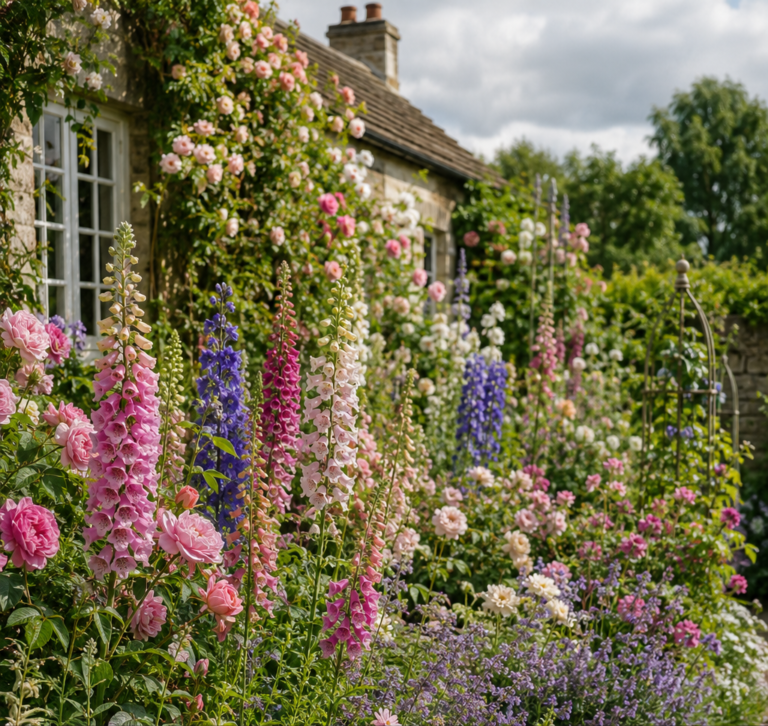
There is a particular kind of garden that stops you in your tracks. It is not a formal garden with clipped edges and colour-coded bedding. It is a border that looks as though it simply happened — full, layered, fragrant, and quietly abundant. A peony lolling over a low stone wall. The scent of lilac drifting past the kitchen window in May. Gooseberries ripening quietly at the back of the border between two hydrangeas. This is the cottage garden at its best, and it is having a proper revival in British gardens right now.
What is driving that revival is something more interesting than nostalgia alone. Gardeners who fell in love with the romantic look of peonies and forsythia are now asking whether their borders can do more — whether beauty and productivity can share the same space without either one suffering. The answer, as any traditional cottage gardener would tell you, is yes. The original cottage garden was never purely ornamental. It was a practical, productive, layered space where flowers and food grew alongside one another as a matter of course. The modern version of that idea — heritage charm with genuine usefulness — is exactly what makes this style of planting so compelling for UK gardens today.

This post is about the plants at the heart of that tradition: the classic cottage-garden shrubs and perennials that form the backbone of a border, and the fruiting plants that can be woven among them without losing the romantic feel. Whether you are working with a narrow bed against a fence, a long curved border, or an established patch that needs rethinking, the principles are the same.
Why the Cottage Border Works So Well in the UK
The British climate is, despite everything, well suited to the cottage garden aesthetic. The mild, damp conditions that gardeners often curse produce exactly the lush, full growth that makes a cottage border sing. Peonies thrive in the cool springs we reliably get, hydrangeas appreciate the even moisture in our soil, and lilacs are entirely at home in the kind of temperate climate that the UK provides across most of its regions.
Forged & Grown
Garden pieces, printed to order
3D printed planters and garden accessories, made in the UK. Self-watering designs, sculptural shapes, colour options — each one made when you order it.


There is also a cultural resonance at work. Cottage planting has deep roots in British gardening history — in the kitchen gardens of country houses, the allotments of industrial towns, the dooryard gardens of rural cottages where flowers and vegetables grew side by side out of necessity. Reconnecting with that tradition feels meaningful at a time when many gardeners are increasingly interested in growing some of their own food, reducing their environmental footprint, and creating spaces that genuinely support wildlife.
The Layered Structure That Makes It All Work
A cottage border succeeds or fails on its structure. The classic approach is layered planting: tall plants at the back, medium shrubs in the middle, and lower fillers at the front. This sounds simple, but it takes some thought to execute well, particularly when you are mixing flowering shrubs with fruiting plants that have their own size and spread requirements.
A useful way to think about it is in three distinct bands. At the back of a border, you want height and structure — standard or half-standard fruit trees, taller shrubs like lilac or established hydrangeas, or a trained apple against a wall or fence. The middle zone is where the real cottage-garden magic happens: peonies, forsythia, compact hydrangeas, currant bushes, and the medium-height perennials that billow softly around them. The front is for ground-level interest and softening — lady’s mantle spilling over a path, hardy geraniums weaving between the legs of taller plants, low herbs providing scent and useful harvest.
The Cottage Border Planner
Click any plant to reveal its growing notes. Each column represents a layer of your border.
Click any plant card to expand growing notes · All plants suited to UK conditions
What makes this structure work in a practical sense is that each layer has a slightly different moment of peak interest. Forsythia blazes in early spring before most other plants are properly awake. Peonies arrive in May and June with their extraordinary, brief display. Hydrangeas carry the border through late summer when many spring-flowering shrubs have gone quiet. The fruit — whether gooseberries ripening in July, currants in August, or apples hanging through September — gives the border a reason to be visited right through the season.
The Classic Shrubs: Beauty, Scent, and Backbone
Peonies: The Undisputed Heart of the Cottage Border
Few plants carry quite the emotional weight of a peony in full bloom. They are lush, extravagant, and deeply nostalgic — the sort of plant that makes you feel as though you are standing in a garden from another era. They are also, once established, genuinely low-maintenance, which makes them far more practical for a UK border than their glamorous appearance might suggest.
Peonies prefer a sunny or lightly shaded spot with free-draining soil, and they dislike being disturbed once settled, so the position matters. Plant them with the buds no more than 2–3cm below the surface — too deep and they will produce generous foliage but few or no flowers. This is one of the most common reasons peonies fail to perform in British gardens, and it is entirely avoidable. They need very little else: a mulch of garden compost in spring, a stake or peony ring for support in exposed positions, and the patience to leave them undisturbed for several years while they establish.

The varieties available for UK gardens run from the classic blowsy doubles — ‘Sarah Bernhardt’ in shell-pink, ‘Karl Rosenfield’ in deep crimson — to the simpler, single-flowered types that are particularly good for wildlife and that have a more relaxed, meadow-like quality in the border. For cottage planting, the doubles are the traditional choice, but the singles work beautifully if you want a slightly less formal look or if you are growing alongside wildflowers.
Peonies pair exceptionally well with other cottage staples. The combination of peonies, lady’s mantle, and hardy geraniums in the middle of a border creates the kind of soft, billowy planting that defines the cottage aesthetic. For a more dramatic effect, grow them alongside delphiniums or alliums, which flower at a similar time and provide the vertical contrast that peonies, with their rounded habit, tend to lack.
Hydrangeas: Structure and Colour from Midsummer Onwards
Hydrangeas earn their place in a cottage border by doing something very few other shrubs can manage: providing substantial late-season interest without any fuss. They flower from July onwards, carrying the border through that awkward period after the first flush of summer colour when many gardens start to look tired.
For border planting, the mophead and lacecap hydrangeas (Hydrangea macrophylla) are the most commonly grown in the UK, and they are genuinely versatile. They prefer evenly moist soil — the kind of conditions that British gardens often provide naturally — and they appreciate a little shelter from cold winds, particularly in northern gardens. Spring or autumn are the best times to plant, giving the roots time to establish before they face the full demands of flowering. If you have a shadier spot that needs filling, the climbing Hydrangea anomala petiolaris is remarkable against a north- or east-facing wall and has a certain wild, romantic quality that suits cottage planting well.
Compact varieties have opened up hydrangeas for smaller borders. ‘Magical Revolution Red’ stays under a metre, while ‘Incrediball’ and ‘Incrediball Blush’ produce enormous blooms on a manageable shrub. For a traditional mophead in mid-pink, ‘Mme Emile Mouillère’ is hard to fault. All of these work well in the middle tier of the border, providing structure and late colour while taller plants take the back positions.
The pairing of hydrangeas with penstemons and low ornamental grasses has become something of a signature of the modern British mixed border, and it is particularly effective when you are aiming for that layered, just-planted look where plants seem to have discovered one another naturally.
Lilac: Scent, Romance, and a Brief but Glorious Season
Lilac is perhaps the most evocative of all cottage-garden shrubs. Its scent — rich, sweet, slightly powdery — is one of those smells that places you immediately in a particular kind of garden, usually someone else’s grandmother’s, usually in May. The timing is part of its charm: lilac blooms for two to three weeks, during which it is almost overwhelming in its generosity, and then it quietly retreats to being a large, undemanding shrub for the rest of the year.
For UK gardens, lilac performs best in full sun and well-drained soil, and it dislikes heavy clay unless the drainage has been improved. The common lilac (Syringa vulgaris) can become quite large over time — up to four or five metres in a favourable position — so it suits the back of a border better than the middle. Compact varieties like ‘Palibin’ (Syringa meyeri) are a better choice for smaller gardens, staying under two metres and offering a slightly later, slightly smaller flower.
Pruning lilac requires a little knowledge: the flowers form on wood produced in the previous year, so heavy pruning in winter or early spring will remove the flowering wood and result in a flowerless season. The right approach is to deadhead immediately after flowering and remove any obviously crossing or dead stems, leaving the new growth to develop into next year’s flowers.
Forsythia: The Easiest Early-Season Shrub You Can Grow
Forsythia divides gardeners almost as sharply as privet hedges used to, but its virtues in a cottage border are real. It is almost indestructible, tolerating a wide range of soils and positions, flowering reliably every year in February and March before most other plants are showing any sign of life, and providing a genuinely bright, warm note at the darkest point of the gardening year.

The key to making forsythia look intentional rather than incidental in a border is pruning. Left to its own devices, it becomes a large, floppy, rather untidy shrub that can swamp neighbouring plants. Pruned immediately after flowering — cutting back flowered stems by about a third to a half — it stays compact and shapely, and the relationship between its late-winter display and the spring bulbs planted around its base becomes something genuinely beautiful rather than accidental. Crocuses, snowdrops, and early daffodils underplanted around forsythia make it look as though the whole thing was carefully orchestrated, even when it wasn’t.
For border use, ‘Lynwood Variety’ and ‘Week End’ are reliable UK choices, with good flower cover and manageable size. The variegated ‘Fiesta’ is smaller and more contained, with attractive foliage interest through the growing season once flowering is over.
Weaving in the Fruit: The Cottage Garden’s Productive Heart
The traditional cottage garden was never exclusively ornamental. Currants grew alongside hollyhocks. Gooseberry bushes occupied the middle ground between roses and lavender. Apple trees cast dappled shade over the vegetable patch at the back. This mixing of ornament and produce is not merely charming — it is genuinely useful, particularly in smaller British gardens where every square metre has to earn its keep.
Fruit Trees as Structural Anchor Points
A well-chosen fruit tree can be the making of a cottage border. A cordon-trained apple against a sunny fence, a half-standard pear at the back of a long bed, a crab apple in a position where its blossom can be appreciated from the house — all of these bring height, seasonal interest, blossom for pollinators, and ultimately fruit, without sacrificing the border’s ornamental character.
Crab apples are particularly valuable in this context because they earn their place across the full year. The blossom in April and May rivals anything in the spring garden, the fruit persists well into winter, providing food for birds when it is most needed, and some varieties — ‘Evereste’ and ‘John Downie’ are both excellent UK choices — colour magnificently in autumn. Crab apple jelly, if you want to use the fruit, is one of the most underrated pleasures of the productive garden.
For apples and pears in borders, the rootstock matters. A tree on a dwarfing rootstock (M27 for apples, Quince C for pears) stays small enough for a border without dominating it, while a semi-dwarfing rootstock (M26 for apples) gives a slightly larger tree that still suits a medium to large border. If you are thinking about growing fruit trees and want a fuller guide to getting started, the post on growing raspberries covers some of the practical principles of productive garden planting that translate well to other fruiting plants.
Currants and Gooseberries: The Unsung Heroes of the Mixed Border
Redcurrants, whitecurrants, and gooseberries are almost perfectly adapted to the conditions of a mixed border. They are tolerant of partial shade, which makes them useful in spots that would be unsuitable for sun-demanding fruit. They can be trained as cordons against a fence or wall, taking up very little horizontal space, or grown as free-standing bushes in the middle tier of a border where they provide genuine structural interest.
Redcurrants in full fruit are one of the most beautiful sights in the summer garden — the strigs of translucent red berries catching the light like clusters of small rubies. Whitecurrants are even more elegant and considerably less familiar, which makes them a talking point as well as a practical choice. ‘Blanka’ and ‘White Versailles’ are both reliable UK varieties.

Gooseberries have the particular advantage of tolerating quite difficult conditions — shade, clay, exposed positions — that would challenge most other fruiting plants. Varieties like ‘Invicta’ and ‘Hinnonmaki Red’ are both disease-resistant and productive, with the latter offering small, dark-red fruit that looks genuinely ornamental among flowering plants.
The underplanting around these fruiting shrubs is where you can really bring in the cottage aesthetic. Hardy geraniums, lady’s mantle, and low herbs like thyme and chives work beautifully around the base of a currant or gooseberry bush, covering the bare soil, suppressing weeds, and adding an additional layer of interest and harvest.
Raspberries: Height, Structure, and an Exceptional Summer Crop
Raspberries in a border are a slightly less obvious choice than currants or gooseberries, but they work well in the right position. The canes provide height and a certain informality at the back of a border, and the fruit — coming in July for summer varieties, September and October for autumn-fruiting types — extends the productive season beautifully.
The key consideration is support. Raspberries need posts and wires, or some equivalent structure, to keep the canes upright and prevent them from leaning into neighbouring plants. In a cottage border, this structure can be made to look intentional — willow or hazel stakes have a natural quality that suits the style — rather than purely functional. The detailed practical side of growing this crop is covered in the guide to growing raspberries.
Quinces: The Most Romantic Fruiting Shrub in the British Garden
The quince (Cydonia oblonga) deserves far wider planting than it currently enjoys in British gardens. It is a beautiful tree or large shrub in every season: the blossom in May is a pale, blowsy pink with an almost old-fashioned quality that fits the cottage garden perfectly; the large, golden fruit in October is visually spectacular; and the leaves in autumn turn a warm yellow before they fall. The fruit requires cooking rather than eating fresh, but quince paste, quince jelly, and quince poached in red wine are some of the most extraordinary things a garden can produce.
The flowering quince (Chaenomeles), which is different from the fruiting quince, offers similar ornamental value in a smaller, more manageable plant. Trained against a wall, it produces flowers in shades from deep crimson to white as early as February, and the small, hard fruit can be used in jams and jellies alongside apples. For a north or east-facing wall where few other fruiting plants will thrive, it is almost without competition.
Practical Plant Combinations for UK Borders
Understanding the plants individually is useful; knowing how to put them together is what actually makes a border work. The following combinations are all tried-and-tested for British growing conditions, and all of them balance ornamental and productive planting in the spirit of the traditional cottage garden.
Cottage Border: Peak Season Guide
A month-by-month view of when each plant performs in a UK border
Timings are approximate for UK conditions · Exact dates vary by region and variety
The Romantic Spring Border
Forsythia at the back, pruned hard after flowering each year to keep it shapely, with a clump of peonies in front. Interplant the forsythia with spring bulbs — early narcissi, tulips, camassias — so that the late-winter yellow display transitions into a longer spring show. Let lady’s mantle and hardy geraniums spill across the front of the border, and tuck in a cordon-trained redcurrant against the fence behind the forsythia where it will appreciate the shelter and reflected warmth.
This combination gives you interest from February through to June, with the redcurrant providing fruit in July after the main ornamental display has finished. If you can add one or two clumps of edible flowers such as nasturtiums or calendula to the front of the border, the whole thing becomes genuinely productive as well as beautiful.
The Long Season Mixed Border
Lilac at the back of a deep border, with a half-standard crab apple to one side providing blossom at a similar time and fruit interest later in the season. In front of the lilac, a compact hydrangea or two, paired with penstemons in soft pinks and purples that complement the lilac colour. A gooseberry bush trained as a cordon provides a vertical accent in the middle ground. At the front, lady’s mantle, hardy geraniums, and sprawling herbs like thyme and creeping oregano soften the edge.
This border has interest from the forsythia season right through to October when the crab apples are at their best and the hydrangeas are holding their faded blooms in that characteristically beautiful way. It is also, quietly, one of the most productive arrangements you can fit into a medium-sized border without it ever feeling like a vegetable patch.
The Small Garden Cottage Border
Not everyone has space for a full mixed border, and the cottage garden ideal translates surprisingly well to smaller spaces. A compact lilac like ‘Palibin’ at the back of a narrow bed, a single peony in front of it, a whitecurrant cordon against the fence to one side, and a generous planting of lady’s mantle and hardy geraniums at the front — this is a complete cottage border in perhaps two square metres of planting space. Add a wigwam of climbing beans for height in summer if you want to push the productive element further, or grow nasturtiums up it instead for a more purely ornamental effect.
For those working with containers alongside beds, it is worth knowing that some of the herbs that suit cottage-style planting — thyme, chives, and similar kitchen herbs — work well in pots that can be positioned at the border’s edge, adding flexibility to the arrangement.
Three Cottage Border Combinations
Ready-to-plant schemes for UK gardens — beautiful, productive, and wildlife-friendly
Soil, Drainage, and the Other Practicalities
One of the most important lessons from the research behind these plant combinations is that a single border cannot suit all plants equally. Peonies demand free-draining soil and will rot in waterlogged ground. Hydrangeas prefer consistently moist conditions. Forsythia dislikes waterlogging but tolerates most other soils. The answer is not to try to grow all of them in the same soil conditions, but to match sections of the border to the plants that will thrive there rather than forcing one scheme across the whole space.
In practice, this often means amending soil before planting: improving drainage in heavier areas by working in grit and organic matter before planting peonies; enriching drier, sandier ground with well-rotted compost before planting hydrangeas; using raised beds or mounded planting where the underlying soil is particularly difficult. The effort is worthwhile because correctly sited plants establish faster, require less maintenance, and look better for longer than plants that are fighting their conditions.
Shelter is another consideration that is often overlooked in border planning. Late frosts are the main threat to peonies, which produce their buds just as the risk of frost in the UK is at its highest — April and May. A sheltered position, ideally with some protection from an east-facing aspect where frost damage is worst, makes an enormous difference. Lilac blossom is similarly vulnerable to late-frost damage, which tends to brown the flowers before they fully open in exposed gardens.
Three Cottage Border Combinations
Ready-to-plant schemes for UK gardens — beautiful, productive, and wildlife-friendly
Making the Border Wildlife-Friendly
The cottage garden tradition has always been naturally generous to wildlife, and the combination of flowering shrubs, fruiting plants, and low-growing perennials described in this post is particularly good for supporting pollinators, birds, and beneficial insects. Peonies attract bumblebees when they open, forsythia provides very early forage at a time when little else is available, and the fruit — especially if you can leave a proportion of it unharvested — feeds birds from summer right through winter.
Single-flowered peonies are more accessible to bees than the dense doubles, whose petals can prevent pollinators from reaching the pollen. Where you have a choice, including some singles alongside the doubles is a simple way of improving the border’s ecological value without compromising its ornamental character. The guide to companion planting has more on how to integrate productive and wildlife-friendly elements into border design, which applies directly to the mixed cottage-style approach described here.
Crab apples, quinces, and flowering quinces are all excellent sources of blossom in the spring, when pollinators need it most, and the fruit they produce later in the season supports birds through autumn and early winter. Leaving fallen fruit on the ground — something many gardeners are instinctively reluctant to do — is one of the simplest and most effective ways of supporting thrushes, fieldfares, and redwings in the colder months.

A Note on Wildlife Gardening and the Productive Border
There is a productive tension at the heart of the cottage-style mixed border between the desire for tidiness — training, staking, pruning — and the kind of managed wildness that makes a garden genuinely welcoming to wildlife. The most successful cottage borders tend to err on the side of slightly less control: stems left standing through winter for insects, seedheads tolerated on plants like alliums and sedums, a little self-seeding permitted at the border’s edges.
This is, perhaps, the most honest version of the cottage garden ideal: a space that is productive and beautiful and generous to the wildlife that shares it, managed with a light hand and an understanding that some apparent disorder is actually a form of ecological abundance. Whether you are fitting a quince into a small urban plot or planning a long mixed border that carries interest from February to November, the plants in this post are the ones that make it possible.
Getting Started: The First Additions to Make
If you are working with an existing border that needs the cottage-garden treatment, the practical advice is to start with structure before adding ornament. A fruit tree or a cordon against the fence can go in at any point from autumn to early spring. Forsythia and lilac are similarly unfussy about planting time as long as the ground is not frozen. Peonies are best planted in autumn when they can establish over winter and be ready to flower the following spring — though they will often spend the first year putting down roots rather than producing blooms, which requires a certain patience.
Hydrangeas can be planted in spring or autumn, and currant and gooseberry bushes are typically available as bare-root plants in winter and early spring, when they are at their cheapest and most readily available from UK nurseries.
The key is to think in layers from the start, planning the back, middle, and front of the border before committing to individual plant choices. A border that is planned this way — even roughly sketched on paper — tends to come together more cohesively and require less remedial rearranging than one that grows plant by plant without an underlying structure.
If you are newer to productive garden planning and want some grounding in the basics before tackling a full border redesign, the post on starting a vegetable garden covers the fundamental principles of planning, soil preparation, and seasonal thinking that apply equally well to a mixed ornamental and productive border.
The new cottage garden is not a replica of the past. It is the best version of the past — familiar plants, beloved scents, the satisfaction of something harvested — made more deliberate, more layered, and more ecologically generous than the original. And in a British garden, with our climate and our deeply rooted affection for this kind of planting, it feels entirely at home.
Continue Your Journey
Growing Raspberries in the UK — A detailed guide to growing this cottage-garden classic productively in British conditions.
Edible Flowers to Grow Indoors and Out — How to weave nasturtiums, calendula, and other edible beauties into your planting scheme.
Starting a Vegetable Garden — The foundations of productive garden planning, from soil prep to seasonal timing.
Growing Herbs Outdoors — A guide to the herbs that complement cottage-style borders and provide year-round harvest.
Companion Planting — How to use plant relationships to support both productivity and wildlife in a mixed border.
Which cottage-garden plants are already earning their place in your borders, and which are on your wish list for this year? I’d love to hear what combinations are working for you — drop a comment below.
Want more seasonal planting ideas and UK-specific garden guides delivered straight to your inbox? Sign up for the Crafting Her Blooms newsletter and never miss a post.