
Climate-Friendly Gardening in the UK: 20 Practical Ways to Make a Real Difference

I sometimes use affiliate links in content. This doesn’t cost you anything but I may make a commission payment from anything you buy through these links. As an Amazon Associate I earn from qualifying purchases. All opinions remain my own.
If you’ve ever wondered whether what you do in your garden actually matters for the environment, the answer is a resounding yes — and for British gardeners especially, the opportunity is significant. The UK has around 41 million gardeners tending over 400,000 hectares of private garden space. That’s more land than all of our national nature reserves combined. When that many people make even small changes to how they garden, the cumulative effect on carbon sequestration, water management, biodiversity, and local climate resilience is genuinely substantial.
Climate-friendly gardening means making choices that reduce your garden’s environmental footprint while actively using it as a tool to help mitigate and adapt to climate change. It covers everything from the compost you use and the tools you power to how you manage your lawn, your soil, and the plants you choose. The good news is that most climate-friendly practices are also just good gardening — they tend to produce healthier plants, richer soil, and more wildlife in the bargain.
This guide walks through 20 practical, achievable changes that UK gardeners can make, with specific attention to British climate conditions, regional variation, and the seasonal timing that matters most in our part of the world. You don’t need to do all of them at once. Picking two or three each season and building them into your routine is exactly how lasting change happens.
Why UK Gardens Are on the Climate Frontline
Britain’s gardens are increasingly called upon to do more than grow things. As our climate shifts — with wetter winters, drier summers, and more frequent extreme weather events — gardens play a critical role in flood prevention, carbon storage, urban cooling, and habitat connectivity. The RHS has been clear in its research that extreme weather events, particularly flash flooding and prolonged drought, are the conditions UK gardeners are most likely to face in coming decades.
Forged & Grown
Garden pieces, printed to order
3D printed planters and garden accessories, made in the UK. Self-watering designs, sculptural shapes, colour options — each one made when you order it.


The Paving Problem
One of the most pressing climate-related issues in UK gardens right now is surface water management. The RHS estimates that roughly a quarter of all UK homes have paved over their front gardens entirely, creating impermeable surfaces that send rainfall straight into drains and contribute to urban flooding.

When you add the thousands of driveways replaced with block paving, tarmac, and concrete each year, the scale becomes clear. A single heavy downpour in a city where gardens have been progressively paved over sends a far greater volume of water into the drainage system than the same rainfall a generation ago — and our Victorian-era drains simply can’t cope.
The Carbon Opportunity
Soil is one of nature’s most effective carbon stores, but only when it’s healthy, undisturbed, and full of organic matter. Gardens that are heavily dug, left bare over winter, or treated with synthetic fertilisers lose carbon to the atmosphere. By contrast, gardens managed with minimal digging, regular organic matter additions, and permanent plant cover actively draw down carbon and keep it locked in the soil food web. Every UK garden, however small, has a role to play in this.
Adapting to Our Changing Seasons
British gardeners are already noticing the changes. Springs arrive earlier in the south and west; summers are drier and longer in the east; winters are milder on average but more prone to sudden cold snaps. The traditional planting calendar is shifting, and climate-friendly gardening means adapting how you time sowings, choose varieties, and manage water — as well as making choices that actively help stabilise what we have.
craftingherblooms.com
Soil Health: The Foundation of Everything
Healthy soil is the single most powerful climate tool available to a gardener. It stores carbon, filters water, supports an entire food web of organisms, and underpins every plant you grow. The following practices make the biggest difference.
1. Go Peat-Free, Completely
If there's one change that climate-conscious UK gardeners should prioritise above all others, it's switching to peat-free compost and growing media. Peatlands store more carbon per hectare than any other terrestrial ecosystem on earth — roughly twice as much carbon as all the world's forests combined. When peat is extracted for horticulture, that carbon is released into the atmosphere. UK peatlands have also experienced decades of drainage and degradation, making their protection and restoration a genuine national priority.
The good news is that peat-free composts have improved significantly in recent years. Brands such as Melcourt Sylvagrow, Fertile Fibre, and New Horizon all offer reliable peat-free options available in UK garden centres. Peat-free growing media behaves slightly differently — it tends to be lighter, drains more freely, and requires slightly more attentive watering — but the adjustment is straightforward once you understand the material. The RHS's own garden centres are now entirely peat-free, and the UK government has set a target to phase out peat-based products for amateur gardeners entirely.
2. Start Composting — and Do It Properly
Home composting is one of the most climate-friendly things any gardener can do. It diverts organic waste from landfill (where it would decompose anaerobically and produce methane, a greenhouse gas around 25 times more potent than CO₂), creates a nutrient-rich soil amendment, and feeds the living organisms that make soil healthy. A well-maintained compost heap also reduces the need for bought-in fertilisers, closing the loop between your kitchen and your garden.
A good UK compost heap needs a roughly equal balance of brown and green materials. Browns include cardboard, woody prunings, straw, and dry leaves. Greens include grass clippings, kitchen scraps, and fresh prunings. In our damp climate, the most common mistake is too much green material without enough brown, producing a slimy, smelly heap rather than sweet crumbly compost. Autumn is an excellent time to build a new heap in the UK, using fallen leaves, end-of-season plant material, and the last of the grass clippings. Most materials will break down over 9–12 months.
- Browns (carbon-rich): cardboard, woody prunings, straw, fallen leaves, paper bags, egg boxes
- Greens (nitrogen-rich): grass clippings, vegetable peelings, tea bags, coffee grounds, fresh plant material
- Avoid: cooked food, meat, dairy, diseased plant material, or anything treated with persistent pesticides
3. Adopt No-Dig or Minimum-Dig Practices
Traditional rotavating and digging disrupts the complex structure of healthy soil, breaks up fungal networks, exposes carbon-rich organic matter to the air, and creates ideal conditions for weed seeds to germinate. No-dig gardening, popularised in the UK by Charles Dowding, involves adding organic matter as a surface mulch and allowing soil organisms to incorporate it naturally over time — mimicking how soils work in the wild.
craftingherblooms.com
For UK vegetable beds, a no-dig approach means adding a generous layer of well-rotted compost (around 5–10cm) to the surface each autumn, then planting directly into it the following spring. Weeds are managed by excluding light rather than digging them out, usually with cardboard mulched over, and the result over several seasons is markedly better soil structure and fewer weeds than a conventionally dug plot.
4. Mulch Bare Soil Every Autumn
Leaving soil bare over winter is one of the most common climate-unfriendly gardening habits in UK gardens. Bare soil loses carbon through oxidation and microbial activity, erodes in heavy rain, and loses much of its structure to frost-thaw cycles. A thick mulch of composted bark, wood chip, leaf mould, or even layers of cardboard protects the soil surface, moderates temperature extremes, retains moisture, and feeds the organisms below.
Autumn — from October through to November across most of the UK — is the ideal time to apply mulch before the soil cools too much. In Scotland and northern England, aim to mulch by mid-October. In the milder south and west, you have until late November. A layer of 5–8cm is sufficient for most borders; on vegetable beds, fresh compost works best.
Water Management: Working With Britain's Rainfall
Britain has a complicated relationship with water — too much in winter, not enough in summer, and both extremes are intensifying with climate change. Climate-friendly water management in UK gardens is about capturing and retaining what nature provides rather than relying on mains supply.
5. Install Water Butts — and Use Them
A standard 200-litre water butt can collect enough water from a single garage roof to meet most container and raised-bed watering needs through a dry summer. In a summer drought — which is becoming an increasingly familiar feature of UK weather, particularly in the southeast — having stored rainwater gives you independence from mains supply and helps reduce pressure on local reservoirs.
For maximum effectiveness, install butts on every downpipe you have. If space allows, linking multiple butts with overflow connectors dramatically increases your storage capacity. Water collected directly from roofs is slightly acidic, making it particularly good for ericaceous plants such as blueberries, rhododendrons, and camellias — plants that can suffer in hard-water areas of England if watered from the tap.
6. Reduce Impermeable Surfaces
Replacing paving with gravel, permeable block paving, or planted surfaces is one of the highest-impact things a UK homeowner can do for local flood resilience. Even modest changes help — removing one concrete slab and replacing it with a planted container or a patch of gravel with planting pockets makes a difference. If you're planning a driveway, permeable block paving and resin-bound gravel are both climate-friendly choices that meet local planning requirements in most UK councils for front gardens.
Borders and lawns absorb rainfall naturally. If your garden has the capacity to absorb more water — through planting or lawn restoration — it contributes directly to reducing local flood risk downstream. In areas of the UK designated as flood zones, this is especially relevant.
7. Create a Bog Garden or Rain Garden
If you have a low-lying area of the garden that tends to collect water, consider turning it into a deliberate feature rather than fighting it. Bog gardens and rain gardens are designed to hold and slowly release excess water, reducing runoff while providing habitat for moisture-loving plants and the insects that depend on them. Native plants such as ragged robin (Lychnis flos-cuculi), marsh marigold (Caltha palustris), and purple loosestrife (Lythrum salicaria) are perfect for wet spots and offer excellent wildlife value.
A simple rain garden can be created by excavating a shallow depression, lining it with a freedraining substrate, and planting with water-tolerant species. In heavy rain it fills temporarily and drains over 24–48 hours. It requires almost no maintenance once established and actively manages the water leaving your site.
Plant Choices: What You Grow Matters
The plants in your garden determine how much wildlife it supports, how much water it needs, how much carbon it stores, and how resilient it is to weather extremes. Climate-friendly planting is about choosing strategically as well as beautifully.
8. Prioritise Native and Near-Native Plants
Native British plants have co-evolved with native wildlife over thousands of years, which makes them far more valuable ecologically than ornamental varieties with no local equivalents. A hawthorn hedge, for instance, supports hundreds of species of insects, birds, and mammals that an equivalent length of close-board fencing supports almost none. Native wildflowers such as foxglove, knapweed, field scabious, and oxeye daisy feed specialist pollinators that may not visit ornamental garden flowers at all.

This doesn't mean your garden needs to look like a field or a hedgerow. Many of the best plants for UK wildlife gardens are also genuinely beautiful — English lavender, bird's-foot trefoil, native bluebells, and the climbing dog rose all hold their own ornamentally while providing exceptional wildlife value. If you're starting a new border, mixing a third to half native species into the planting plan significantly increases the ecological value without compromising the look. Good native and near-native choices for UK borders include:
- Trees and large shrubs: hawthorn, blackthorn, hazel, field maple, elder, holly
- Perennials: foxglove, knapweed, field scabious, oxeye daisy, teasel, meadow cranesbill
- Ground cover and climbers: dog rose, honeysuckle, ivy, wild strawberry, bird's-foot trefoil
9. Plant More Trees and Large Shrubs
Trees and large shrubs store more carbon than any other garden plants — their woody structure locks carbon away for decades. A single mature apple tree, hazel, or silver birch stores a significant volume of carbon and provides year-round wildlife habitat, seasonal food, and valuable shade that can reduce the temperature of nearby buildings and outdoor spaces. The government's Urban Tree Challenge and various local authority schemes in the UK offer free or subsidised trees for eligible gardens and communities.
Fruit trees are a particularly good choice for climate-friendly UK gardens — they store carbon, produce food, require minimal inputs once established, and support pollinators in spring. UK-suited heritage varieties worth considering include:
- Apples: 'Discovery', 'Cox's Orange Pippin', 'Bramley's Seedling', 'Egremont Russet'
- Pears: 'Conference', 'Concorde', 'Beth'
- Plums and damsons: 'Victoria', 'Czar', 'Merryweather Damson'
- Cherries: 'Stella' (self-fertile), 'Morello' (for shadier spots)
Even in a small garden, a trained espalier or cordon apple against a south-facing fence provides all the climate benefits in a compact form.
10. Grow Your Own Food
Growing food at home reduces the environmental cost of what you eat — there's no packaging, no refrigerated transport, no food miles. The carbon footprint of a homegrown tomato is a fraction of that of an imported one, even when you account for the energy used in watering and fertilising. Growing your own also encourages you to eat seasonally, which further reduces environmental impact and tends to improve the nutritional quality of what you're eating.
UK kitchen garden staples that require minimal inputs include broad beans, French beans, courgettes, chard, kale, and lettuce. Raised beds are one of the most efficient ways to grow food in small UK gardens, and companion planting — which you can read about in detail in our companion planting guide — reduces the need for pesticides while improving yields.
11. Create a Wildflower Area
Converting even a small patch of lawn or border to wildflowers dramatically increases the biodiversity value of a garden. Native British wildflowers support pollinator populations that are in serious decline, provide seed heads for birds through winter, and often require far less water and maintenance than conventional planted borders. A patch as small as 2–3 square metres planted with a native wildflower mix can make a meaningful difference.
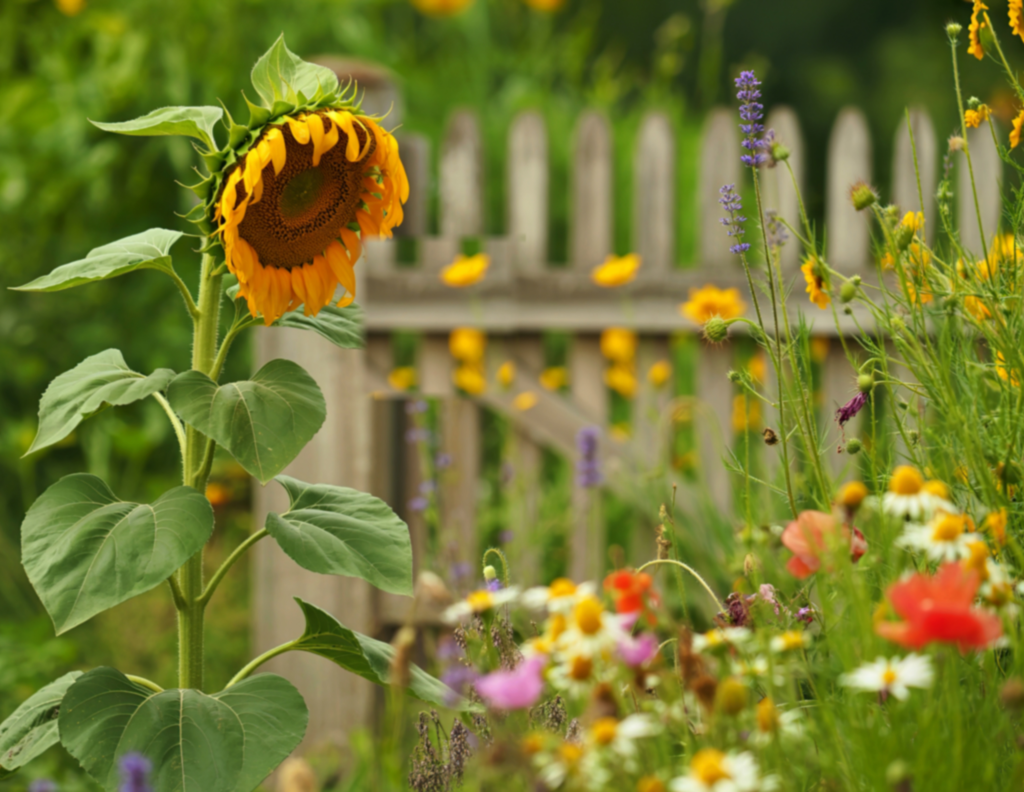
For UK gardens, the key is choosing a mix suited to your soil type. Chalk and limestone soils in southern England suit species such as cowslip, kidney vetch, and common rockrose. Clay-heavy soils in the Midlands and north suit ox-eye daisy, meadow cranesbill, and ragged robin. Our full guide to creating a wildflower garden in the UK walks through the process from preparation to planting in full detail.
12. Plant for Year-Round Seasonal Interest
A climate-friendly garden provides something for wildlife in every season — not just summer. Spring-flowering bulbs such as snowdrops, crocus, and native bluebells provide early nectar for bumblebee queens emerging from hibernation. Autumn-fruiting shrubs such as hawthorn, holly, and rowan provide berries for birds through winter. Seed heads left on spent perennials through winter feed finches and sparrows when little else is available.
Planting for year-round interest is also better for climate resilience because it maintains permanent plant cover, which protects soil from erosion and frost damage throughout the year. As a principle, if any part of your garden is bare for extended periods, there's an opportunity to fill it with something that benefits the climate, the soil, or local wildlife.
Reducing Inputs: Less Is Often More
A surprising amount of the environmental footprint of gardening comes not from what we grow but from what we use to grow it — the synthetic fertilisers, peat-based composts, petrol-powered machinery, and plastic pots and packaging that are standard features of conventional gardening. Reducing these inputs is one of the simplest and most impactful shifts a climate-conscious gardener can make.
13. Switch to Electric or Manual Garden Tools
Petrol-powered garden machinery is a significant source of carbon emissions and air pollutants. A petrol lawn mower running for an hour produces roughly the same quantity of air pollutants as driving a modern car for several hundred miles — a figure that surprises most gardeners. The shift to electric tools, powered by a home electricity supply that is itself becoming increasingly renewably generated, substantially reduces this footprint.
Battery-powered lawn mowers, hedge trimmers, leaf blowers, and rotary cultivators are now widely available in the UK from brands including Greenworks, EGO, and Bosch, and the performance gap with petrol tools has closed considerably in recent years. For smaller gardens, push-reel mowers remain the most energy-efficient option of all — they require no power, produce no emissions, and cut grass cleanly without the scalping that rotary mowers can cause.
14. Stop Using Peat-Based Potting Compost
As mentioned above, this deserves its own specific recommendation because it's one of the most impactful single changes a UK gardener can make. When buying compost for containers, seed sowing, and potting on, always check the label and choose products clearly marked peat-free. Most UK garden centres now stock a good range, and online suppliers including Fertile Fibre and Carbon Gold offer specialist peat-free growing media suited to specific applications such as seed sowing and ericaceous planting.
craftingherblooms.com
15. Avoid Synthetic Fertilisers and Pesticides
Synthetic nitrogen fertilisers are produced using the Haber-Bosch process, which is one of the most energy-intensive industrial processes in existence, and their application to soils releases nitrous oxide — a greenhouse gas nearly 300 times more potent than CO₂. In a climate-friendly garden, synthetic fertiliser is replaced by compost, well-rotted manure, green manures, and slow-release organic feeds such as pelleted chicken manure or seaweed meal.
Similarly, synthetic pesticides disrupt the soil food web, kill beneficial insects alongside harmful ones, and persist in the environment in ways that compound over time. Natural pest management — through companion planting, encouraging predators such as ground beetles and ladybirds, physical barriers, and simply accepting a degree of pest damage — is both more sustainable and often more effective over the long term.
16. Rethink Your Lawn
Conventional lawn management — regular mowing, autumn feeding with synthetic fertiliser, herbicide treatment for weeds — is one of the more environmentally costly elements of the typical British garden. A hard-mown, monoculture lawn offers very little to wildlife, contributes to soil compaction, and relies on significant chemical and energy inputs. The climate-friendly alternative isn't necessarily to get rid of your lawn but to manage it differently.
Mowing less frequently, especially during summer, allows low-growing wildflowers such as clover, self-heal, and bird's-foot trefoil to bloom among the grass, providing nectar for bees. Raising your mower height reduces water stress on the grass in dry summers. Leaving grass clippings on the lawn (where mowing is done frequently enough to produce short clippings) feeds the soil naturally. If your lawn has bare patches, overseeding with a native wildflower and grass mix is far more climate-friendly than applying lawn sand or weedkiller.
Wildlife Gardening: Biodiversity Is Climate Action
Supporting wildlife in your garden is inseparable from climate-friendly gardening. Healthy, biodiverse gardens are more resilient to extreme weather events, support pollinator populations that keep food systems functioning, and create green corridors through urban areas that allow species to move and adapt as habitats shift.
17. Build a Wildlife Pond
A garden pond is arguably the single most impactful addition you can make for wildlife in a UK garden. Even a small pond — no more than a metre across and 60cm deep at its deepest point — can support dragonflies, frogs, toads, newts, water boatmen, diving beetles, and dozens of species of birds that use it for drinking and bathing. Ponds have been lost from the British countryside at a dramatic rate over the past century; every new garden pond directly counteracts that trend.
For climate-friendly credentials, choose a pond fed by rainwater rather than mains supply, planted with native aquatics such as water mint, yellow flag iris, and frogbit, and with gently sloping sides that allow amphibians to enter and exit easily. Our detailed wildlife gardening guide covers pond creation and management in full.
18. Put Up Hedges Instead of Fences
Hedges offer wildlife connectivity that fences and walls simply cannot. A hedge of mixed native shrubs — hawthorn, blackthorn, field maple, and hazel — provides nesting habitat for birds, overwinter cover for mammals and invertebrates, spring flowers for early pollinators, and autumn berries for migrating thrushes and resident finches. Hedges also absorb CO₂, slow wind and surface water, and reduce the urban heat island effect by providing shade and transpirational cooling.
In the UK, native mixed hedges establish well from bare-root whips planted between November and March, and they're significantly cheaper and more wildlife-friendly than container-grown ornamental hedging. A mixed 5-metre run of native hedge planted as bare-root whips typically costs under £30 and will be well established within three years.
19. Leave the Leaves
The autumn impulse to clear every fallen leaf and sweep every border to bare soil is one of the most climate-unfriendly gardening habits there is. Fallen leaves are a free mulch, a free source of leaf mould, a winter habitat for invertebrates including hibernating hedgehogs, ground beetles, and the overwintering pupae of dozens of butterfly and moth species, and a food source for song thrushes foraging for earthworms in the leaf litter.
Leave leaves on borders and under hedges where they fall. Rake them off lawns (where they can smother grass) and pile them into a simple leaf mould cage made from four stakes and chicken wire. Leaf mould made from UK native deciduous tree leaves — oak, beech, hornbeam, and sycamore are all excellent — takes 12–18 months to break down into a beautiful, fibrous mulch that is ideal for use in seed sowing mixes and as a soil conditioner.
20. Create Habitat Piles and Log Stacks
Rotting wood is one of the most biodiverse habitats in any garden. A stack of logs or a dedicated bug hotel made from hollow stems, dry leaves, and bark provides habitat for stag beetles (whose larvae require rotting wood for their entire larval stage of up to seven years), solitary bees, lacewings, and dozens of other beneficial insects. These aren't just wildlife features — they're climate-friendly because they keep organic matter in the garden rather than sending it to landfill, and they support the insect predators that manage garden pest populations naturally.
The most effective log stacks for UK wildlife use native hardwood logs at least 15cm in diameter, partially buried in a shaded, damp corner of the garden. Birch, oak, and apple wood all support excellent invertebrate diversity. If you have dead wood from a tree removed in your garden, this is the ideal material — it's already colonised by the fungal networks that stag beetles and other wood-boring invertebrates depend on.
craftingherblooms.com
A UK Seasonal Climate Calendar
One of the advantages of climate-friendly gardening is that many of its most impactful practices align naturally with what you'd be doing anyway at particular times of year. Here's a quick seasonal overview for British gardeners:
Spring (March–May)
- Sow green manures in empty vegetable beds
- Plant native wildflowers from pot-grown plants or direct seed
- Install water butts before summer begins
- Mulch borders before rapid growth starts
- Add compost to vegetable beds and top up containers with peat-free growing media
Summer (June–August)
- Water only in the evening or early morning using stored rainwater
- Allow sections of lawn to grow long — No Mow May and beyond
- Deadhead perennials but leave some to set seed
- Resist pesticide use — natural predator populations are building
Autumn (September–November)
- This is the most important season for climate-friendly action
- Mulch all borders and vegetable beds generously
- Plant native bulbs and bare-root trees and hedging from November onwards
- Build compost heaps using fallen leaves and spent plant material
- Install log stacks, bug hotels, and other habitat features
- Sow green manures in empty vegetable beds
Winter (December–February)
- Leave seed heads and dead stems standing for overwintering insects and bird food
- Plan next year's planting with climate resilience in mind
- Order peat-free growing media and native plants for spring delivery
- If you have a pond, keep a small area ice-free in hard frosts
Where to Start: A Simple First Season Plan
Twenty changes can feel like a lot. A more useful approach is to choose three or four that fit your garden's specific context and your current season, do them well, and build from there. Where you start depends on what you've got:
- Heavy clay soil in the north: Improving drainage, mulching, and reducing compaction are your highest priorities
- Large lawn in the southeast: Introducing wildflower areas and switching to a battery mower will make the most immediate difference
- Small urban garden with containers: Switching to peat-free compost and growing food are your two biggest wins
- Established garden with borders: Focus on native planting, leaving the leaves, and reducing or eliminating pesticides
The through-line across all of these practices is the same: working with natural systems rather than against them, reducing artificial inputs, and using your garden space to give something back to the environment that sustains us. British gardens have an extraordinary collective potential for climate action. The most important step is simply the first one.
Frequently Asked Questions
What does climate-friendly gardening mean? Climate-friendly gardening means managing your garden in ways that reduce its environmental footprint and actively contribute to climate change mitigation and adaptation. This includes practices that store carbon in soil and plants, reduce reliance on synthetic fertilisers and peat-based products, manage water sustainably, support biodiversity, and minimise the use of fossil-fuel-powered machinery.
Does my garden actually make a difference to climate change? Yes, meaningfully so — especially in aggregate. UK private gardens collectively cover more land than all of Britain's national nature reserves. When millions of gardeners make climate-friendly choices around composting, planting, water management, and soil care, the combined effect on carbon storage, biodiversity, and flood resilience is substantial.
What is the most important climate-friendly change I can make in my garden? Going peat-free is often cited as the single highest-impact change for UK gardeners, given the enormous carbon value of peatland ecosystems. Beyond that, composting, mulching bare soil, and reducing hard surfaces are consistently high on the list. The best answer for your garden specifically depends on its size, soil type, and current management.
What plants are best for a climate-friendly UK garden? Native British plants are generally the most climate-friendly choice because they support the widest range of native wildlife and are adapted to local conditions, requiring fewer inputs to thrive. Trees, large shrubs, and perennials that provide year-round structure also store more carbon than annual bedding plants. Edible plants — particularly fruit trees and perennial vegetables — combine climate value with practical food production.
Can I have a climate-friendly garden and still make it look beautiful? Absolutely. Many of the most beautiful UK gardens are deeply climate-friendly — they're full of native plants, wildlife, structure, and seasonal interest. The idea that an ecological garden means a scrubby, neglected space is a persistent myth. Properly designed and managed wildlife-friendly gardens can be as formal or informal, as productive or ornamental, as you wish.
Conclusion: Your Garden as Climate Action
Climate-friendly gardening isn't about sacrifice or constraint — it's about gardening better. The practices that reduce a garden's environmental footprint almost always produce better results in the garden itself: richer soil, fewer pests, more wildlife, stronger plants, and less work over time as natural systems do more of the heavy lifting. British gardeners have something genuinely valuable to contribute to the climate challenge, and the tools to do it are available in every garden centre and seed catalogue in the country.
Start with what you have, in the garden you have, this season. The collective impact of 41 million UK gardeners making thoughtful, climate-conscious choices is hard to overstate — and it begins in your garden, with whatever you decide to do this week.
Want to explore more ways to make your garden work harder for the environment? Continue your journey here:
- How to Create a Wildflower Garden That Thrives in UK Gardens — turning lawn or bare ground into a pollinator haven
- Wildlife Gardening: A Complete UK Guide — ponds, hedges, log stacks, and everything in between
- Companion Planting: The Natural Way to Grow More With Less — reducing pesticides through smart plant combinations
- Eco-Friendly Garden Ideas for UK Gardens — practical sustainability upgrades for every garden size
- The Best Winter Cover Crops for Your Vegetable Garden — protecting soil and fixing nitrogen through the cold months
What climate-friendly change has made the biggest difference in your own garden? Share your experience in the comments below — we'd love to hear what's working for UK gardeners in different parts of the country.
If you found this guide useful, sign up to the Crafting Her Blooms newsletter for seasonal gardening advice, UK-specific planting guides, and practical ideas for growing and gardening with the environment in mind.


