How to Plant a Native Hedge for Wildlife in a UK Garden
I sometimes use affiliate links in content. This doesn’t cost you anything but I may make a commission payment from anything you buy through these links. As an Amazon Associate I earn from qualifying purchases. All opinions remain my own.
A fence marks a boundary. A native hedge feeds a garden.
Ask most UK gardeners what they want from the edge of their plot and the answer is usually privacy, a windbreak, somewhere to hang a trellis. A well-chosen mixed native hedge does all of that, and then keeps going: it flowers in spring, feeds pollinators through summer, fruits through autumn, and shelters birds and small mammals all winter. No fence panel or clipped evergreen has ever done a fraction of that work.
This guide covers everything you need to plan, buy, and plant a native hedge this year, and why the smart move is to start thinking about it now, months before bare-root ordering season actually opens.
🌿 Why Native Hedges Beat Fences and Evergreen Hedging for Wildlife
A close-board fence is wildlife-neutral at best. It offers no food, no nesting structure, and nothing for insects. Even a popular evergreen hedge like cherry laurel or leylandii is mostly dense green cover with very little to eat and almost no value to native invertebrates that haven’t evolved alongside it.
Forged & Grown
Garden pieces, printed to order
3D printed planters and garden accessories, made in the UK. Self-watering designs, sculptural shapes, colour options — each one made when you order it.


Native hedging plants are different because they co-evolved with British insects, birds, and mammals over thousands of years. Hawthorn alone is thought to support well over 300 species of invertebrate, from moth caterpillars to beetles and aphids that in turn feed the birds. Layer in blackthorn, hazel, and a few flowering and fruiting extras, and a single hedgerow becomes a corridor of food and shelter running the entire length of your boundary.
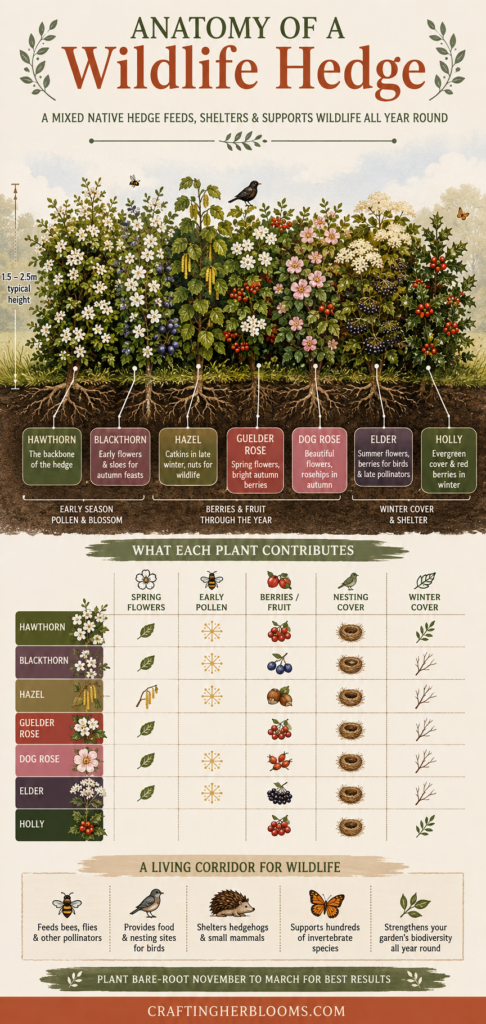
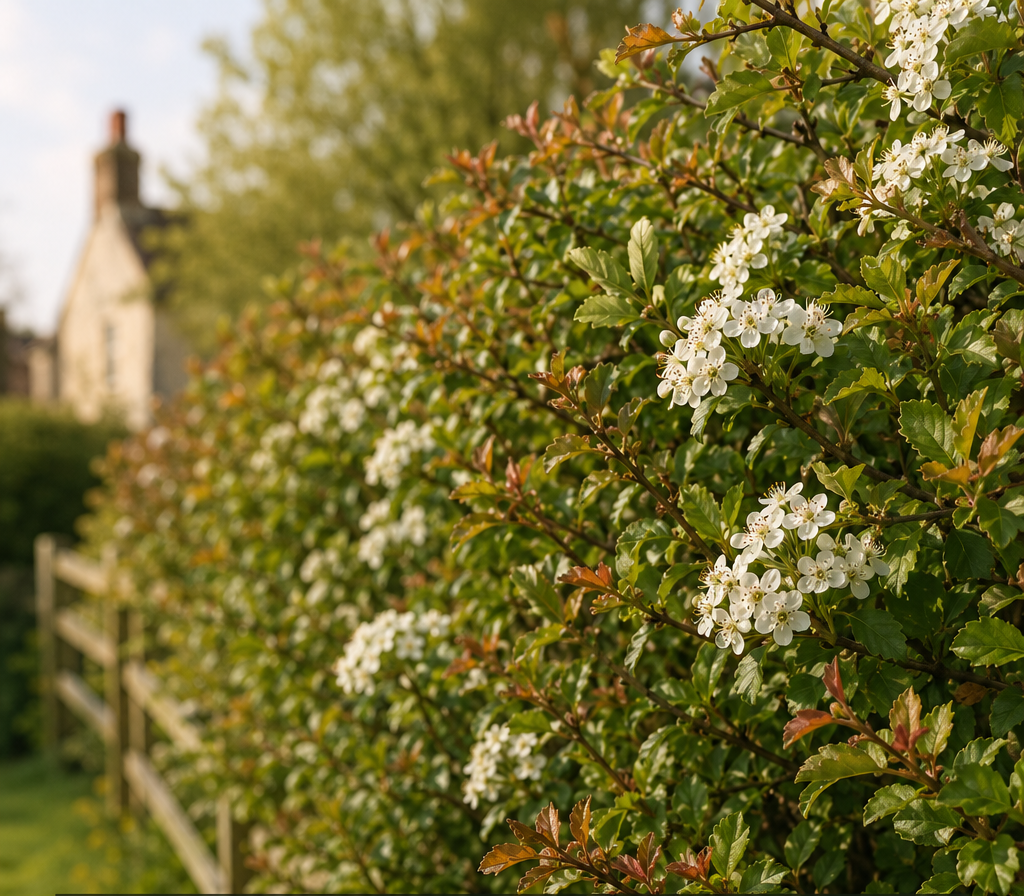
This is also a structural upgrade over a single-species hedge. A beech or privet hedge can look immaculate, but it is still one plant doing one job. A mixed native hedge behaves more like a hedgerow habitat than a garden feature: different species flower and fruit at different points across the year, so there is always something in bloom or in berry for whatever is passing through.
If you already have a wildlife-friendly garden underway, a native hedge is usually the single highest-value addition you can make. It does more for biodiversity per metre than almost anything else in a typical UK garden.
It is worth naming the trap here too. Plenty of shrubs are marketed as “wildlife-friendly” alternatives to a plain hedge without actually being native. Non-native berrying shrubs, ornamental cotoneasters, and some fast-growing evergreens are sometimes sold this way, but UK insects and birds have not evolved alongside them in the same way. Some of these plants, cotoneaster and certain berberis species among them, are also considered invasive in parts of the UK and can spread from gardens into wild spaces. When in doubt, stick to genuinely native British species. They will always outperform a “wildlife-friendly” label on a plant that never grew here naturally.
📏 Before You Order: Measuring and Planning Your Hedge Line
A little preparation now saves a lot of frustration once your bare-root order arrives and needs to go straight in the ground.
Measure your boundary length so you know roughly how many whips to order. As a rough guide, a double staggered row at 30 to 45cm spacing works out to around five or six plants per metre of hedge, though exact numbers vary by supplier and spacing choice.
Check what’s already there. If you’re replacing an existing fence or a tired evergreen hedge, factor in removal time. Old conifer hedging in particular can leave the soil quite depleted, and a season of digging in organic matter before planting will help a new native hedge establish far more evenly.
Think about eventual height and width. Most native hedging species will happily reach 1.5 to 2.5 metres with a couple of trims a year, but hedges like hawthorn and blackthorn can go taller if left. Decide early whether you want a tidy boundary hedge or a taller, looser wildlife corridor, since that shapes how hard you prune in later years.
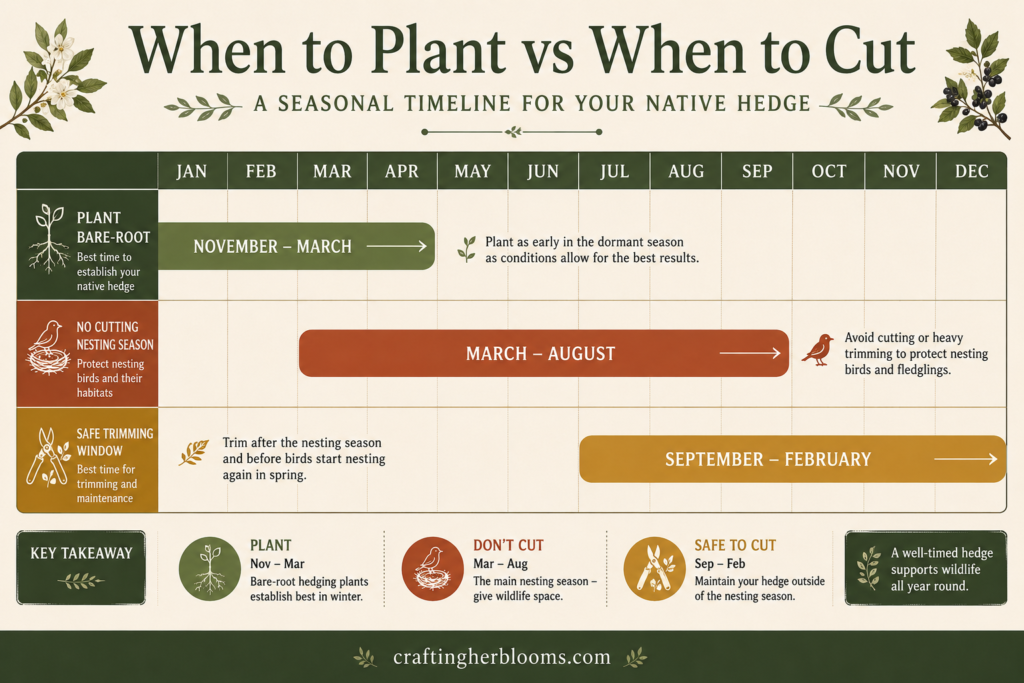
Factor in your region’s timing. UK bare-root planting windows shift slightly depending on where you garden. Southern England often has workable soil into early March, while Scotland and higher, colder parts of Northern England and Wales may need planting wrapped up by late February before the ground turns unworkable. If you’re in the Midlands or East Anglia, the standard November-to-March window applies fairly reliably. Whichever zone you’re in, aim to get bare-root plants in the ground as early in the dormant season as conditions allow, rather than leaving it to the last few weeks.
Leave a gap or two for hedgehogs. A completely sealed hedge line, especially where it meets a neighbouring garden, can block hedgehog highways. A 13cm gap at the base every few metres, or a purpose-cut hole through an existing fence panel alongside the new hedge, keeps that route open without compromising the hedge itself.
🐦 The Best Native Hedging Plants for UK Wildlife
A strong mixed hedge is built from a handful of workhorse species, each contributing something different across the seasons.
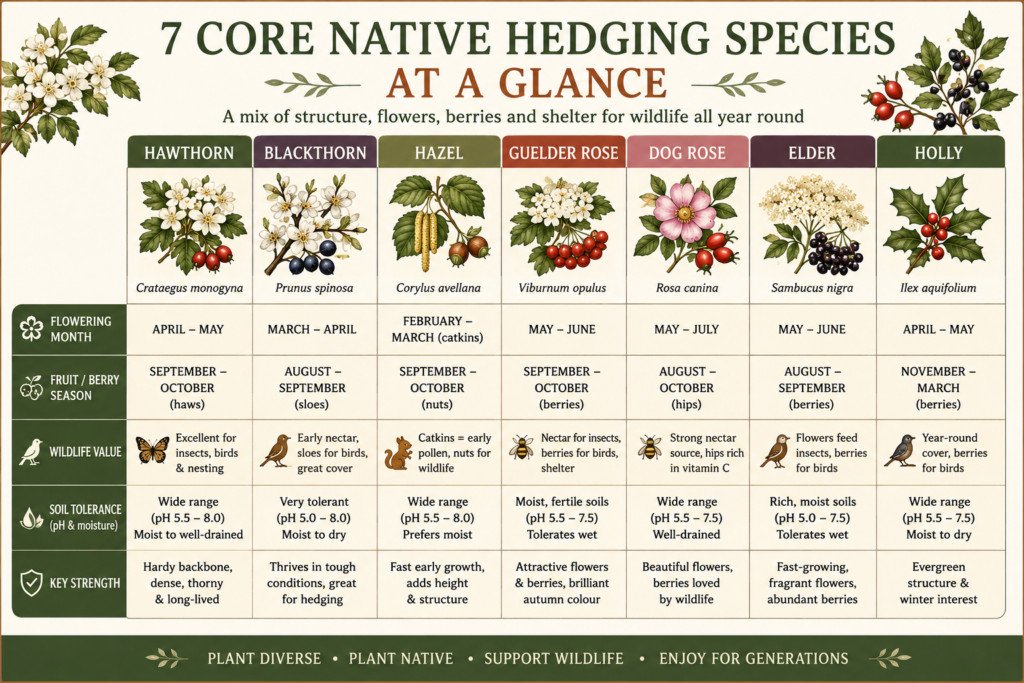
Hawthorn (Crataegus monogyna) is the backbone of most native hedges and should make up roughly half of a mixed planting. It copes with almost any soil, flowers heavily in May, and carries deep red haws through autumn that blackbirds and thrushes strip in hard weather.
Blackthorn (Prunus spinosa) flowers even earlier, often before the leaves appear, giving early pollinators a vital source of nectar in a hungry gap of the year. Its sloes ripen in fields hedgerows across the country and its dense, thorny growth makes excellent nesting cover.
Hazel (Corylus avellana) brings catkins in late winter, some of the earliest pollen available to emerging insects, plus nuts later in the year that feed everything from wood mice to jays. It also takes well to occasional coppicing, which keeps a hedge productive for decades.
Guelder rose (Viburnum opulus) earns its place with white lacecap flowers in early summer and glossy red berries that hang on well into winter, giving late-season colour and food when much else has finished. It is one of the most attractive native shrubs for a garden hedge, not just a functional one.
Dog rose (Rosa canina) threads through a hedge with pale pink summer flowers followed by bright red hips that persist into the coldest months, prized by everything from waxwings to blackbirds.
Elder (Sambucus nigra) grows fast and forgivingly, offering broad flat flowerheads in early summer and dark purple berries in autumn that are among the first fruits to disappear once the birds find them.
Holly (Ilex aquifolium) is worth including as an evergreen anchor within an otherwise deciduous hedge. It provides dense, thorny shelter through winter and its berries (on female plants) are a genuinely important late-season food source once softer fruits have gone.
None of these need to be sourced as named cultivars. Ordinary species plants are cheaper, more resilient, and better for wildlife than showy garden varieties bred for flower size rather than nectar or fruit.
Worth including if you have the space: field maple (Acer campestre) adds gentle autumn colour and a softer leaf texture among the thornier species, dogwood (Cornus sanguinea) brings winter stem colour once its leaves drop, and spindle (Euonymus europaeus) produces striking pink and orange autumn seed cases that are as good for wildlife as they are decorative. None of these need to dominate a mix, but a whip or two of each adds texture and extends the hedge’s seasonal interest even further.
A note on proportions rather than a rigid formula: aim for hawthorn as roughly half your total plant count, with the remaining species distributed so that no single one dominates a long stretch of hedge. A hedge that reads as “half hawthorn, then a repeating scatter of everything else” behaves far more like a genuine hedgerow than one planted in obvious blocks of each species.
🌸 Planning a Mixed Hedge for Year-Round Interest
The trick to a genuinely useful wildlife hedge is sequencing, not just species choice. Aim for something flowering or fruiting in every season rather than one big spring show followed by months of plain green.
A simple approach that works well in most UK gardens: use hawthorn as roughly half the mix for structure and reliability, then fill the rest with blackthorn, hazel, guelder rose, dog rose, and elder in a randomised, non-repeating pattern rather than neat blocks of each species. A naturalistic hedge reads as one continuous feature rather than a row of individually labelled shrubs, and it also spreads pest and disease risk across species instead of concentrating it.
If you are working from a shortlist rather than a full mixed-hedgerow order, prioritise plants that flower at different points: blackthorn for late winter, hawthorn and guelder rose for late spring, dog rose and elder for early summer. Check what is already doing well in your garden’s other flowering shrubs and borders, since a hedge that echoes the colours and rhythm of your existing planting will feel considered rather than bolted on. If you’re also planning a wildflower meadow nearby, a flowering hedge boundary pairs naturally with it and extends the pollinator season on both sides.
For smaller gardens, you do not need the full seven-species list. Three or four well-chosen plants, weighted towards hawthorn and blackthorn for structure with one or two flowering extras like guelder rose or dog rose, will still deliver a meaningfully better result than a single-species hedge.
Underplanting the base for extra wildlife value
The base of a young hedge is bare ground for the first couple of years, and that gap is worth using. A strip of native woodland-edge perennials along the hedge foot, primroses, red campion, foxgloves, or bugle, adds early nectar at ground level while the hedge itself is still filling out above.
This underplanting also gives cover for ground-feeding birds and small mammals moving along the hedge line, effectively doubling the habitat value of the same strip of garden. Keep a clear ring immediately around each hedge whip free of competing growth in year one, but the space between plants further down the row is a good spot for this kind of low, informal planting.
🌳 Bare-Root vs Potted: Why Bare-Root Wins for Hedging
Garden centres sell potted hedging plants year-round, so it is tempting to assume that is simply how hedges are bought. For a native mixed hedge, bare-root is almost always the better choice, for three reasons.
Cost is the most obvious one. Bare-root whips are typically a fraction of the price of the same species in a pot, because growers avoid the cost of compost, containers, and year-round watering. For a hedge that might need dozens of plants, this difference adds up fast.
Establishment is the second reason, and arguably the more important one. Bare-root plants are lifted while dormant and go straight into the ground with an undisturbed root system that grows outward naturally from day one. Pot-grown plants often carry a spiral of roots that have circled the container, and while that can be teased out at planting, bare-root avoids the problem entirely.
Availability is the third. Native hedging species are grown as field crops specifically for the bare-root season, so the choice and quality of what is on offer between November and March is far better than what most garden centres stock as potted hedging outside that window.
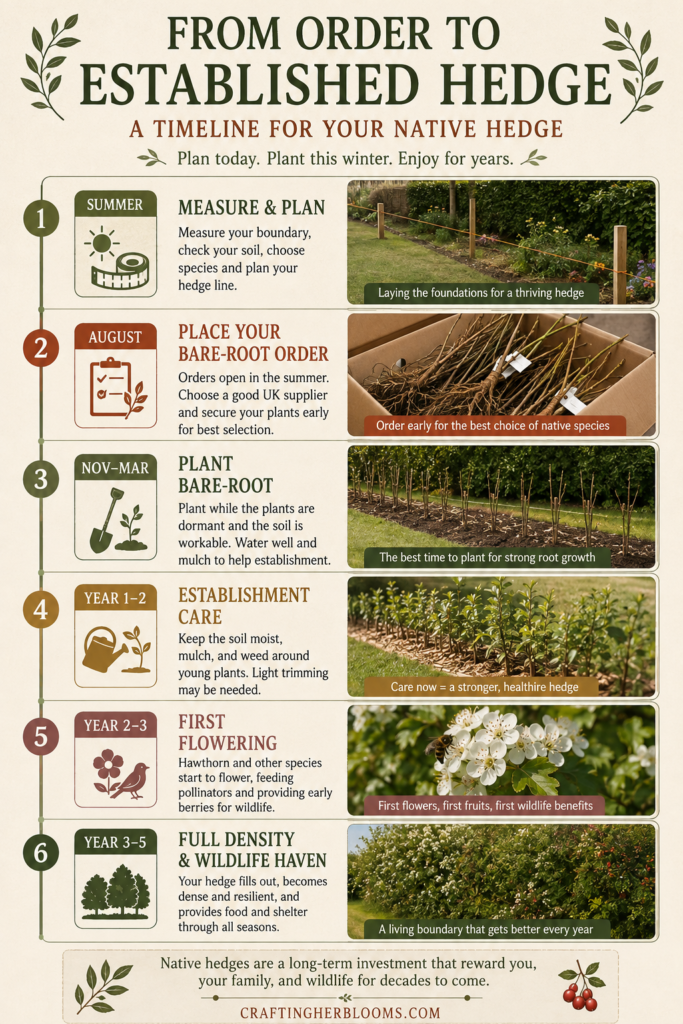
The trade-off is timing. Bare-root plants are only available and only successfully plantable while dormant, from roughly November through to March, depending on the weather. This is worth being clear about now: this guide is written in the summer planning window precisely so you can choose your species, measure your hedge line, and get your order placed with a supplier well before that fixed autumn and winter planting season opens. Most specialist hedging nurseries and mail-order suppliers open for pre-orders from around July or August, and popular native mixes can sell out of their best stock well before November.
🪴 How to Plant Your Bare-Root Hedge
Once your bare-root order arrives, the plants need to go in the ground quickly. If conditions are frozen or waterlogged, heel them into a spare patch of soil or a trench temporarily rather than leaving roots exposed to the air.
Mark and prepare the line. Dig a trench or line of planting holes roughly 30cm wide and deep enough that each whip’s soil mark, the darker line on the stem showing its previous planting depth, sits level with the surrounding ground.
Space for a proper hedge, not a row of individual plants. For a dense, stock-proof wildlife hedge, a double staggered row spaced around 30 to 45cm apart within each row, with roughly 30cm between the two rows, produces a thick base with far fewer gaps than a single line.
Give the roots the best possible start. Dipping bare roots in a mycorrhizal fungi slurry before planting is a small step that measurably improves establishment, particularly on poorer soils, by helping the plant access water and nutrients as its root system settles in.
Backfill in stages. Spread the roots out naturally in the trench rather than cramming them into a narrow hole, then backfill gradually, firming gently with your heel as you go to remove air pockets without compacting the soil too hard.
Protect from browsing. If rabbits, hares, or deer are a possibility in your area, a spiral guard or mesh tube supported by a cane around each whip will prevent them being stripped back to nothing in their first vulnerable year. This one detail can be the difference between a hedge that establishes and one that has to be replanted.
Water in well, even in cooler months, so the soil settles firmly around the roots with no air gaps left behind.
A reliable pair of secateurs earns its keep here too, for trimming any damaged roots or awkward stems back to a clean cut before planting, and again later for formative pruning once the hedge is established.
💧 Establishment Care: The First Two Years
The first two growing seasons matter more than anything you do afterwards. A hedge that is well looked after early on will outpace one that is planted and left, even if the second hedge eventually catches up in size.
Watering is the priority through the first spring and summer, particularly in any dry spell. New bare-root plants have a limited root system and cannot yet reach deep moisture reserves, so a thorough weekly soak in dry weather does far more good than frequent light sprinkling.
Keep a clear ring of bare soil or mulch around the base of each plant for at least the first year. Grass and weeds compete aggressively for water and nutrients, and a hedge left to fight through unmanaged growth at its base will establish noticeably more slowly than one kept clear.
A mulch of well-rotted organic matter, garden compost, or bark applied in a ring around each plant (kept clear of the stems themselves) helps retain moisture and suppresses competing growth without much ongoing effort. If you’re building a wildlife-friendly composting system, this is exactly the kind of use that puts your own compost to work.
Formative pruning in the first year or two encourages the dense, bushy base that makes a hedge good for nesting and shelter. A light trim of the leading shoots after the first growing season encourages side branching lower down, rather than a hedge that grows tall and thin with all its growth at the top.
✂️ Ongoing Management That Preserves Wildlife Value
How you maintain a native hedge matters just as much as how you plant it. A hedge trimmed the wrong way, at the wrong time, loses most of the wildlife value it was planted for.
Timing is the single most important rule, and it is a legal one as well as a practical one. Under the Wildlife and Countryside Act 1981, it is an offence to damage or destroy an active bird’s nest, which in practice means hedges should not be cut between March and August, when most garden birds are nesting. The safest and simplest approach is to schedule all significant hedge trimming for September to February, well outside the nesting window, and to always check carefully for active nests before cutting even within that safer period.
Avoid trimming too tightly or too often. A hedge cut hard every year, especially one shaped into a very neat, flat-sided block, produces far less flower and fruit than one allowed a looser, slightly informal outline. Flower buds on species like blackthorn and hawthorn form on the previous year’s growth, so an annual hard cut removes much of next spring’s blossom before it has a chance to open.
A better rhythm for a wildlife hedge is a lighter trim every one to two years rather than an annual close cut, allowing some growth to flower and fruit before it is tidied back. If space allows, leaving one section of the hedge entirely uncut for a few years on rotation gives an even richer structure for nesting birds and overwintering insects.
Where formative shaping is needed on young growth outside the nesting season, the same pruning principles that apply across the rest of the garden hold true here: clean cuts, the right tool for the stem thickness, and a clear sense of the shape you are working towards before you start.
❓ Common Questions About Planting a Native Wildlife Hedge
How many plants do I need per metre? For a dense double staggered row at 30 to 45cm spacing, budget for roughly five to six whips per metre of hedge line. A single row spaced more widely will need fewer plants but takes longer to thicken up and knit together.
Can I plant a native hedge in front of an existing fence? Yes, and it is a genuinely good option if you are not ready to remove a fence outright. The hedge will eventually provide the wildlife value while the fence keeps doing its structural job during the years the hedge is establishing.
Do I need permission to plant a boundary hedge? Generally no, for an ordinary garden boundary. It is worth checking your property deeds if the hedge sits directly on a shared boundary line, and being a considerate neighbour about eventual height and any overhang once the hedge matures.
What if my soil is heavy clay or very free-draining sand? Hawthorn, blackthorn, and hazel are all tolerant of a wide range of soils, including clay, which makes them a safe backbone regardless of what you’re working with. Guelder rose prefers slightly moister ground, so weight your mix towards the more adaptable species if your soil is on the extreme end of dry or waterlogged.
Will a native hedge attract pests into the rest of the garden? Not in any meaningful way. What it attracts is a broader base of predatory and pollinating insects, which tends to help keep pest populations in balance elsewhere in the garden rather than adding to them.
⏳ “How Long Until It Looks Good?”
This is the honest objection every gardener has about hedging, and it is worth answering directly rather than glossing over. A newly planted bare-root hedge looks like a row of thin sticks for its first season, and it will not match the instant privacy of a fence panel or a large potted evergreen bought in full leaf.
What it does offer is a completely different trajectory. A well-planted native hedge typically reaches useful density within three to five years, faster with attentive watering and formative pruning in those first two seasons. By year three, most mixed native hedges are thick enough to screen effectively and are already flowering and fruiting. By year five, they are established garden features in their own right, and unlike a fence, they improve every year after that rather than needing replacement.
The comparison that matters is not “hedge on day one versus fence on day one.” It is five years of a fence that does the same single job indefinitely, against five years of a hedge that starts modest and ends up feeding birds, sheltering hedgehogs, and flowering through spring and summer while still doing the boundary job a fence does. For most UK gardens, especially ones already leaning into wildlife-friendly choices elsewhere, that trade is worth the patience.
If your garden already has some structure to build around, a native hedge sits comfortably alongside an existing cottage border or specimen trees like a flowering cherry or Japanese maple, giving the whole garden a sense of layered, natural boundary rather than a single hard edge.
Plan now, order in late summer, and plant while your hedge is dormant this coming winter. By next spring, you will already be watching the first blossom open along a boundary that is quietly doing far more work than any fence ever could.
Continue Your Journey
- How to Create a Wildlife Garden from Scratch: The UK Beginner’s Guide
- How to Create Wildlife Habitats in a Small UK Garden
- The Best Plants for Spring Pollinators in a UK Garden
- How to Make Your UK Lawn More Wildlife-Friendly (Without Digging It Up)
- The Best Garden Pruners: Which Shears Should You Get?