Rewilding Your Garden: What It Really Means for a UK Back Garden
I sometimes use affiliate links in content. This doesn’t cost you anything but I may make a commission payment from anything you buy through these links. As an Amazon Associate I earn from qualifying purchases. All opinions remain my own.
Say the word rewilding and most of us picture beavers, bison and thousand-acre estates. Then we look out at a twelve-metre back garden with a shed, a washing line and a lawn, and wonder what on earth it has to do with us.
The honest answer is: quite a lot, but not in the way the headlines suggest. A back garden cannot be rewilded the way a river valley can, and “just let it go wild” is poor advice for a plot with neighbours either side.
What you can do is hand some of your space back to nature, on purpose and in stages. This guide explains what garden rewilding actually means, how it differs from ordinary wildlife gardening, and where you might sit on the spectrum. There is a simple “start here” plan at the end.
🌿 So What Does Rewilding Actually Mean?
In its original sense, rewilding means restoring natural processes at landscape scale, then stepping back and letting nature lead. Conservation projects use it for the likes of beaver reintroductions and large estate restoration. That is as far as we will go with the big picture.
Forged & Grown
Garden pieces, printed to order
3D printed planters and garden accessories, made in the UK. Self-watering designs, sculptural shapes, colour options — each one made when you order it.


At garden scale, the idea is borrowed and made smaller. It means giving up some control, so that soil, seeds, weather and wildlife do more of the work than you do.
It does not mean doing nothing. Even the most hands-off garden needs a little thought, because the plants that arrive first are not always the ones you would choose.
How it differs from wildlife gardening
Wildlife gardening is something you design. You choose the plants, add the pond and install the log pile, then manage it all to help particular creatures. Our beginner’s guide to creating a wildlife garden covers that approach step by step.
Garden rewilding sits on the looser end of the same spectrum. You still help nature, but you plant less, mow less, tidy less and watch what turns up. The focus shifts from “what shall I put in?” to “what shall I stop doing?”
🧭 The Spectrum: Where Does Your Garden Sit?
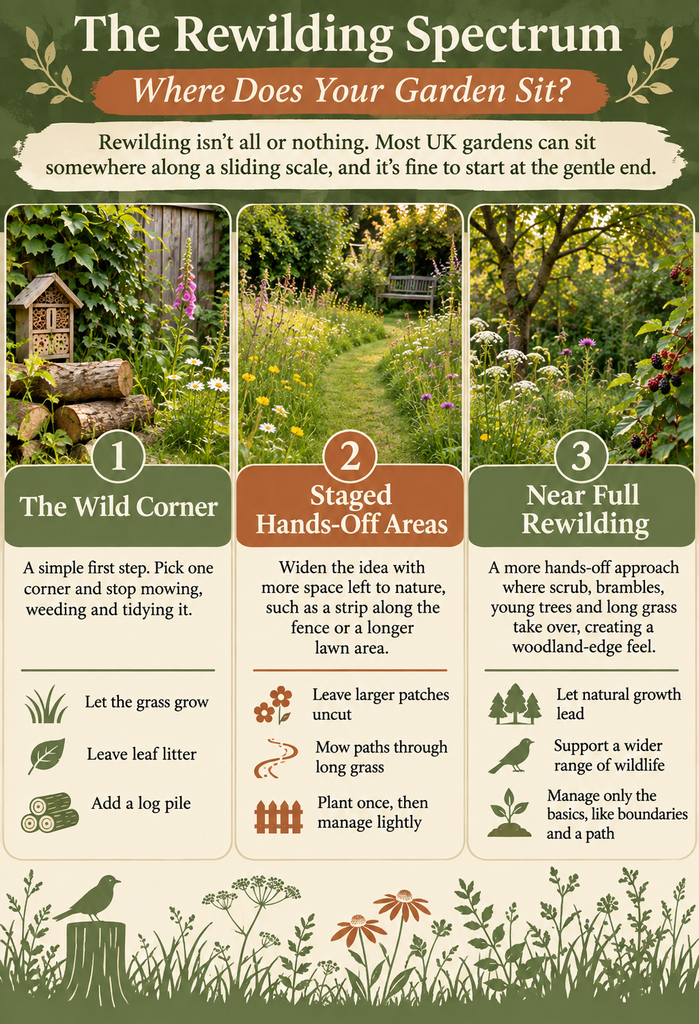
Rewilding is not an all-or-nothing choice. Most UK gardens can sit somewhere along a sliding scale, and it is fine to start at the gentle end.
Stage one: the wild corner
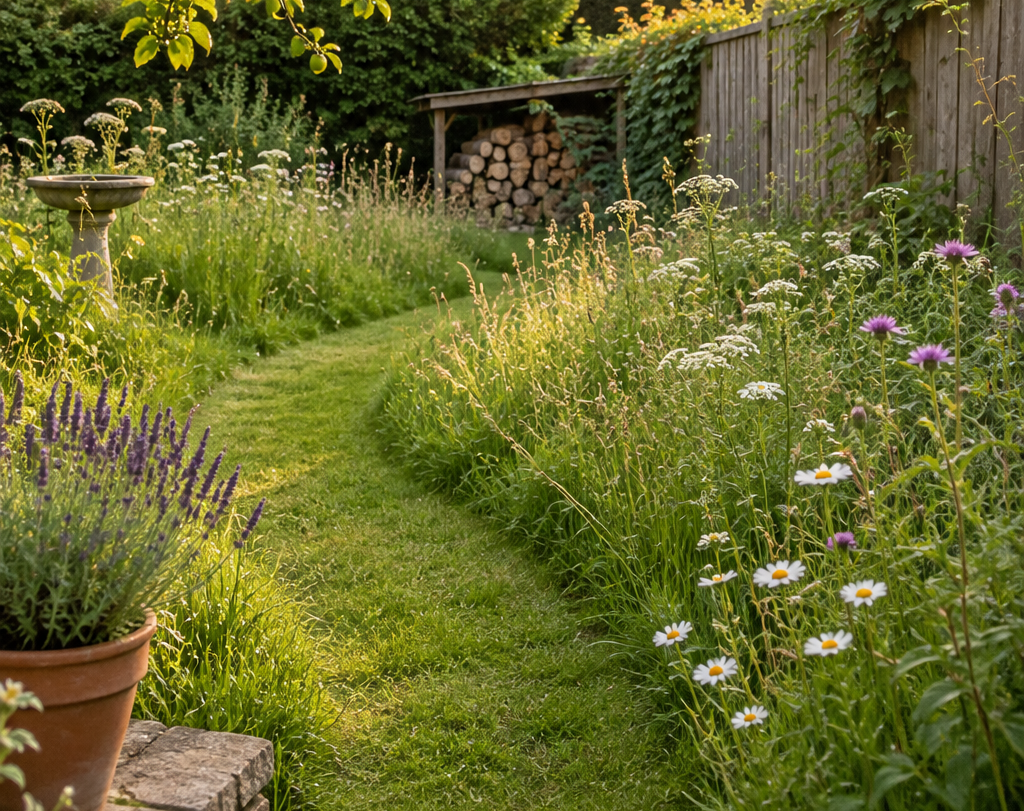
This is the easiest way in. You pick one corner, usually somewhere out of sight, and stop mowing, weeding and tidying it. Leaf litter stays, long grass grows and a log or two goes in.
It is low risk, it costs nothing and it can be reversed. Plenty of gardeners never go beyond this stage, and that is perfectly respectable.
Stage two: staged hands-off areas
At this stage you widen the idea. Perhaps a strip along the back fence, a section of lawn left long, or a border you plant once and then barely touch.
You might let the lawn grow in one patch and cut paths through it. Our guide to mowing paths through a wildflower meadow shows how paths keep a long-grass area looking intentional.
Stage three: near full rewilding
A few gardeners go much further and manage very little beyond the boundaries and a path. Scrub, brambles, young trees and long grass take over, and the garden becomes more like a patch of woodland edge.
This works best on larger plots, especially ones with understanding neighbours. In a small suburban garden it takes more careful management than the name suggests, and I would call it an exception rather than the rule.
🪵 Practical First Steps
You do not need to buy anything to begin. These steps are all about stopping, leaving and waiting.
Stop mowing patches
Pick a section of lawn and let it grow for a season. Plantlife, the wild plant charity, suggests that cutting less often supports more flowers and more nectar than a regularly mown lawn, and mowing around once every four weeks is a commonly suggested middle ground.
Leave some areas uncut through the summer, then cut and clear the clippings in early autumn. Removing the cuttings stops the soil getting richer, which tends to favour wildflowers over tough grasses. Our guide to making your lawn more wildlife-friendly goes into more detail, and our wildflower meadow guide takes the idea further if you have space.
Leave leaf litter and deadwood
Fallen leaves are not rubbish. They shelter insects, feed the soil and give hedgehogs and amphibians somewhere to hide.
Leave leaves under shrubs and in borders, and rake them off paths and the lawn only. Add a pile of logs or branches somewhere shady and let it rot down slowly.
Stop the chemicals
Rewilding and slug pellets, weedkillers and pesticides do not mix well. Even treatments labelled as organic can harm the very creatures you are hoping to welcome.
Give your garden a season without them and see what balances itself out. Predators such as ladybirds and birds often catch up with pests more quickly than you would expect.
Let the soil and seed bank work
Soil holds a hidden store of seeds that have been waiting, sometimes for years, for light and space. When you stop digging and mowing, many of them germinate on their own.
Resist the urge to strip the surface bare. Our guide to creating living soil explains how undisturbed soil builds up life underneath, and the idea of chop and drop mulching fits neatly with the leave-it-be approach.
Add a little structure
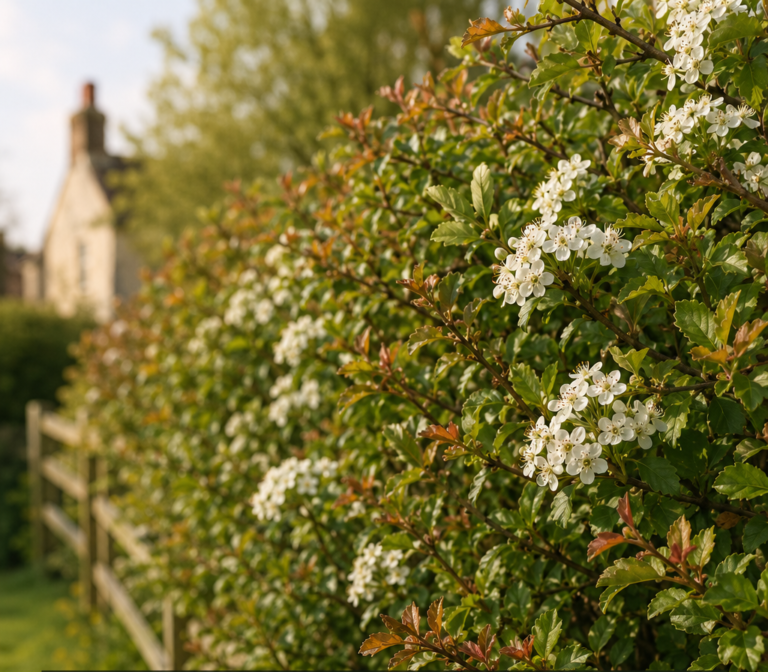
A native hedge is one of the most valuable things a garden can offer, and you plant it once and then manage it lightly. See our guide to planting a native hedge for wildlife for species and spacing.
If your space is small, our advice on wildlife gardening in a small urban plot shows how much a courtyard or terrace can still do.
⚖️ The Honest Trade-Offs
Rewilding has real costs, and it is better to know them before you start.
- It looks messy. Long grass and seed heads can look neglected to someone expecting neat stripes. Mown paths, a tidy edge and a bench help signal that the wildness is deliberate.
- It takes time. Nature does not hurry. You may wait a year or two to see much change, and the first season can look worse before it looks better.
- It does not guarantee results. I would be wary of anyone promising particular species or big boosts in biodiversity. Wild patches can help many creatures, but outcomes depend on your location, soil and surroundings.
- Invasive plants will move in. Left alone, a garden can fill with brambles, nettles, bindweed and worse. Some management is not a failure of rewilding but part of it.
When to step in
Pull or cut back anything that threatens to take over the whole plot. A sturdy pair of budget secateurs is useful for tackling bramble and woody seedlings, and a strimmer can handle the autumn cut of a long-grass patch.
Keep a close eye on non-native invasive plants. They can outcompete wildlife-friendly species quickly, and some carry legal responsibilities.
📜 Rules, Neighbours and Injurious Weeds
Most of what you do in your own garden is up to you, but a few rules are worth knowing about before you go wild.
Ragwort and other injurious weeds
Under the Weeds Act 1959, five plants are classed as injurious: common ragwort, spear thistle, creeping or field thistle, curled dock and broad-leaved dock. It is not illegal to have them in your garden.
However, Defra can require you to control them if they threaten to spread onto agricultural land or grazing. Ragwort is poisonous to horses and livestock, so if your garden borders a paddock or farmland, deal with it promptly. Government guidance on injurious weeds is on GOV.UK.
Japanese knotweed and other invasive species
Japanese knotweed is not illegal to have, but under the Wildlife and Countryside Act 1981 it is an offence to cause it to spread into the wild. Disposal needs care, because the plant regrows from tiny fragments.
If you spot it, do not strim or dig it out yourself. Ask a specialist or your local council for advice. The same caution applies to other listed invasive plants such as Himalayan balsam and giant hogweed, which can cause painful skin burns.
Neighbours and overgrown gardens
Gardens that look abandoned sometimes lead to complaints. Councils have powers over land that is seriously untidy and affecting the area, and over problems such as pests or hedges that block light.
In practice, a bit of kindness goes a long way. Tell your neighbours what you are doing, keep the boundary edges tidy, cut a clear path and consider a small sign explaining that the wild area is deliberate. Our advice on the UK trends in wildlife-friendly gardening shows how widely this approach has caught on.
If you rent, check your tenancy agreement first. If you have a leasehold property or live in a conservation area, check any rules on trees and hedges as well.
🗓️ What to Expect Through the Year
A rewilded patch changes with the seasons, and knowing the rhythm stops you panicking in the awkward months.
Spring brings fresh growth, and the first flowers from the seed bank often appear now. Resist tidying, because ground-nesting bees and overwintering insects are still emerging.
Summer is the peak for flowers, insects and birds. Grass gets tall and seed heads form, so keep your mown path crisp and the boundary neat.
Autumn is the time for the one big cut, if you do one. Cut the long-grass patch, remove the clippings, and leave some stems standing for insects to overwinter in.
Winter looks bare and a little rough. Seed heads feed birds, and the leaf litter does its quiet work, so leave well alone until spring.
🏡 If Your Garden Is Small
A courtyard or a tiny terrace can still join in. You do not need a lawn to rewild.
Let a pot of herbs flower, leave a corner of a border unweeded, and skip the weekly sweep behind the planters. Even a single log under a shrub counts.
The key is proportion. In a small garden, one wild feature that is clearly intentional looks better and does more good than a half-hearted attempt to let everything go.
🗺️ A Simple “Start Here” Plan
Here is a gentle plan for a typical UK back garden. It asks very little, and you can stop at any point.
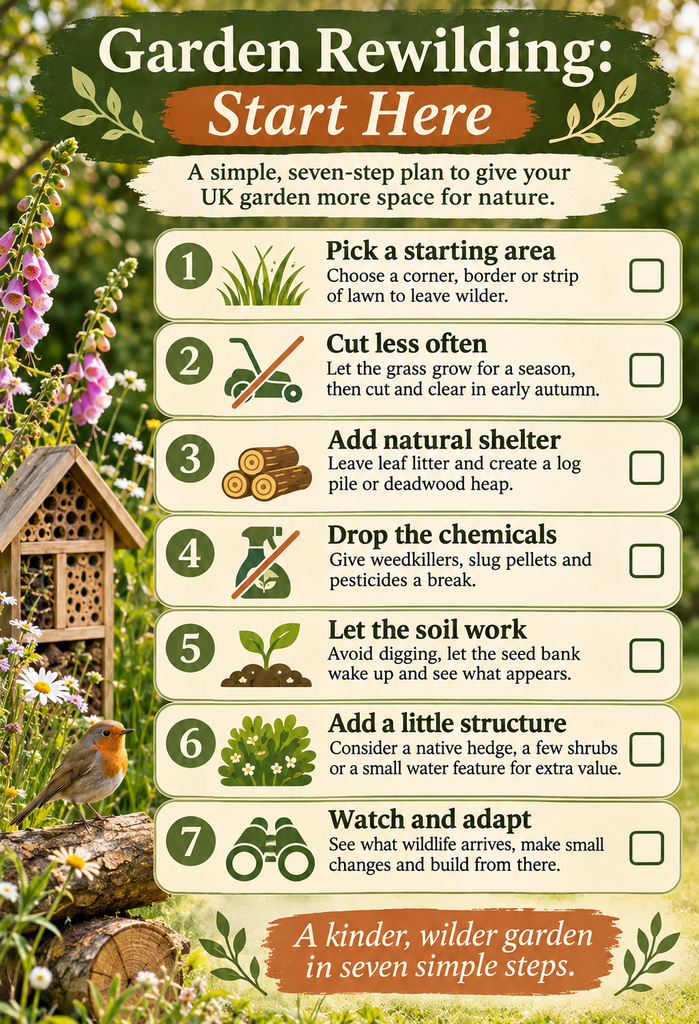
- Pick your spot. Choose one corner or strip, ideally out of sight and away from your main seating area.
- Stop mowing it. Let the grass grow through the spring and summer, and leave it uncut until early autumn.
- Add some deadwood. Pile a few logs in the shade and leave the leaves alone nearby.
- Skip the chemicals. Give the whole garden a pesticide-free year.
- Keep a path. Mow a clear route through or beside the wild patch so it looks cared for.
- Watch and note. Jot down what appears, month by month, and photograph it.
- Review in a year. Decide whether to stay, expand or tweak the area.
You can read more about how rewilding links with the bigger picture in our guide to what climate-friendly gardening means.
🌼 Final Thoughts
Rewilding a back garden is less about dramatic transformation and more about small, steady choices. A corner left alone, a lawn cut less often, a log left to rot: each is a modest act that gives wildlife a little more room.
Start small, stay curious and stay on good terms with your neighbours. The wild patch will look after the rest.