The Best Plants for Summer Pollinators in a UK Garden
I sometimes use affiliate links in content. This doesn’t cost you anything but I may make a commission payment from anything you buy through these links. As an Amazon Associate I earn from qualifying purchases. All opinions remain my own.
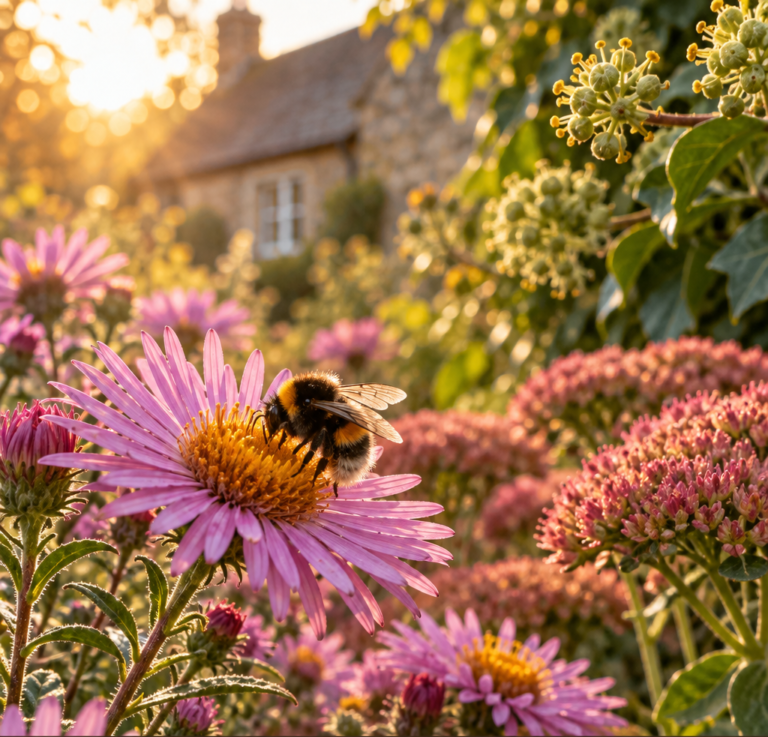
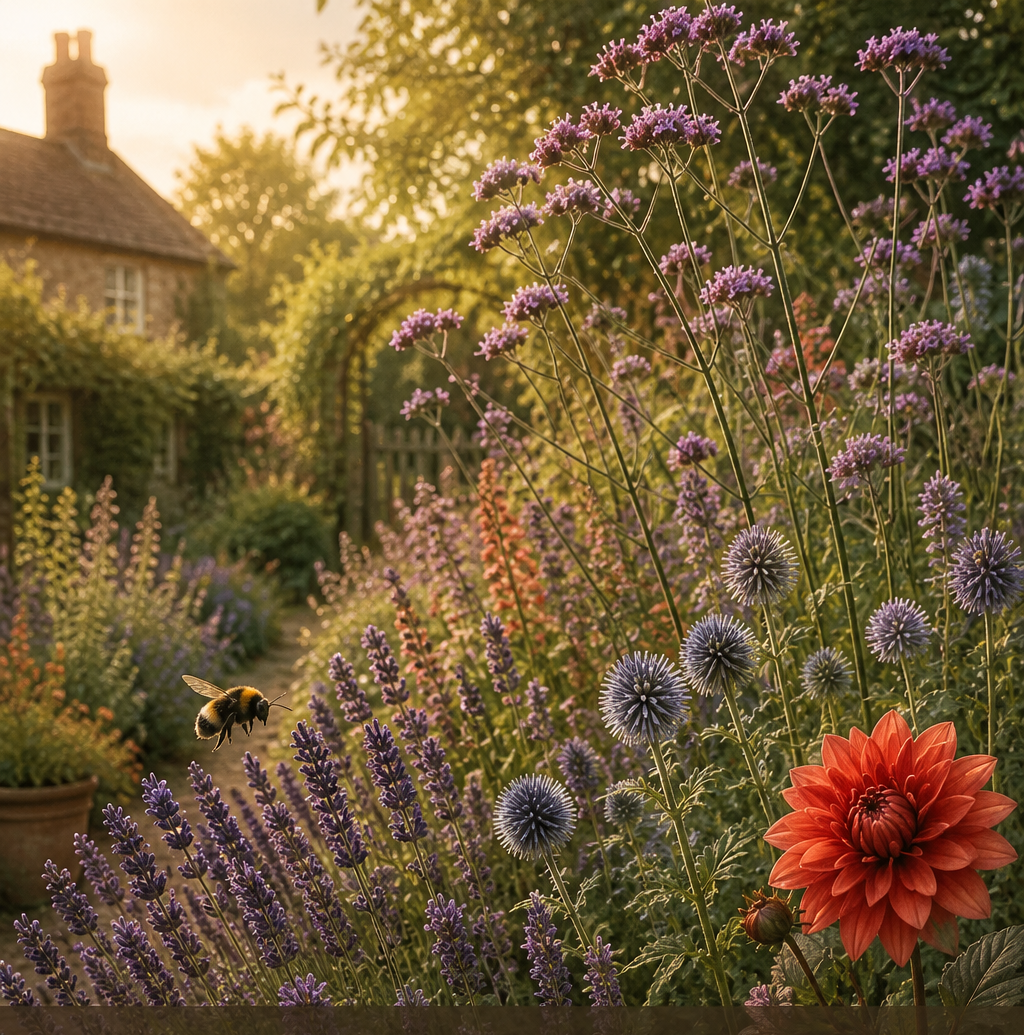
There is a particular hum that settles over a British garden in high summer, a low, busy murmur of bees moving from bloom to bloom under a sky that finally feels generous. This is pollinator peak, the three-month stretch from June through August when more bees, hoverflies, and butterflies are active in the UK than at any other point in the year. It is also, not coincidentally, the moment when the competition for nectar becomes fiercest, which means the plants you choose right now matter more than almost any other gardening decision you will make this season.
Get the planting right and your garden becomes a genuine lifeline through the hungriest, busiest weeks of the pollinator calendar. Get it wrong, and you end up with a border that looks lovely from the kitchen window but offers surprisingly little to the creatures who need it most. This guide walks through exactly which plants earn their place in a UK summer pollinator garden, why flower shape matters more than most gardeners realise, and how to put it all together into a border that genuinely hums with life.
Why June to August Is Pollinator Peak in UK Gardens
Late spring’s flush of blossom and early bulbs has faded by the time June arrives, and the autumn ivy and sedum flowering is still months away. Into that gap step the UK’s peak pollinator populations: bumblebee colonies are at their largest, solitary bees are provisioning nests at full pace, and butterfly numbers are building toward their summer high. All of these insects are drawing on the same limited pool of flowering plants, which is why gardens with genuine summer nectar diversity punch so far above their weight.
The scale of the need is easy to underestimate. A single bumblebee colony can require thousands of individual flower visits per day once it reaches full size in midsummer, and a garden that only offers one or two flowering plants during this window simply cannot keep pace. This is the season when continuous, overlapping bloom matters more than any other principle of pollinator gardening, because a gap of even two or three weeks between one plant finishing and the next starting can mean real hardship for a colony that depends on your border.
Forged & Grown
Garden pieces, printed to order
3D printed planters and garden accessories, made in the UK. Self-watering designs, sculptural shapes, colour options — each one made when you order it.


If you already have a spring pollinator planting scheme in place, summer is where you build on that foundation rather than starting from scratch. The two seasons work together, spring plants supporting emerging queens and early foragers, summer plants sustaining the much larger populations that follow.
Understanding Flower Shape: Single vs Double Blooms
Before choosing individual plants, it is worth understanding one concept that quietly undermines more pollinator gardens than any other mistake: the difference between single and double flowers. This single idea will change how you shop at the garden centre for the rest of your gardening life.
A single flower has one simple ring of petals arranged around an open centre, which gives bees and hoverflies direct, unobstructed access to the pollen-bearing stamens and the nectar at the flower’s base. A double flower has been bred to produce extra rows of petals, often at the expense of the reproductive parts of the flower altogether. Many popular double cultivars of roses, dahlias, and marigolds have had their stamens bred out entirely in favour of more petals, which means there is often no pollen and dramatically less nectar for a pollinator to find, even when the flower looks more impressive to human eyes.
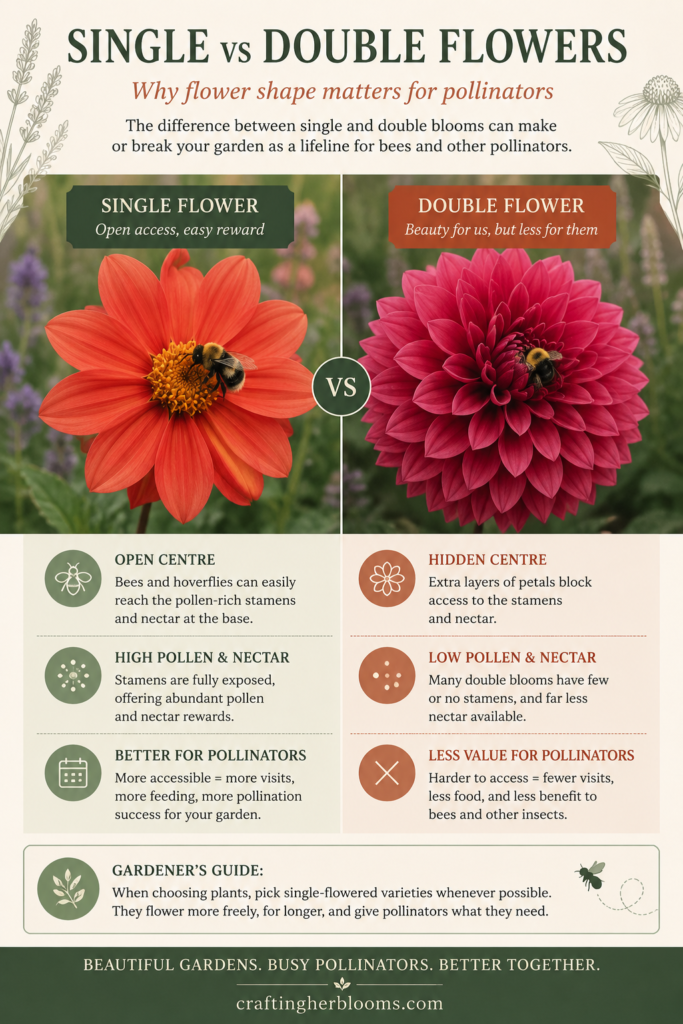
The practical upshot is straightforward. When a plant label offers you a choice between a single and a double form of the same variety, the single form is almost always the better choice for pollinators, and it is frequently the better choice for your border’s overall performance too, since single flowers tend to flower more freely and for longer. Keep this principle in mind as you read through the plant recommendations below, because it comes up again and again.
The Best Summer Pollinator Plants for UK Gardens
Lavender: The Backbone of a Summer Pollinator Border
No British pollinator garden earns its stripes without lavender, and for good reason. English lavender, botanically Lavandula angustifolia, is repeatedly identified as one of the most attractive summer plants for bees in UK conditions, and it has the added benefit of flowering reliably even through a dry, difficult summer once established.
Two cultivars come up again and again in UK growing advice: ‘Hidcote’, with its compact habit and deep violet-blue flower spikes, and ‘Munstead’, slightly looser and paler but often earlier into bloom. Both are hardy, both cope well with British winters, and both are widely available from garden centres and specialist herb nurseries across the country. If you want to extend the lavender season further, some of the Lavandula x intermedia cultivars, sometimes sold as lavandin, flower slightly later and produce noticeably longer stems, which is useful if you also want material for cutting and drying.
Positioning is where lavender succeeds or fails. It wants full sun, ideally a south or southwest-facing spot that gets at least six hours of direct light, and it absolutely will not tolerate sitting in wet soil over winter. Free-draining conditions are non-negotiable, so if your garden has heavy clay, work in horticultural grit at planting time or grow lavender in a raised bed or large container instead. For a deeper dive into varieties and pruning technique, our complete guide to growing lavender in the UK covers the full picture, including the specific autumn pruning approach that keeps plants compact and productive for years rather than turning woody and gappy after three seasons.
Care through summer is refreshingly simple. Deadhead spent flower spikes to encourage a second flush, and resist the urge to water once the plant is established, since lavender genuinely prefers to be left alone in a dry spell. The one task that matters is pruning lightly straight after flowering finishes in late summer, cutting back into the current season’s soft growth but never into old, woody stems, which will not reshoot.
Catmint: The Long-Flowering Workhorse
If lavender is the backbone of a summer pollinator border, catmint, botanically Nepeta, is the plant that keeps the whole scheme looking full and generous from June right through to September. Nepeta ‘Six Hills Giant’ is the variety most UK gardeners reach for first, producing a billowing mound of soft grey-green foliage topped with spikes of lavender-blue flowers that bees find almost impossible to resist.
Catmint’s real strength is its stamina. Where many summer perennials flower hard for a few weeks and then fade, a well-sited Nepeta will keep producing new flower spikes for months, particularly if you shear the whole plant back by around a third once the first flush starts to look tired in midsummer. This simple trick, sometimes called the Chelsea chop when done slightly earlier in the season, triggers a fresh flush of foliage and flower that carries the plant right through to autumn.
Grow catmint in full sun to very light shade, in any reasonably well-drained soil, and give it room to spread since it billows outward rather than staying neatly upright. It works beautifully as an edging plant along a border front, softening the line between lawn and bed while offering low-level nectar that ground-feeding insects and low-flying bees can access easily.
Achillea: Flat-Topped Flowers That Bees Can Land On
Achillea, commonly known as yarrow, brings something genuinely different to a summer pollinator border: a flat, plate-like flower head made up of dozens of tiny individual blooms clustered together. This structure is particularly valuable because it gives hoverflies and smaller solitary bees a stable landing platform, and because each flower head effectively offers multiple feeding opportunities in one visit.
UK garden centres now stock achillea in a striking range of colours, from the classic mustard-yellow of ‘Cloth of Gold’ to the soft terracotta and dusky pink shades of the ‘Summer Pastels’ mix, all of which perform reliably in British border conditions. Achillea is remarkably drought-tolerant once established, which makes it an increasingly sensible choice as UK summers trend hotter and drier, and it pairs naturally with other plants that share this resilience, something we cover in more depth in our guide to climate-resilient perennials.
Plant achillea in full sun in free-draining soil, since it tends to flop and struggle in anything too rich or damp. Deadheading the flat flower heads as they fade encourages further flowering through the summer, and leaving the last flush standing into autumn provides useful seed for birds once the pollinator season winds down.
Echinops: The Architectural Globe Thistle
Echinops, or globe thistle, brings genuine drama to a pollinator border with its perfectly spherical, steel-blue flower heads held on tall, upright stems. Beneath the striking appearance, though, is a genuinely excellent nectar plant, and the globe-shaped flower heads are covered in tiny individual florets that open in sequence, extending the flowering period considerably longer than a single-flush bloom.
Echinops ritro is the variety most commonly available in the UK and stays a manageable height of around 90cm to 1.2 metres, which makes it well suited to the middle or back of a mixed summer border. It thrives in poor, free-draining soil and genuinely prefers to be left alone once planted, needing no feeding and very little watering beyond its first season while establishing.
The architectural quality of echinops makes it a natural anchor plant, something to place where its distinctive silhouette can be appreciated against softer, looser neighbours like catmint or achillea. Bees, particularly bumblebees, are drawn to it in large numbers once it comes into full flower in July, and the seed heads that follow are attractive to finches later in the season.
Single-Flowered Dahlias
Dahlias have enjoyed a huge resurgence in British gardens over the past decade, and for pollinator purposes, the single and semi-double forms are genuinely valuable summer performers. This is the clearest possible illustration of the single versus double principle covered earlier: a single dahlia with its open centre of visible stamens will feed dozens of bees over its flowering life, while a fully double, pompon-style dahlia of the same colour may offer almost nothing.
Look specifically for varieties marketed as single or collarette dahlias, such as ‘Bishop of Llandaff’ with its near-black foliage and scarlet single blooms, which has become something of a modern classic in UK cottage borders. Dahlias flower from midsummer right through to the first frosts, which makes them one of the longest-performing plants on this list and a genuinely useful bridge into early autumn pollinator support.
In UK growing conditions, dahlia tubers are typically planted out after the last frost, generally late May in most of the country, and lifted or heavily mulched over winter in all but the very mildest coastal gardens. They want full sun and rich, well-drained soil, and regular deadheading through summer keeps new flowers coming rather than letting the plant divert energy into seed production.
Verbena Bonariensis: Height Without Bulk
Few plants deliver as much pollinator value for as little visual weight as Verbena bonariensis. Its wiry, near-transparent stems rise to around 1.5 metres and carry small clusters of purple flowers that seem to float above the rest of the border, allowing you to add height without blocking the view of shorter plants behind or in front.
This is consistently named among the top summer nectar plants in UK pollinator research, and it is easy to see why once you watch a border in full flower: butterflies, particularly peacocks and red admirals, seem drawn to it above almost anything else on offer. It self-seeds readily in most UK gardens, which some gardeners see as a bonus, since it fills gaps naturally, and others manage by simply hoeing off unwanted seedlings each spring.
Verbena bonariensis wants full sun and free-draining soil, and it copes well with poorer conditions than many border perennials. It is not reliably hardy in the coldest parts of the UK, so gardeners in Scotland and the far north of England may find it behaves as an annual, which is not necessarily a problem given how readily it self-seeds and how cheaply young plants can be bought each spring.
Borage: The Annual Bee Magnet
If you want fast, dramatic pollinator impact from seed sown directly in spring, borage is difficult to beat. Its clear blue, star-shaped flowers refill with nectar remarkably quickly after each visit, which means a single borage plant can support an extraordinary number of bee visits across a single day, and the flowers are so reliably nectar-rich that beekeepers have long prized borage as a forage crop.
Borage grows fast and large, often reaching 60 to 90cm within weeks of sowing, and it thrives in ordinary UK garden soil without any particular fuss. Sow directly outdoors from April through June for a succession of flowering plants right across the summer pollinator peak, and expect it to self-seed generously, so choose its spot with next year in mind or be prepared to weed out unwanted seedlings.
Borage sits particularly well in a productive or kitchen garden setting, since the flowers are also edible and make an attractive addition to summer drinks and salads. If your summer pollinator planting overlaps with a vegetable patch, borage earns its place twice over, supporting pollinators for your fruiting crops while asking almost nothing in return.
Flowering Herbs: An Easy Win for Productive Gardens
One of the simplest ways to boost pollinator numbers in a UK garden costs nothing and requires no new planting at all: simply let your herbs flower. Oregano and marjoram produce clouds of tiny pink-purple flowers that bees find genuinely irresistible, chives throw up rounded purple pom-pom flowers in early summer that are equally popular, and thyme, left unclipped for a few weeks, becomes a low carpet of nectar that ground-nesting bees favour heavily.
Fennel deserves particular mention here, since its flat umbels of small yellow flowers are a magnet for hoverflies in particular, and hoverfly larvae are voracious predators of aphids, which makes fennel a genuinely useful multitasker in a productive garden. If you are already growing herbs for the kitchen, our guide to growing herbs in pots across the UK covers positioning and care, and the same plants that feed your cooking can simply be left to flower for a few weeks before you cut them back for a fresh flush of leaves.
This approach works particularly well if your garden combines ornamental borders with a productive patch, since letting even a portion of your herb bed flower each summer costs you very little kitchen harvest while delivering a genuinely significant pollinator benefit. Chives in particular can be left to flower on a rotating basis, some plants cut for the kitchen while others are allowed to bloom, so you never lose the full harvest in any one year.
Building a Border for Bees: A Sample Summer Planting Plan
Understanding individual plants is one thing, but putting them together into a border that performs from June to August takes a bit of planning. Here is a sample layout for a sunny border roughly three metres long and a metre and a half deep, designed around the plants covered above and structured in the classic tall-back, low-front arrangement that UK gardeners will recognise from our broader guide to purposeful border planting.
Build Your Border: Summer Pollinator Planting Calculator
Tell us how long your border is, and we will scale the sample summer pollinator planting plan to fit, from architectural echinops at the back to billowing catmint along the front edge.
Back of the border
Middle of the border
Front edge
Fill any gaps: scatter a few borage seeds directly into any leftover space at planting time. Borage is not scaled to length here as it simply fills whatever room remains.
Figures are a guide based on a border roughly 1.5 metres deep. Adjust spacing to suit your own soil, aspect, and plant sizes at maturity.
At the back, plant three Echinops ritro spaced around 60cm apart, giving you a run of architectural steel-blue globes that will anchor the whole scheme by midsummer. Immediately in front of these, add a loose drift of five Verbena bonariensis, allowing their airy stems to weave forward and soften the more solid shapes behind them, since their see-through habit means they will not block the echinops from view even when planted closer to the front.
The middle of the border is where lavender and dahlias do their work. Run a line of five to seven lavender ‘Hidcote’ plants along roughly two-thirds of the border’s length, spaced 40cm apart to allow for their eventual spread, then interplant with two or three single-flowered dahlias such as ‘Bishop of Llandaff’ for a strong colour contrast and continued flowering once the lavender’s first flush fades in late July. Tuck two clumps of achillea into any remaining gaps in this middle zone, since their flat flower heads work well threading between the more upright lavender and dahlia stems.
Along the front edge, plant catmint in a generous run, five or six plants spaced 45cm apart, letting it billow forward over the border edge and soften the transition to lawn or path. If you have any leftover space, particularly at a border corner or along an unused edge, scatter a few borage seeds directly into the soil in April for fast, cheerful colour that will fill any gaps within weeks. This combination gives you continuous flower from early June through to the first frosts, genuine height and structure, and a mix of flower shapes that between them cover the needs of everything from tiny solitary bees to large bumblebee queens and passing butterflies.
Regional Timing Across the UK
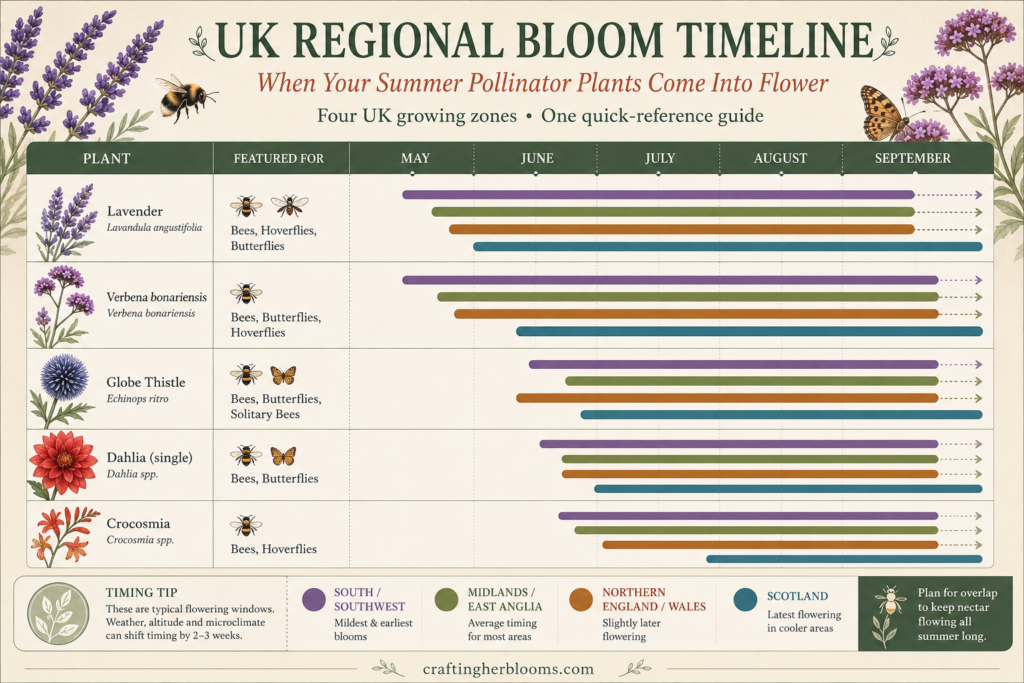
Summer pollinator planting timing varies meaningfully depending on where you garden. In the South and Southwest, borage can go in from mid-April, lavender and catmint typically hit their first flush by late May, and the whole scheme should be in full swing well before the June bank holiday.
Across the Midlands and East Anglia, push most of these sowing and planting dates back by one to two weeks, and expect lavender’s first flowering peak to land in early to mid-June rather than late May. Gardeners in Northern England and Wales should generally wait until early May for dahlia tubers and borage sowing, since late frosts remain a real risk into late April in many inland and upland areas.
In Scotland, particularly anywhere beyond the milder west coast, treat Verbena bonariensis as an annual unless you are in a genuinely sheltered, favoured spot, and expect the whole pollinator season to run two to three weeks later than in southern England, with peak flowering more concentrated into July and August rather than starting properly in June.
Caring for Your Pollinator Border Through Summer
Keeping this planting scheme performing through the full pollinator peak comes down to a handful of consistent habits rather than any complicated routine. Deadhead lavender, achillea, and dahlias regularly, since removing spent flowers is the single most effective way to keep a plant producing new blooms rather than diverting energy into seed.
Watering matters most in the first year while plants establish root systems, after which most of this planting list, with the notable exception of dahlias and borage, becomes genuinely drought-tolerant and needs little supplementary watering even through a dry British summer. Avoid pesticides entirely in and around this border, including so-called organic or natural sprays, since even products marketed as pollinator-friendly can affect bees if applied while plants are in flower.
If aphids or other pests do appear, resist the urge to spray immediately and give hoverflies and ladybirds a chance to arrive first, since a border already attracting pollinators tends to attract their natural predators too within a week or two. This is one of the quieter rewards of pollinator gardening: a well-planted border increasingly looks after its own pest problems as the wider insect population it supports grows more diverse and balanced.
Frequently Asked Questions
What flowers attract the most bees in a UK garden in summer? Lavender, catmint, and borage consistently rank among the most bee-attractive summer flowers in UK growing conditions, largely because they produce nectar reliably and refill quickly after each visit, allowing them to support far more individual bee visits per day than less generous flowering plants.
Should I deadhead lavender if I want to support pollinators? Yes, deadheading spent lavender spikes encourages a second flush of flowers later in summer, which extends the total nectar supply your plants offer rather than reducing it, since you are simply prompting more flowering rather than removing food the bees needed.
Are double-flowered dahlias bad for pollinators? Fully double dahlia varieties typically offer little to no accessible pollen or nectar because their reproductive structures have been bred out in favour of extra petals, so choosing single or collarette dahlia forms instead makes a genuine difference to how useful your plants are to visiting bees.
Can I grow a pollinator border in partial shade? Most of the plants covered in this guide, including lavender, achillea, and verbena bonariensis, need full sun to perform well and will flower poorly or become leggy in shade, so a bright, open, south or west-facing spot will always deliver better pollinator results than a shadier corner.
When is the best time to plant a summer pollinator border in the UK? Perennials like lavender, catmint, echinops, and achillea are best planted in spring or early autumn to allow root establishment before summer heat or winter cold, while borage and dahlias are better added once the risk of frost has passed, generally from mid-April in the south to mid-May further north.
Bringing It All Together
A genuinely useful summer pollinator border is not about cramming in every plant on this list, but about choosing a handful that suit your soil, aspect, and region, and then committing to the small habits, deadheading, avoiding pesticides, choosing single flowers over double, that make the biggest practical difference. Start with lavender and catmint if you are working with limited space or a tight budget, since these two alone will carry an enormous share of the summer pollinator load in most UK gardens.
If you have the room to build out a fuller scheme, the planting plan above gives you a genuine template rather than just a list of suggestions, one that has been thought through for succession, structure, and the specific needs of UK pollinators across a real summer. However you approach it, the reward is immediate and genuinely rewarding to witness: a border that hums, quite literally, with life through the very months when that life needs your garden most.
Continue Your Journey
If this guide has you thinking about your border’s wider design, our complete guide to purposeful border planting covers the structural principles behind building any UK wildlife-friendly border from scratch. For the plants that carry pollinator support earlier in the year, see the best plants for spring pollinators, which pairs naturally with everything covered here.
Container gardeners will find our guide to bee and butterfly buffet planters useful for adapting this same approach to pots and small spaces, and anyone building a wider pollinator-friendly plot should read our guide to climate-resilient perennials for plants that will keep performing as UK summers grow hotter and drier. Finally, if flowering herbs caught your interest, our complete guide to growing herbs in the UK will help you build a productive bed that feeds your kitchen and your local bee population in equal measure.
What is already flowering in your garden this summer, and which of these plants might fill the gaps? We would love to hear what is working in your own border.
If you would like seasonal planting reminders and more UK-specific growing guides like this one delivered straight to your inbox, join our newsletter list for monthly tips timed to exactly what your garden needs, when it needs it.