
The Best Garden Pruners: Which Shears Should You Get?

I sometimes use affiliate links in content. This doesn’t cost you anything but I may make a commission payment from anything you buy through these links. As an Amazon Associate I earn from qualifying purchases. All opinions remain my own.
Pruning is an important part of garden maintenance, and it can be done with a number of different tools. If you’re looking for the best garden pruners to help you with your gardening tasks, then you’ve come to the right place! In this blog post, we will take a look at some of the best shears on the market and see what makes them so great. So if you’re ready to learn more about pruning shears, keep reading!
What’s a Bypass Pruner?
In a nutshell, bypass pruners function similarly to scissors. Because the top blade of bypass pruners goes around the other, they are frequently chosen for regular pruning tasks. This is generally due to the fact that they are excellent in producing clean, smooth cuts to delicate plants in a garden without causing harm. They are frequently utilized on living, green plants.

What’s an Anvil Pruner?
On the other hand, anvil pruners resemble more of a knife on a chopping board than scissors. They’re excellent for cutting through tough wood or branches, but they tend to squash and crunch delicate plants. These are frequently used for dead brown vegetation.
To make pruning easier for you, we’ve compiled a list of some of the best hand pruners available. We’ve chosen our favorite bypass and anvil versions.
Forged & Grown
Garden pieces, printed to order
3D printed planters and garden accessories, made in the UK. Self-watering designs, sculptural shapes, colour options — each one made when you order it.


Best garden pruners
Lowe 1.101 Anvil Pruner
Lowe invented the anvil pruner, and it’s still made in Germany today. You won’t want to use any other brands of pruners after you’ve used this solid steel anvil pruner with replaceable parts, which makes extremely accurate cuts. Professional barbers use them every day and value comfort, longevity, and the high-quality cuts.


Felco F7 Pruner
The Felco F7 is the Cadillac of pruning shears, with a rotating, swivel handle for greater comfort and reduced blisters when you have a lot of trimming to complete. The blades can also be replaced. The spring is surrounded by a spiral guard that keeps dirt and debris out of the spring.


Corona BP 4840 Pruner
The Corona BP 4840 bypass pruner is made of high-carbon steel and is more durable than stainless-steel blades, yet they will rust quicker so you’ll need to pay attention to how you maintain them. The metal spiral guard on these shears prevents clogging.


Fiskars Powergear2 Ultrablade Softgrip Pruner
The Fiskars Powergear2 garden pruner has a contoured, rolling grip for more comfort when trimming. The bypass pruner handle also acts as a protection shield for the spring, protecting it from bits and grime that may get caught in the mechanism.


Okatsune 103 Japanese Garden Bypass Pruners
These Japanese-made pruning shears are razor-sharp to allow you to make precise, clean cuts in your garden. For ease of one-handed pruning, reviewers on Amazon suggest swiping the latch mechanism against your leg to open or close it.
The handles are also quite slick, which they warn users against slipping forward when using the smooth handles. You should wear gloves while utilizing these pruners to avoid injuring yourself. For a high-quality trimming experience, these pruners have extra accuracy.


Fiskars Power-Lever Anvil Garden Hand Pruners
Fiskars’ Power-Lever Anvil Pruners are a well-made pair of anvil pruning shears that can handle thick, dry branches with ease. The locking mechanism isn’t very secure, according to Amazon users, so be sure to store it someplace safe if you can’t lock it securely.


Tabor Tools K77A Straight Pruning Shears
For most jobs, most folks choose a decent pair of bypass pruning shears. These straight-blade versions, on the other hand, will be some of the finest pruning scissors you may use for smoothing and contouring your hedge. You can achieve a smoothly trimmed surface across the entire breadth of a hedge with these if you have one.
After each cut, the shock-absorbing spring in these scissors opens readily. The blades are made of stainless steel and are suitable for both small and big hands. These won’t chop branches, but they may be used to gather herbs, remove tips, or even grow plants indoors.
This is a more specialist choice than most of today’s selections. If you know you need it, this is the combination to have on hand. But if you learn that you do need it, this is the pair you’ll want to have in your grasp.


Happy Hydro Titanium Coated Trimming Scissors
Something that appears to be a more ancient style of bonsai shears will appeal to Traditionalists in the art of bonsai. However, there is a secondary benefit connected with a more contemporary world.
The smooth, non-slip grip and blades that are constructed of stainless steel offer strength but the titanium layer over the steel makes it easy to clean sticky stone pine sap from their surface. Furthermore, there’s a soft rubberized lining inside the handle to reduce fatigue.
Unlike most other shears we’ve seen, these have a springless mechanism. This is intended to prevent strain on your hands. The scissors’ short blades allow you to easily trim delicate leaves and slender branches.


How To Choose The Best Pruning Shears
It’s difficult to pick the ideal pruning shears since they come in so many varieties.
Is it a small branch that needs to be trimmed, or are you attempting to break down a dry and woody bush in order to remove it? Is your job more basic than usual pruning, or is it something more challenging?
Let’s look at some of the most prevalent characteristics of pruning shears and what they provide. This should at least give you an indication of which sort of shears you’ll need for your task.
Blade Styles And Types Of Cuts
Pruning shears come in a variety of blade shapes, just like good pair of loppers.
Bypass pruning shears are the best option for most people. In a scissors-like motion, an upper blade slides past a lower blade, resulting in a clean chop. Bypass pruners are ideal for most pruning jobs and are simple to clean and maintain.
Anvil pruning shears have a flat anvil-like base on which the upper blade descends. The lower anvil has a notch through which the blade may cut all the way through the material.
These anvil pruners are ideal for breaking stuff into smaller pieces, such as dry or dead material, which can be done without causing damage. Green stems might be crushed by their cutting technique.
A straight blade hand pruner has a scissor-style blade. Although they aren’t as popular as bypass or anvil pruners, they can help when getting into tight spaces.

Finally, there are snip-style pruning shears or pruning snips. These are like a pair of tiny, sharp-tipped scissors and are used for delicate pruning tasks. Straight or slightly curved blade versions are available.
A pair of snips may be the ideal instrument for delicate cutting. Just keep in mind that snips can’t cut anything thicker, and are usually used on green soft materials.
Blade Quality
Pruning shears are generally constructed of steel, but there are two versions available.
Carbon steel blades are extremely durable and can easily cut through a wide range of materials. To maintain them clean and lubricated, they must be cleaned and oiled on a regular basis, but they may last for years. Carbon steel is also very simple to sharpen as needed.
Stainless steel or lower-grade steels are also quite popular, although they are often coated with a nonstick material. The nonstick layer on the sharp blades might assist prevent resin buildup on them. However, over time, dents and nicks in the blade surface can develop in lower-quality steel.
Cutting Mechanism
Springback or ratcheted pruning shears are the two most popular cutting designs.
Backer pruners, bypass pruners, or snips are all examples of this type of shears. They have a powerful spring that opens the jaws of the shears once your hand grip loosens. On softer green wood, both are used for light to medium-strength pruning chores.

Pruners with an anvil-style blade are known as ratchet pruners. A ratcheting mechanism located behind the pivot point helps to apply additional pressure when cutting through heavier, denser materials.
This is especially essential when trying to break down a large amount of deadwood or condensing materials in order to put them in a compost pile.
Grip Coatings
There are several types of grip coatings accessible, and it’s critical to get the right ones for your needs.
The “Softouch” series of Fiskars scissors has soft grips that provide a reasonably soft surface against which your hand may apply pressure.
The textured rubber grip is more pleasant to use for extended trimming than a hard surface, and the light texture prevents it from slipping out of your hand.
A variety of handle materials are used, but the most frequent is PVC or rubberized grips, which are produced by dipping metal handles of a pair of pruning shears into liquid PVC plastic or rubber/silicone.
They’re typically quite comfy to grasp, but if your palm gets sweaty, the surface might become slippery. Wearing gloves while utilizing this approach tends to eliminate slipperiness.
Metal-bodied grips, when combined with hard plastic, resin, or PVC, are known as rigid grips.
These are highly durable, and they are unlikely to break even if you drop them a lot. With continuous use, the firm handle may be painful.
Safety Locks
Most pruning shears have a safety lock, which is similar to a locking mechanism on loppers. When the jaws aren’t in use, this basic mechanism keeps them shut.
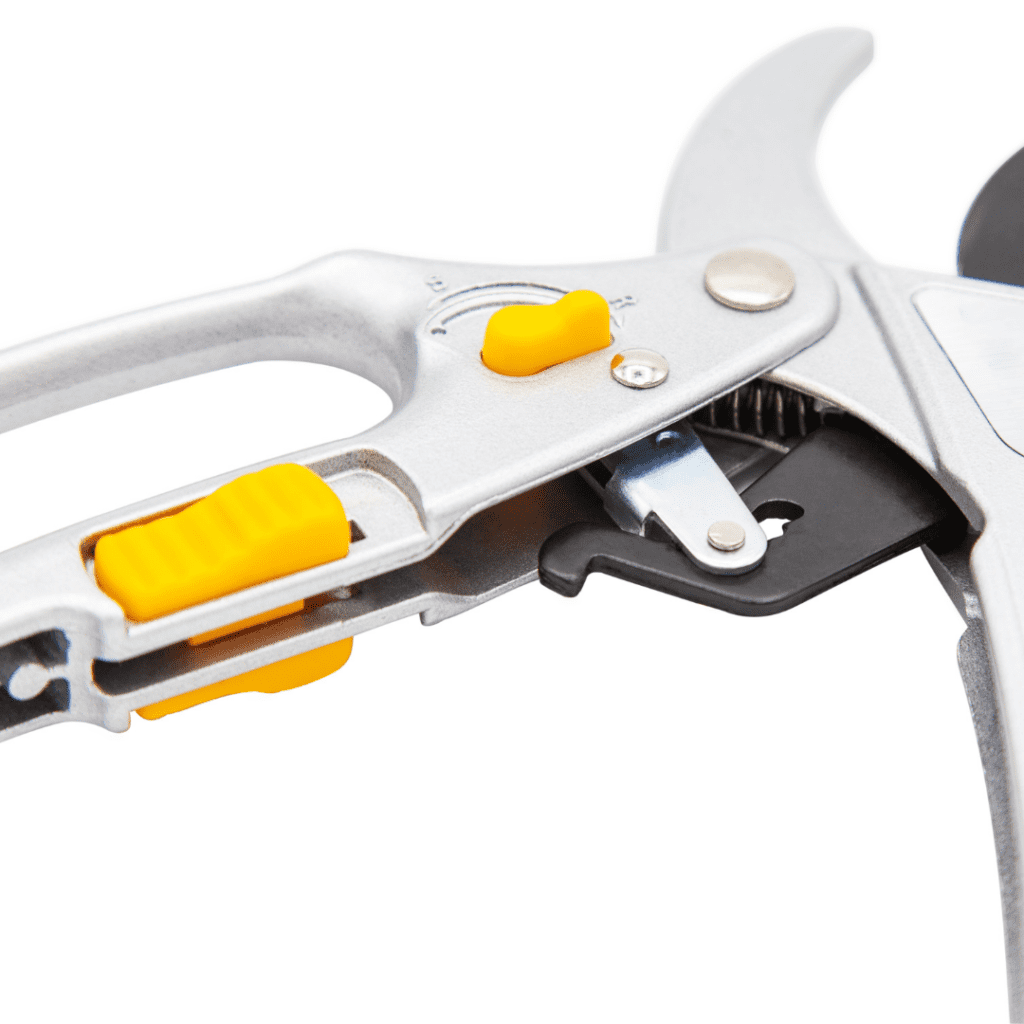
Springback styles need these. Otherwise, your blades would remain open and might be a hazard in your toolbox.
Look for a safety lock that is sturdy and will withstand many openings and closings without breaking. If you don’t want your pruning shears to open when not in use, get a sheath that will keep them shut.
Caring For Your Pruning Shears
You’ll need to maintain your pruning shears once you’ve acquired a decent pair. New gardeners frequently overlook this, but it is essential for a variety of reasons.
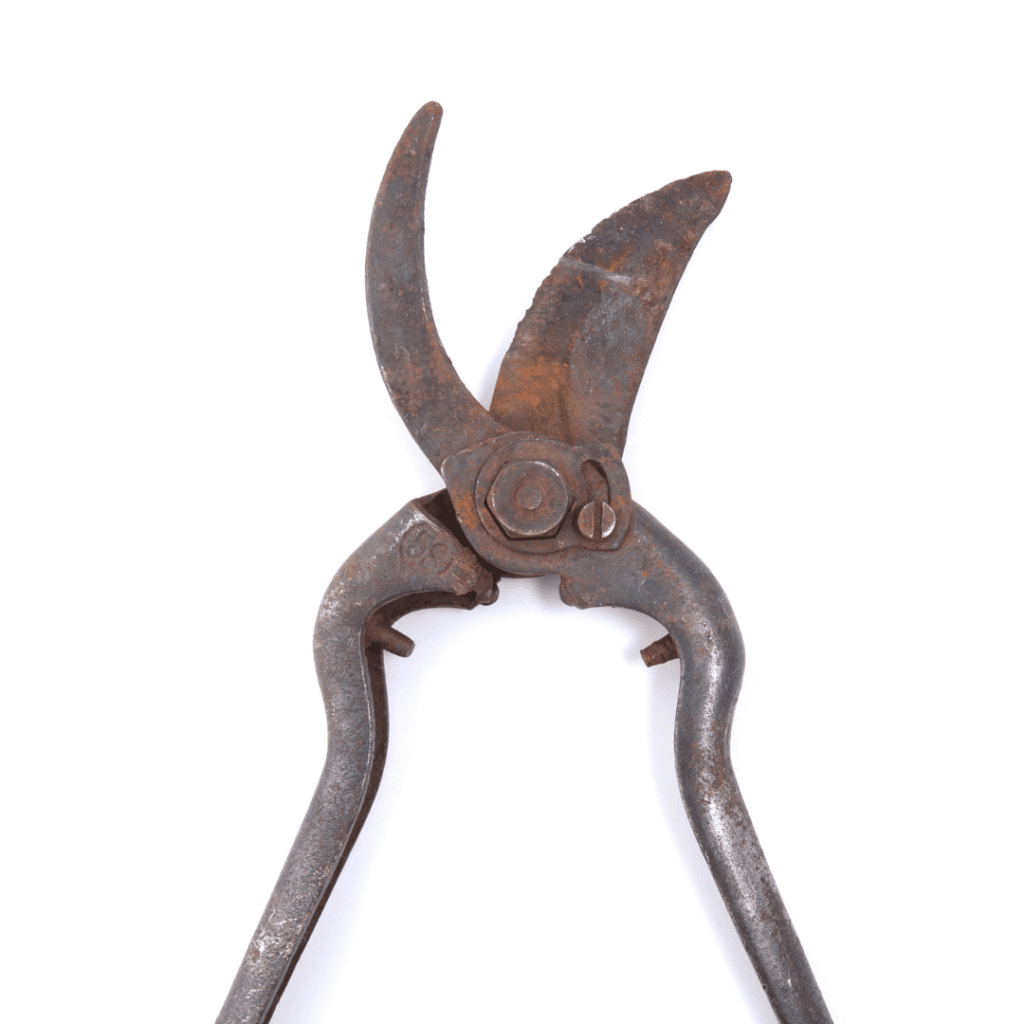
Keep your pruning shears clean and sanitary. Many plant illnesses can quickly pass from one plant to the next, whether through direct contact or via contaminated equipment. Cleaning and disinfecting your shears between uses, as well as sterilizing them while you’re pruning, may help to minimize the transfer of plant disorders.
However, it does not end there. Pruning shears that are well-oiled and cleaned can last for longer. Plus, a good sharpening will extend their lifespan considerably.
What if you’ve already been negligent with your pruning shears and allowed them to get rusty? Consider cleaning them up before purchasing a new pair to see whether they can be restored.


