
Winter Bedding Plants: The Best Choices for Colour in a UK Garden

I sometimes use affiliate links in content. This doesn’t cost you anything but I may make a commission payment from anything you buy through these links. As an Amazon Associate I earn from qualifying purchases. All opinions remain my own.
By late autumn, most of the garden is winding down. The vegetable beds are cleared, the summer bedding has gone leggy and brown, and the borders that felt so full in July start to look bare. Winter bedding plants are the one job left on the list that actually adds colour rather than tidying it away.
Done well, a winter bedding display carries a UK garden from the first hard frost right through to the daffodils. Done badly, or left too late, you end up with gappy pots and slug-chewed pansies that never really get going. This guide covers the plants worth growing, when to plant them across the UK’s regions, and how to keep them looking good through the coldest months.
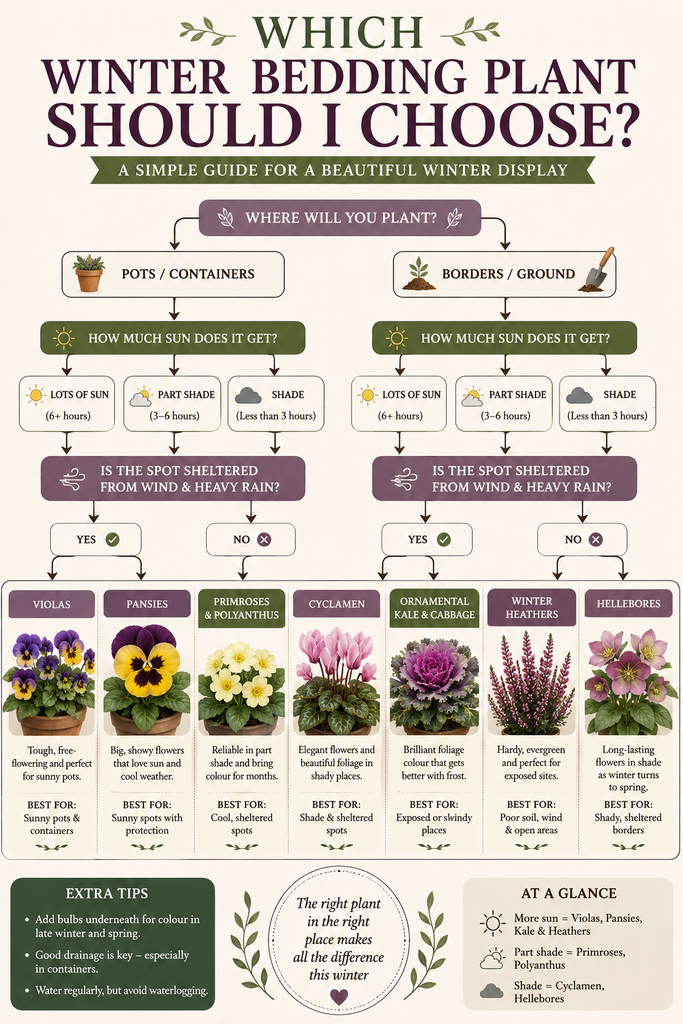
What Counts as a Winter Bedding Plant?
Winter bedding is the term for the hardy annuals, biennials and short-lived perennials planted from autumn to provide colour through the cold months, usually replaced the following spring. Unlike summer bedding, which is planted after the last frost and dies at the first one, winter bedding is chosen specifically for its tolerance of low temperatures, short days and wet British winters.
The best-known examples are pansies, violas, cyclamen and primroses, but the category also stretches to ornamental cabbages, heathers and hellebores. What they share is toughness. A good winter bedding plant needs to keep flowering, or at least hold its colour, through frost, driving rain and weeks of grey skies with barely six or seven hours of daylight.
Forged & Grown
Garden pieces, printed to order
3D printed planters and garden accessories, made in the UK. Self-watering designs, sculptural shapes, colour options — each one made when you order it.


This matters more in a British winter than almost anywhere else. The UK rarely gets the deep, dry cold that puts plants into total dormancy. Instead it gets mild, wet spells interrupted by sharp frosts, which is exactly the pattern that catches out plants bred for a more predictable climate. Varieties proven in UK trial gardens and garden centres are worth prioritising over anything marketed generically as “winter colour.”
Winter Bedding vs Spring Bedding
The two terms get used loosely, and garden centres often blur them together in the same display bay, but there is a real difference worth understanding before you buy. True winter bedding, pansies, violas, cyclamen, ornamental kale, is planted in autumn and bred to actually flower or hold colour through the coldest, darkest months.
Spring bedding, by contrast, is often the same autumn planting but chosen for a display that peaks later, from February or March onward, as light levels climb. Polyanthus and some primrose varieties sit in this category, giving relatively little in December but building to a much fuller display by April. Neither approach is wrong, but it is worth deciding which you actually want before planting, since a bed chosen for spring impact can look thin and disappointing through the darkest weeks if that was not the plan.
Most experienced UK gardeners plant a mix of both, using the true winter performers for immediate colour and layering in spring-peaking varieties and bulbs underneath for the display to build rather than plateau.
The Best Winter Bedding Plants for UK Gardens
Pansies and Violas
Pansies and violas do more winter bedding work in British gardens than any other plant, and for good reason. They flower from October through to April in a mild year, shrug off short frosts, and come in almost every colour combination going.
Violas are the tougher, more free-flowering of the two, with smaller flowers produced in far greater numbers. The ‘Sorbet’ and ‘Penny’ series are widely available and reliably hardy through UK winters, holding their flowers even after a cold snap. For larger, showier blooms, ‘Universal’ pansies are the standard winter bedding choice in garden centres nationwide, bred specifically to keep flowering at low light levels.
Both do best in a soil-based compost with reasonable drainage. Waterlogged roots, not cold, are what actually kills most pansies over winter.
Cyclamen (Cyclamen hederifolium and Cyclamen coum)
Hardy cyclamen are one of the few winter bedding plants that genuinely prefer to be left alone once planted. Cyclamen coum flowers from January into March in shades of pink, magenta and white, with attractively marbled foliage that stays decorative even before the flowers appear.
These are best in a sheltered spot with free-draining soil, since they resent sitting wet over winter. A woodland edge, the base of a deciduous tree, or a shaded container all work well. Once established, hardy cyclamen will self-seed and naturalise, spreading slowly into a reliable patch of winter colour that returns without replanting.
Primroses and Polyanthus
Primroses (Primula vulgaris) and polyanthus, their larger, more colourful cousin, flower from December through to May depending on variety and season. The ‘Crescendo’ series is a dependable garden centre staple, bred for weather resistance and a long flowering season.
They suit cottage garden planting schemes particularly well, looking equally at home massed in a border or mixed into a container with violas and bulbs. Primroses also cope better with damp shade than most other winter bedding, making them useful for the parts of a garden that get little winter sun.
Ornamental Cabbage and Kale
Ornamental cabbages and kales are grown for foliage rather than flowers, and they earn their place through sheer resilience. Varieties like ‘Nagoya’ and ‘Peacock’ develop increasingly intense colour, often deep purple, cream or pink, as temperatures drop, meaning the display actually improves through a cold snap rather than suffering from one.
They are particularly good value in exposed or northern gardens where flowering bedding can struggle, since the display comes from leaves rather than blooms that frost can damage. A row of ornamental kale along a path or in large pots gives structural winter interest that most flowering bedding cannot match.
Winter-Flowering Heathers (Erica)
Winter-flowering heathers, particularly Erica carnea and Erica x darleyensis varieties, flower from November through to March and are one of the few winter bedding options that are genuinely evergreen. ‘Springwood White’ and ‘December Red’ are established, widely stocked varieties that perform reliably across the UK.
Unlike most other heathers, these tolerate a wider soil pH range, which makes them a practical choice for gardens without acidic soil. They work particularly well underplanted with dwarf spring bulbs, since the heather provides structure while the bulbs push through for a second wave of colour.
Hellebores (Helleborus niger and Helleborus orientalis)
Hellebores flower later in the winter bedding calendar, typically from December (Helleborus niger, the Christmas rose) through into March (Lenten rose varieties), but they are worth including for their sheer reliability once established. Established plants come back every year, making them more of an investment piece than seasonal bedding, but a few added each winter build into a genuinely low-maintenance display.
They prefer a partially shaded spot with reasonable soil, and the nodding flower habit means they show best planted slightly above eye level, in a raised bed or on a slope.
Bellis Perennis (Winter Daisies)
Bellis perennis, the double-flowered form of the common daisy, gives a cheerful, compact display for edging beds or filling gaps in containers. It flowers from late autumn through spring and copes well with frost, though it can look tired after a very hard freeze and benefits from deadheading to keep flowering strong.
It pairs particularly well with taller pansies or violas, adding a low, neat edge to a mixed winter container.
Choosing Winter Bedding by UK Region
Winter bedding performance varies more by region in the UK than most gardeners expect, largely down to how early the first hard frost arrives and how much winter rainfall a given area gets.
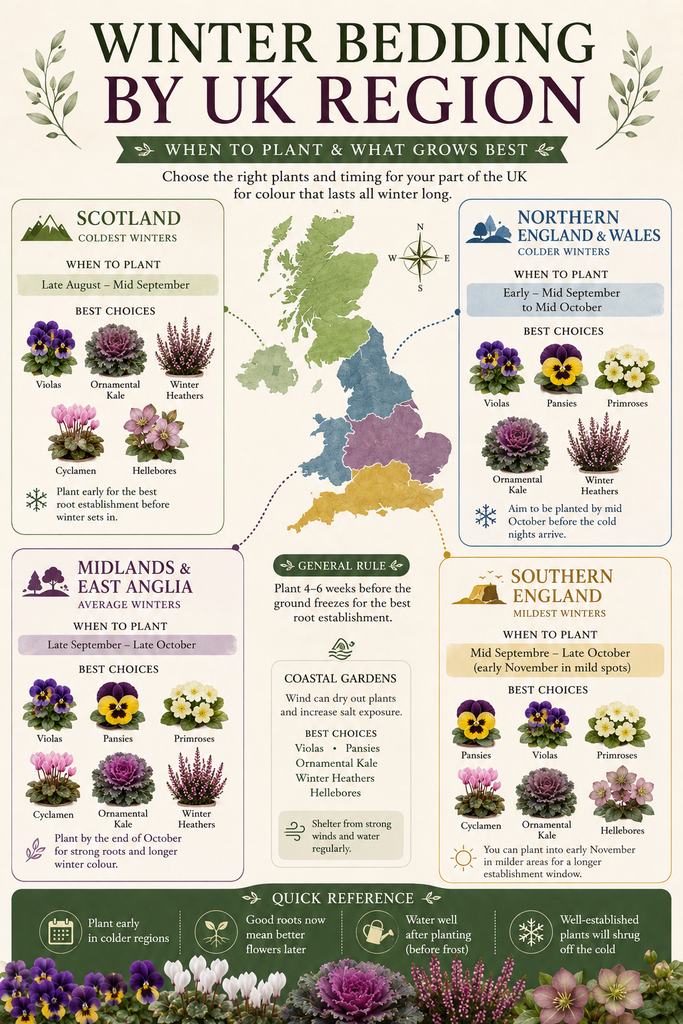
Southern England has the mildest and longest winter bedding season, with pansies, violas and cyclamen often still flowering into April. Planting can be left slightly later here, into late October, without losing much display time.
The Midlands and East Anglia see a shorter season and colder nights, particularly inland and away from coastal moderation. Ornamental kale and heathers tend to outperform more delicate flowering bedding here, and planting is best done by mid-October to give plants time to establish before the cold sets in properly.
Northern England and Wales benefit from choosing the hardiest varieties within each category, prioritising violas over pansies and heathers over cyclamen where a display needs to survive a harder frost. Raised beds and containers that can be moved against a sheltered wall perform noticeably better than open borders in these areas.
Scotland has the shortest and coldest winter bedding window, and gardeners here often get better results treating winter bedding as an early-spring rather than a true winter display, planting a little later and expecting flowering to concentrate from February onward. Heathers, ornamental kale and the hardiest viola varieties are the safest choices, and containers moved into an unheated greenhouse or against the house during the coldest spells make a real difference to survival.
These regional differences also apply to timing displays around local frost dates rather than a single UK-wide calendar. A first frost that arrives in early October in parts of Scotland and the North might not reach the South West until December, so treating “winter” as starting on a fixed date rather than a local weather pattern is one of the more common planning mistakes. Checking average first and last frost dates for your specific area, rather than relying on a generic UK figure, gives a far more accurate planting and protection schedule.
Coastal gardens across all four regions get a partial exemption from this pattern, since the sea moderates temperature swings and reduces the risk of hard, sudden frosts even at similar latitudes to colder inland spots. Gardeners on or near the coast can often treat their conditions as a milder microclimate than the regional average would suggest, and can push planting slightly later and hardiness requirements slightly lower as a result.
When to Plant Winter Bedding
The ideal planting window across most of the UK runs from late September to early November, giving plants time to establish roots in soil that is still relatively warm before growth slows for winter. Planting too late, once the ground has turned cold and wet, means roots struggle to establish and plants are far more vulnerable to both frost and rot.
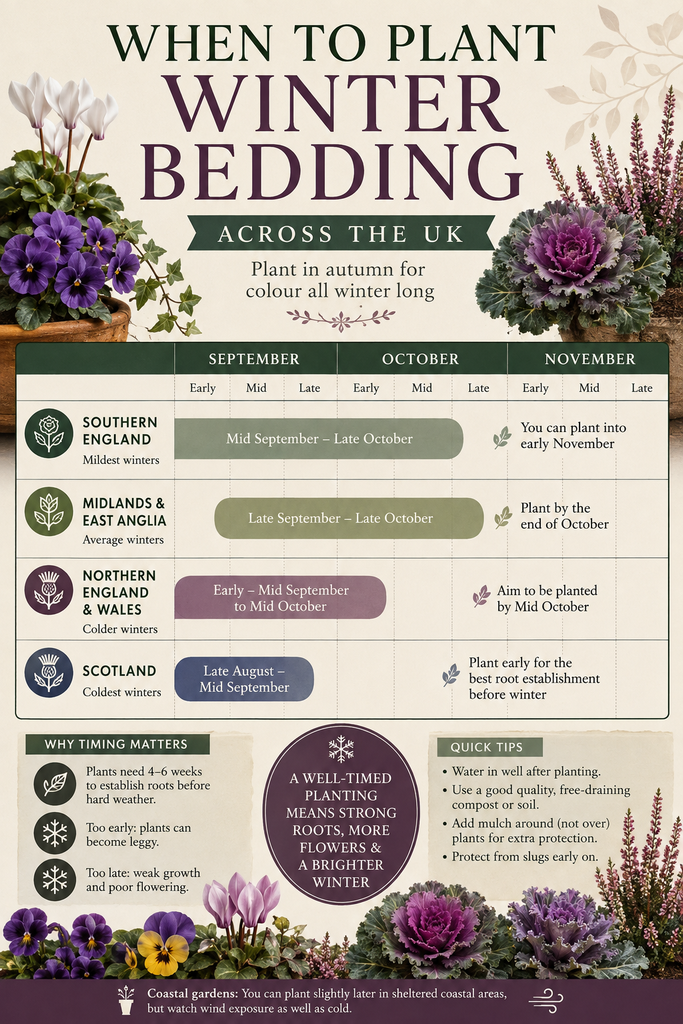
If existing summer bedding is still flowering well into September, it is usually worth holding off rather than ripping out productive plants early. But once summer displays start to fade, there is little benefit to delaying further. The earlier winter bedding goes in within that autumn window, the stronger it will be going into the coldest months.
Plug Plants vs Garden-Ready Plants
Winter bedding is typically sold in two forms, and the choice between them is mostly about timing and budget rather than quality. Plug plants, small young plants sold in trays, are cheaper and more widely available by post, but they need a few weeks of growing on in a cold frame or sheltered spot before they are sturdy enough to go straight into an exposed bed or container.
Garden-ready plants, sold in individual pots at a larger size, cost more per plant but can go straight into their final position, which makes them the better choice for anyone planting later in the autumn window or wanting an instant display. For a small garden or a handful of containers, garden-ready plants are usually worth the extra cost given how much of the display’s success depends on strong establishment before the cold sets in properly.
Containers, Beds and Borders
Winter bedding works in almost any planting situation, but containers and borders each come with their own considerations through a British winter.
Containers dry out less in winter than summer, but they are far more vulnerable to waterlogging and to the compost freezing solid, which can kill roots even in a plant that would survive perfectly well in open ground. Raise pots off the ground on pot feet to improve drainage, and group containers together against a house wall for mutual shelter from wind. Terracotta is particularly prone to cracking in hard frosts unless it is frost-proof rated, so check before committing a favourite pot to permanent outdoor use. Our guide to container gardening for UK gardens covers the wider planting principles that apply here too.
Beds and borders need reasonable drainage above almost anything else. Winter bedding planted into heavy clay that sits wet will rot at the root long before frost becomes the real problem. Working in grit or well-rotted compost before planting makes a meaningful difference on heavier soils, and raised beds are worth considering in gardens where drainage is a persistent issue.
Hanging baskets and window boxes are worth a special mention, since they freeze and dry out faster than any other planting method due to their small soil volume and exposure on all sides. Violas, trailing ivy and small cyclamen tend to cope best in this situation, and baskets are usually the first thing worth moving to shelter during a hard freeze.
Preparing Soil and Compost Before Planting
Winter bedding puts far more demand on drainage than on soil fertility, so preparation should focus there rather than on heavy feeding before planting. For containers, a soil-based compost such as John Innes No. 2 holds up far better over a wet British winter than a peat-free multipurpose mix alone, since it does not compact and waterlog in the same way after weeks of rain.
For open beds and borders, working in horticultural grit alongside well-rotted compost improves drainage on heavier soils without stripping out the organic matter plants need to establish. A layer of grit as a mulch around the base of individual plants, particularly cyclamen and hellebores, also helps keep foliage and crowns from sitting in constant damp, which is often what triggers rot rather than the cold itself.
Caring for Winter Bedding Through the Cold Months
Winter bedding needs far less attention than a summer display, but it is not entirely maintenance-free. Watering should continue through winter, though far less frequently than in summer, since UK winters bring plenty of rain but pots under eaves or house overhangs can still dry out surprisingly fast. Check compost with a finger before watering rather than working to a schedule.
Feeding is generally unnecessary if plants went in with fresh compost, but a low-nitrogen liquid feed every few weeks from late winter onward, as light levels start to improve, can extend flowering into spring. High-nitrogen feed is best avoided, since it encourages soft, sappy growth that frost damages easily.
Deadheading spent flowers on pansies, violas and Bellis keeps plants flowering for longer and prevents energy going into seed production instead. This matters more in a mild winter, when plants are actively growing, than during a hard cold snap when growth largely stops anyway.
Frost protection is worth reserving for the most vulnerable plants and the harshest forecasts rather than applying blanket cover to everything. Horticultural fleece thrown over containers on nights when temperatures are forecast well below freezing protects flowers and buds without smothering the plant, and it can simply be removed once the cold spell passes.
Common Problems in British Winter Gardens
Waterlogging causes more winter bedding losses than frost does. Roots sitting in cold, saturated compost or soil rot quickly, and the visible symptom, wilting despite wet conditions, is often mistaken for underwatering, leading to the problem being made worse rather than fixed. Improving drainage before planting is far more effective than trying to correct it afterwards.
Slugs remain active in mild UK winters far later than most gardeners expect, and a soft spell in December or January can bring on an unwelcome resurgence just as bedding is trying to establish. Copper tape around pots, and clearing damp hiding spots like fallen leaves near vulnerable plants, both help without resorting to anything harsh around edible or wildlife-friendly gardens.
Wind damage is a particular risk for taller or more exposed winter bedding, especially in coastal or upland gardens. Choosing lower-growing varieties for exposed spots, and grouping containers for shelter, reduces the risk of physical damage far more reliably than trying to stake small bedding plants.
Frost heave, where repeated freezing and thawing pushes shallow-rooted plants partly out of the soil, is a common but under-recognised problem in open borders. Checking plantings after a hard frost and firming any lifted plants back in prevents roots drying out and dying.
Grey mould (Botrytis) tends to appear on pansies and violas during mild, damp spells, showing as fuzzy grey patches on flowers and stems. Removing affected material promptly and improving air circulation between plants, rather than packing bedding in too tightly, keeps it from spreading.
Bird damage, particularly from pigeons, can strip the flowers and buds from pansies and primroses in gardens where food is scarce over winter. This tends to be worse in cold snaps when other food sources are limited, and a light layer of twiggy pea sticks pushed in among the display is usually enough deterrent without needing anything more elaborate.
Pairing Winter Bedding With Bulbs and Evergreens
Winter bedding looks best planted with a longer view in mind rather than as an isolated display. Underplanting pansies or violas with dwarf daffodils, crocus or snowdrops means a container or bed transitions naturally from winter flowers into an early spring bulb display without needing to be replanted twice. This is a technique used across the site’s wildlife gardening guides too, since early bulbs are also a valuable nectar source for the first pollinators of the year.
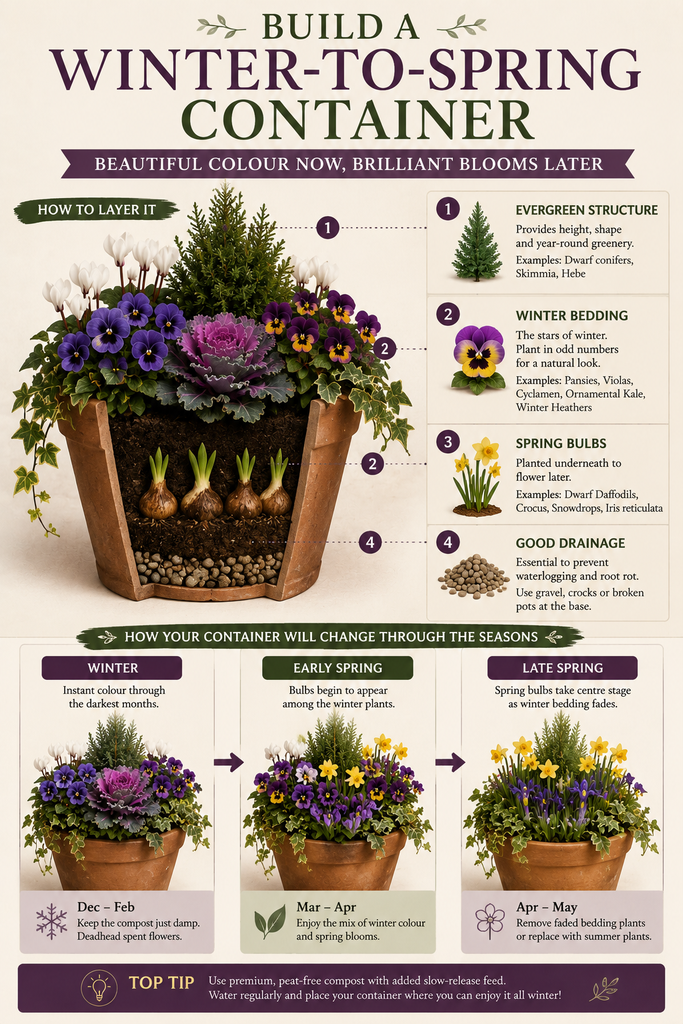
Evergreen structure, whether from dwarf conifers, ivy trained around a container edge, or a small box or holly, gives a winter display shape and permanence even when the bedding itself is between flushes of flower. This is a particularly useful trick in exposed gardens, where the evergreen also offers some physical shelter to more delicate bedding planted around its base.
For anyone extending winter interest into the vegetable plot as well as the ornamental beds, the crossover with winter cover crops is worth knowing, since a resting vegetable bed and a winter bedding display are solving a similar seasonal problem from different angles.
Frequently Asked Questions
Do winter bedding plants come back every year?
Most classic winter bedding, including pansies, violas, ornamental cabbage and Bellis, is treated as an annual or biennial and replaced each autumn. Hardy cyclamen, hellebores and winter heathers are genuine perennials that will return and often improve year on year if left in place.
Can I plant winter bedding after the first frost?
It is possible, but establishment will be slower and losses higher than planting within the recommended late September to early November window. If planting later, choose the hardiest options, particularly violas and ornamental kale, and expect a shorter display season.
What is the hardiest winter bedding plant for a UK garden?
Violas and winter-flowering heathers are generally the most reliably hardy across all UK regions, tolerating both hard frost and the wet, mild spells that catch out less resilient plants. Ornamental kale is a close third, since cold weather actually intensifies its colour rather than damaging it.
Why have my winter pansies stopped flowering?
This is usually down to either waterlogged compost, which stresses the roots, or a lack of deadheading, which lets the plant put energy into seed production instead of new flowers. Checking drainage and removing spent blooms regularly is the most common fix.
Do I need to protect winter bedding from frost?
Most established winter bedding varieties are bred to tolerate ordinary UK frosts without protection. Fleece cover is worth using selectively during unusually hard or prolonged cold snaps, particularly for containers, rather than as a routine measure.
Can winter bedding be grown in a shaded garden?
Yes, though the plant selection narrows. Primroses, hardy cyclamen and hellebores all tolerate shade better than pansies or heathers, which perform best with at least some direct winter sun.
Is it better to plant winter bedding in pots or straight into the border?
Both work well, but pots give more control over drainage and can be moved to shelter during the harshest weather, which makes them the lower-risk option in exposed or very wet gardens. Borders with genuinely good drainage will support the same range of plants with far less ongoing maintenance.
When should I remove winter bedding to make way for spring or summer planting?
Most winter bedding can stay in place until it visibly fades, typically April or May depending on the plant and the season, at which point it can be lifted and composted to make room for summer displays. Hardy perennials among the group, such as hellebores and heathers, are the exception and are best left in place permanently rather than treated as seasonal.
Continue Your Journey
For more UK-specific seasonal planting guidance, these related guides are worth exploring next:


