Summer Cottage Garden Plants: Classic Blooms for June to August

I sometimes use affiliate links in content. This doesn’t cost you anything but I may make a commission payment from anything you buy through these links. As an Amazon Associate I earn from qualifying purchases. All opinions remain my own.
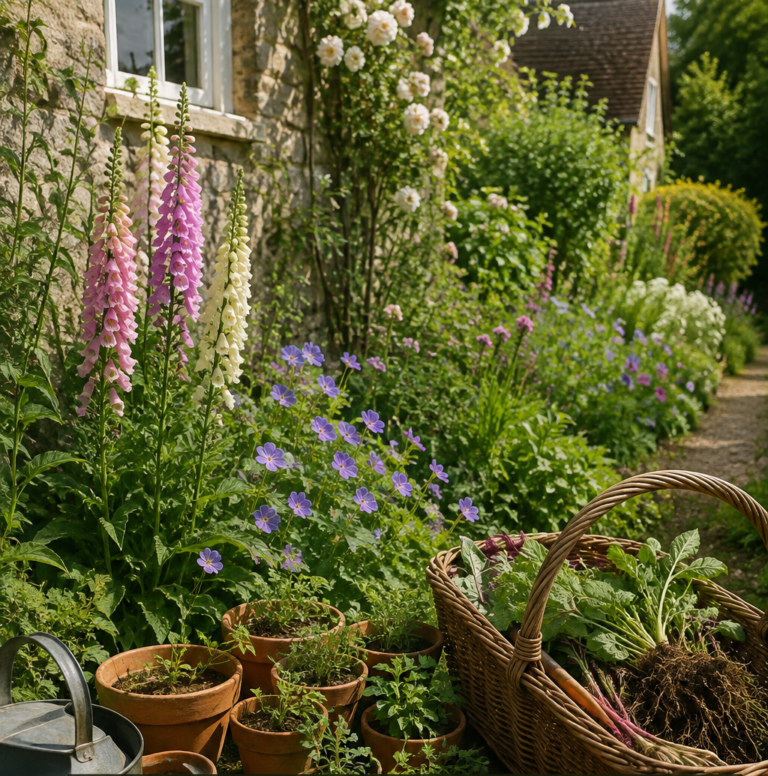
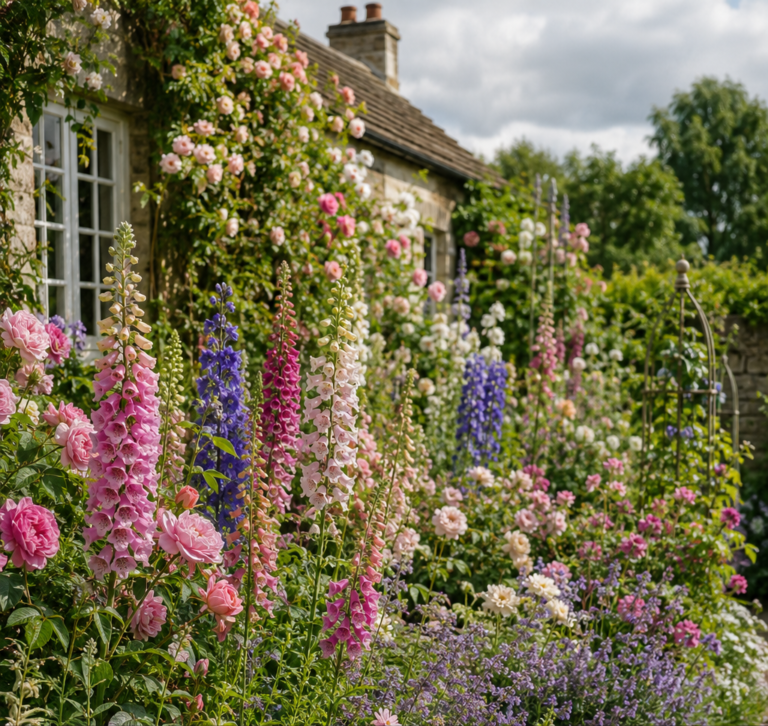
There is a particular moment in a cottage garden — usually somewhere around the third week of June — when everything arrives at once. Roses are billowing over the arch, delphiniums are pushing blue spires above the border, sweet peas are clambering up their wigwam and filling the air with something close to perfume, and the foxgloves haven’t quite finished yet. For a few weeks, it feels almost too much. Then July arrives, a few things go over, and the work of keeping the garden full and flowing begins in earnest.
That is the real secret behind the classic British cottage garden: it doesn’t happen by accident. The tumbling, overspilling look that makes these borders so beloved is the result of deliberate plant selection, good layering, and a set of simple maintenance habits repeated little and often through the growing season.
Get those things right and your garden can hold that feeling of abundance from the first roses in June all the way through to late August, when the hardy geraniums are on their second flush and the phlox is just hitting its stride.
This guide covers the classic plants that form the backbone of a summer cottage border — roses, delphiniums, sweet peas, foxgloves, and hardy geraniums — alongside the layering principles and care routines that keep everything looking full, rather than patchy, across three full months of the British summer.
Forged & Grown
Garden pieces, printed to order
3D printed planters and garden accessories, made in the UK. Self-watering designs, sculptural shapes, colour options — each one made when you order it.


The Classic Plants of a British Summer Border

Roses: The Heart of the Cottage Garden
No plant is more central to the British cottage garden than the rose, and the modern shrub roses available to UK gardeners have transformed what’s possible in a domestic border. Whereas the old once-flowering varieties would give a single magnificent flush in June and then spend the rest of summer being handsome but quiet, today’s repeat-flowering shrubs can carry blooms from late May through to the first frosts.
That longevity comes with conditions, though: the right growing environment and consistent deadheading are non-negotiable if you want the second and third flushes that make modern roses so extraordinary.
For a cottage-garden feel, the English roses bred by David Austin remain the most reliable choice. Varieties like ‘Gertrude Jekyll’ (deep pink, powerfully fragrant, reliably repeat-flowering), ‘Olivia Rose Austin’ (cupped blush pink, excellent disease resistance, outstanding for hips later in the year), and ‘The Generous Gardener’ (a tall, arching climber with soft pink blooms and a myrrh scent) have become staples of cottage borders from Cornwall to Caithness.
For Scotland and Northern England, look to the hardier varieties such as ‘Harlow Carr’, which carries exceptional cold tolerance without sacrificing flower quality.
Roses perform best in moist but well-drained soil in full sun — at least six hours a day — and respond enthusiastically to a handful of specialist rose fertiliser in April, with a second application after the first flush in July. Mulching the base of the plant in April keeps moisture in and suppresses weeds, which matters during the dry spells that have become a more regular feature of British summers.
The roses labelled ‘climbing’ or ‘rambling’ serve a slightly different purpose in the border: use them to cover arches, walls, and obelisks to create the vertical accents and height that make a cottage garden feel three-dimensional rather than flat.
Deadheading is where the magic of repeat flowering lies, and it’s worth spending a few minutes with the secateurs every couple of days in June and July. For most repeat-flowering roses, cut back to the first leaf with five leaflets below the fading bloom, making the cut at an angle above an outward-facing bud.
The exception to the deadheading rule is when you want autumn hips: leave a few late blooms uncut on varieties like ‘Olivia Rose Austin’, ‘Sophy’s Rose’, or any of the species roses, and they’ll reward you with jewel-like orange and red hips that feed birds through the winter.
Delphiniums: The Tallest Blue in the British Garden
If roses are the heart of the cottage border, delphiniums are its drama. No other hardy perennial delivers quite the same impact — those tall, densely packed spires of blue, violet, white, or purple, some of them reaching two metres or more at the back of a deep border, are one of the most photographed sights in British summer gardens.
They are, it must be said, not the easiest plants: they need staking, slugs kept away from the emerging crowns in spring, and good drainage to avoid the root rots that claim so many promising plants over winter. But get the conditions right and they repay every effort with something close to theatre.
Delphiniums are at their best in June and into early July, making them the ideal companion for the first flush of roses. For UK gardeners, the Pacific Hybrid series and the Elatum Group are both widely available from British nurseries including Downderry Nursery and Long Acre Plants.
Shorter varieties from the ‘Magic Fountains’ series are a sensible choice for exposed northern gardens where a two-metre spike would simply blow over. In Scotland and the north of England, plant delphiniums in sheltered spots facing south or west — the wind is the enemy of tall spires.
The key maintenance task after the first flush is cutting back the spent flower stems hard — down to where the basal leaves emerge from the ground — and applying a balanced liquid feed. In a warm July, this often triggers a second wave of flower spikes by August, smaller than the first flush but still genuinely beautiful. Protect the crowns with sharp grit through autumn: it deters slugs, improves drainage, and makes the difference between delphiniums that thrive for years and those that quietly disappear over winter.
Sweet Peas: The Cottage Garden’s Perfume
Sweet peas are perhaps the most quintessentially British summer flower, and their place in the cottage garden goes beyond aesthetics. The scent that rises from a well-grown wigwam of sweet peas on a warm July morning is one of the genuinely unrepeatable sensory pleasures of British gardening.
It is also entirely free, requiring only a sunny spot, something to climb, and the habit of picking or deadheading every few days.
For UK gardeners, the most successful strategy is to sow sweet peas in autumn — October through to early November — in a cold greenhouse or cold frame, using deep root trainers that allow the long roots to develop without being constricted. The ‘Spencer’ varieties are the classic choice for fragrance and long stems.
Stand-out options include ‘Matucana’ (deep maroon and purple, extraordinarily scented), ‘Painted Lady’ (bicolour pink and white, one of the oldest varieties still grown), and ‘Cupani’ (the species form, small-flowered but with a fragrance that stops you in your tracks) — all widely available from UK suppliers including Higgledy Garden, Thompson & Morgan, and Sarah Raven’s catalogue.
If you missed the autumn sowing window, sweet peas can be direct-sown outdoors from March in the south of England, April in the Midlands and East Anglia, and from mid-April in Northern England and Wales. In Scotland, sowing under cover in February and planting out once the frosts have reliably passed in late May gives the best results.
Whatever the sowing time, nip out the growing tip once the plants have three or four pairs of leaves — this single action significantly increases the number of flowering stems the plant produces.
The golden rule with sweet peas is to keep picking. Every pod that forms signals to the plant that its reproductive work is done, and flower production slows dramatically. Pick or deadhead every two to three days from the moment the first blooms appear, and the plants will keep producing well into August. Letting a few pods ripen at the very end of the season — September — to collect seed for next year is the only deliberate pause in this rhythm.
Foxgloves: Vertical Interest and Wildlife Value
Foxgloves bring something to the summer cottage garden that no other plant quite replicates: towering spires of tubular flowers, each one individually patterned inside with purple spots, reaching up through the border in shades of deep purple, pale pink, cream, and white.
They are biennial in their classic form — Digitalis purpurea — meaning they germinate and grow leaves in year one, then flower and set seed in year two before dying. That life cycle makes them feel slightly unreliable to gardeners used to perennials that simply reappear, but understand how to manage them and they become one of the most effortless contributors to the summer border.
The key is to allow self-seeding. Foxgloves scatter extraordinary quantities of seed when ripe — a single flower spike can produce tens of thousands of seeds — and if you avoid mulching too thickly around the base of spent plants, those seeds will find the soil and germinate freely. By their second summer, those seedlings will be flowering, and the cycle begins again.
Most experienced cottage gardeners simply allow the foxgloves to go where they want to go, editing only when they appear in genuinely inconvenient spots. This managed informality is the essence of the cottage style: the garden looks spontaneous because, in small but meaningful ways, it genuinely is.
For UK conditions, sow fresh foxglove seed in June or July, either in a nursery bed or directly into prepared soil, for flowering the following summer. Southern England, the Midlands, and East Anglia can sow until late July.
In Northern England and Wales, aim to sow by mid-July to give plants enough time to establish before winter. In Scotland, sow in June and consider giving young plants a little cold frame protection through their first winter.
Foxgloves are outstanding for wildlife. The tubular flowers are specifically shaped for bumblebees, particularly buff-tailed and garden bumblebees, and a flowering foxglove in a June garden will be visited by bees virtually continuously on any warm day. If the wildlife-friendly approach to summer gardening matters to you — and for most British cottage gardeners it increasingly does — foxgloves earn their place on ecological grounds alone.
Hardy Geraniums: The Reliable Backbone
If there is one plant that makes the cottage garden feel fuller than it actually is, it’s the hardy geranium — the true cranesbill, not the tender Pelargonium that fills summer bedding displays. Hardy geraniums are perennial, essentially permanent, and utterly unfussy about soil type.
They provide dense ground-covering growth that suppresses weeds and fills the gaps between the showier plants in the border, and many produce a second flush of flowers later in the summer if treated correctly.
For a June-to-August border, the most valuable varieties are those that bloom continuously rather than all at once. ‘Rozanne’ is the outstanding performer — a vigorous scrambling variety with large violet-blue flowers that bloom from June until the first hard frosts, requiring virtually no attention beyond removing dead stems in spring.
‘Johnson’s Blue’ is more compact, with intense blue flowers in June and July, and responds well to being cut back hard after its first flush to produce a second wave of both flowers and fresh foliage. For the front of a border, ‘Geranium sanguineum’ in any of its forms makes a low, spreading mat of magenta, pink, or white flowers that edges paths beautifully.
The Chelsea chop — cutting back roughly half the stems of a hardy geranium clump by two-thirds in late May — staggers the flowering so that not everything peaks simultaneously. For large clumps of ‘Johnson’s Blue’ or ‘Orion’, this technique extends the flowering period by several weeks and prevents the slightly ungainly look that can result when all the stems flop over together after their first flush.
The cut-back stems regenerate quickly, flower slightly later than the uncut stems, and the overall effect is a longer, more continuous display. This principle applies equally to other mid-border perennials like phlox and Shasta daisies.
How to Layer a Cottage Border for Three Months of Colour
Building Height and Structure
The characteristic look of a well-established cottage border — that impression of flowers tumbling over one another, no bare soil in sight, something always just coming into bloom as something else fades — is achieved through deliberate layering rather than accident. The three-tier structure of tall, medium, and low planting is the foundation.
At the back — or in the centre of an island bed — delphiniums, hollyhocks (biennial like foxgloves and equally self-seeding), and tall shrub roses like ‘The Pilgrim’ or ‘Gentle Hermione’ provide the height. In the middle layer, medium-height roses, peonies, phlox, and Shasta daisies take over as the delphiniums fade.
At the front, hardy geraniums, catmint (Nepeta), lavender, and calendula knit the border together, blurring the edge of paths and giving the planting that soft, overflowing quality.
Vertical accents matter enormously in the cottage garden, and this is where climbers earn their space. Sweet peas on wigwams or obelisks placed within the border create height without taking up much ground space, while climbing roses trained over arches provide the classic backdrop.
Honeysuckle scrambling into a shrub gives height without any support structure at all. These vertical elements prevent the planting from looking too flat, especially as you move through the season and the tall back-of-border plants come and go.
Companion Planting Principles for the Cottage Border
The cottage garden tradition has always been loosely aligned with what we’d now call companion planting, even if the Victorians who established the style didn’t use that term. Alliums planted at the base of roses are one of the most visually beautiful combinations in the early summer border — and they’re also believed to reduce aphid pressure and help prevent black spot.
French marigolds scattered through the border attract hoverflies and deter aphids, and their orange and yellow tones complement the pastel palette of traditional cottage planting without overwhelming it. Sweet peas grown on the same support as climbing beans bring bees to the vegetable garden whilst making the structure look considerably more beautiful than bare poles.
If you want to explore these relationships further, the complete guide to companion planting for UK gardens covers the full picture.
The Maintenance Habits That Keep a Cottage Garden Full
Deadheading: Little and Often
Of all the habits that separate a cottage garden that holds its colour all summer from one that becomes tired and patchy by mid-July, deadheading is the most important and the most consistently undervalued. Removing spent blooms prevents plants from putting energy into seed production, redirecting it instead into new flower buds.
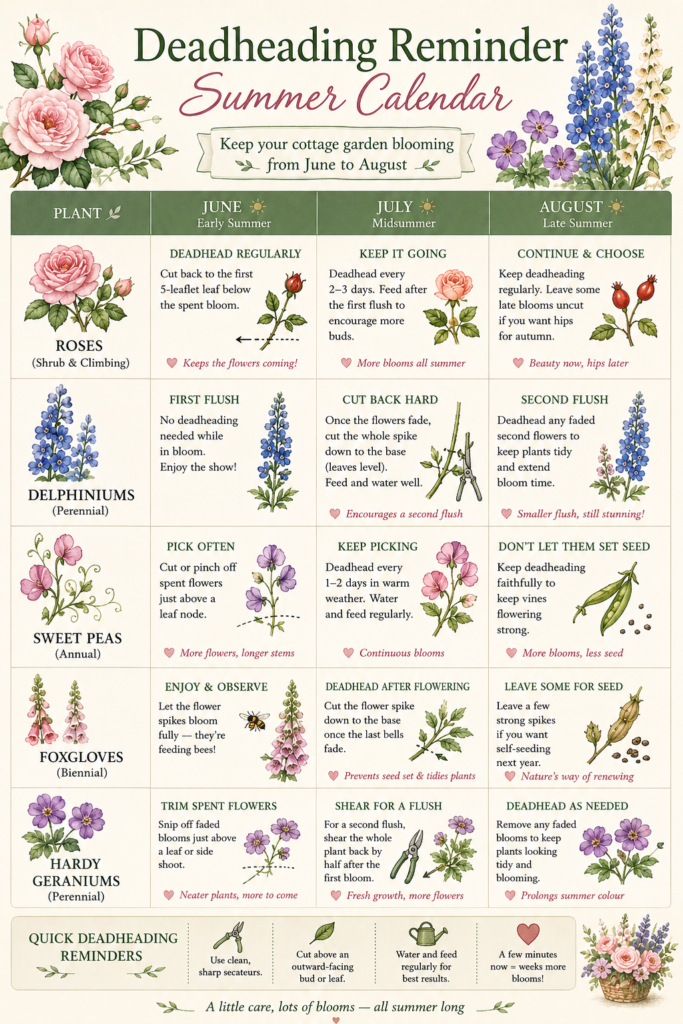
For sweet peas, this is an absolute necessity — miss a week and the plants effectively retire. For roses, it’s what turns a once-flowering display into three months of bloom. For phlox, it extends the season by weeks.
The most effective approach is to deadhead during a slow walk around the garden rather than treating it as a dedicated task. Fifteen minutes every couple of days with a pair of snips is genuinely more effective than a longer session once a fortnight, because it prevents any plant from completing the seed-formation process that triggers the slowdown in flowering.
Some plants — foxgloves and alliums, for instance — are better left to set seed deliberately, both for self-seeding and for the wildlife value of the seed heads.
Feeding Through the Season
A cottage border in full June-to-August production is working hard, and feeding through the season makes a significant difference to both the quantity of flowers and the length of the display. Roses benefit from a granular rose fertiliser in April and a second application in July, immediately after the first flush has been deadheaded — this is what produces the full repeat of flowers that makes modern shrubs so extraordinary.
Delphiniums respond to a liquid seaweed feed after cutting back following the first spike. Hardy geraniums are less demanding but appreciate a handful of balanced general fertiliser worked into the soil in spring.
For pots and containers within the cottage-garden scheme — sweet peas, pelargoniums, and trailing fuchsias are all popular for filling gaps or adding colour to the patio edge — weekly liquid feeding from late May through August is essential. Container plants have no access to the reserves in open soil, and without regular feeding they exhaust the nutrients in their compost within weeks.
A high-potash tomato feed is excellent for flowering container plants, and the results of consistent weekly feeding compared to irregular or no feeding are immediately visible.
Watering Wisely in the British Summer
British summers have become increasingly unpredictable — recent years have brought both extended dry spells in June and July and periods of heavy rain that compact soil and damage flowers. Watering at the roots rather than overhead is the most effective approach for cottage border plants.
It gets water to where the plant can actually use it, avoids the fungal issues that can develop when foliage stays wet overnight, and reduces evaporation during the warmer parts of the day.
For roses in particular, overhead watering should be avoided where possible: wet foliage, especially in humid conditions, encourages black spot. Water in the early morning or evening, directing the hose or watering can at the base of the plant rather than over the flowers.
Grouping thirsty plants — particularly sweet peas, which need consistent moisture to perform at their best — together in the border allows more targeted watering without the same volume needed for drought-tolerant companions like hardy geraniums and lavender.
Mulching the border in April or May with well-rotted garden compost or bark chips serves two purposes: it reduces evaporation significantly during dry spells, meaning you need to water less, and it suppresses annual weeds that would otherwise compete with border plants for moisture and nutrients.
The Chelsea Chop and Strategic Cutting Back
The Chelsea Chop — cutting back certain mid-border perennials by roughly a third in late May, traditionally around the time of the RHS Chelsea Flower Show — is one of those techniques that sounds slightly aggressive but pays dividends through July and August. The principle is simple: plants that have had part of their growth removed in late May flower later and more compactly than untreated stems, so cutting back half of a large clump staggers the flowering across a longer period.
Hardy geraniums are the most common candidates. Cutting back a clump of ‘Johnson’s Blue’ after the first flush produces fresh foliage and a second wave of flowers in August that can be striking, and phlox, Shasta daisies, and asters all respond well to a partial chop in late May.
Cutting back entire plants rather than just part of each clump is a more dramatic intervention: reducing a clump of ‘Geranium × magnificum’ to a few centimetres above the ground after flowering in June produces a complete set of fresh new leaves within a fortnight, and sometimes a second flush of smaller flowers in late summer.
Managing the In-Between Weeks
When the Delphiniums Fade and Before the Phlox Takes Over
Every summer border has a potential lull — the awkward few weeks when the early flush of roses and delphiniums has faded, and the phlox, Shasta daisies, and late-season perennials haven’t yet hit their stride. Identifying your own border’s lull and planning deliberately to fill it is one of the more satisfying exercises in cottage garden management.
Annuals are the most versatile solution for filling summer gaps. A pot of Cosmos ‘Purity’ or ‘Dazzler’ dropped into a bare spot in the border provides immediate colour that lasts until the frosts, and cosmos grows fast enough that seeds sown in April under cover produce flowering plants by late June.
Zinnias, grown in the same way, provide the vibrant reds and oranges that can feel surprisingly at home alongside the more pastel cottage palette. Nigella (‘Love in a Mist’), sown direct in April, self-seeds prolifically and fills the spaces between perennials with fine-cut foliage and sky-blue or white flowers in June and July.
The cut flower garden guide on this site covers many of the best annuals for cutting and using in arrangements as well as in the border — and the two purposes are compatible, since regular cutting has the same effect as deadheading in encouraging continued production.
Embracing the Relaxed Cottage Aesthetic
Part of what makes the cottage garden such a forgiving style is its built-in tolerance of the imperfect. A foxglove appearing in the middle of the border rather than the back is charming rather than wrong. A sweet pea that has wandered into a neighbouring rose is a happy accident. A hardy geranium sprawling over the path edge isn’t a problem to be solved — it’s the effect you were aiming for. This willingness to edit rather than control, to direct rather than dictate, is what separates the cottage aesthetic from more formal garden styles.
Allow self-seeders to wander within reason. Foxgloves, poppies, aquilegias, and calendulas all contribute to the sense that the garden has been there a long time and is comfortable with itself — which is precisely what the cottage style is trying to achieve.
The editing work — removing seedlings that appear in genuinely wrong places, thinning where plants become overcrowded — is much lighter than the work of maintaining formal planting, and it keeps the garden looking refreshed rather than tired.
Regional Timing for UK Gardeners
The British climate’s significant variation from south to north means that the timing of peak performance for summer cottage plants varies considerably across the country. Understanding your region’s rhythm helps you plan which plants will carry the border at which point in the season, and prevents the disappointment of expecting June roses in Scotland or July phlox in Cornwall before it’s ready.
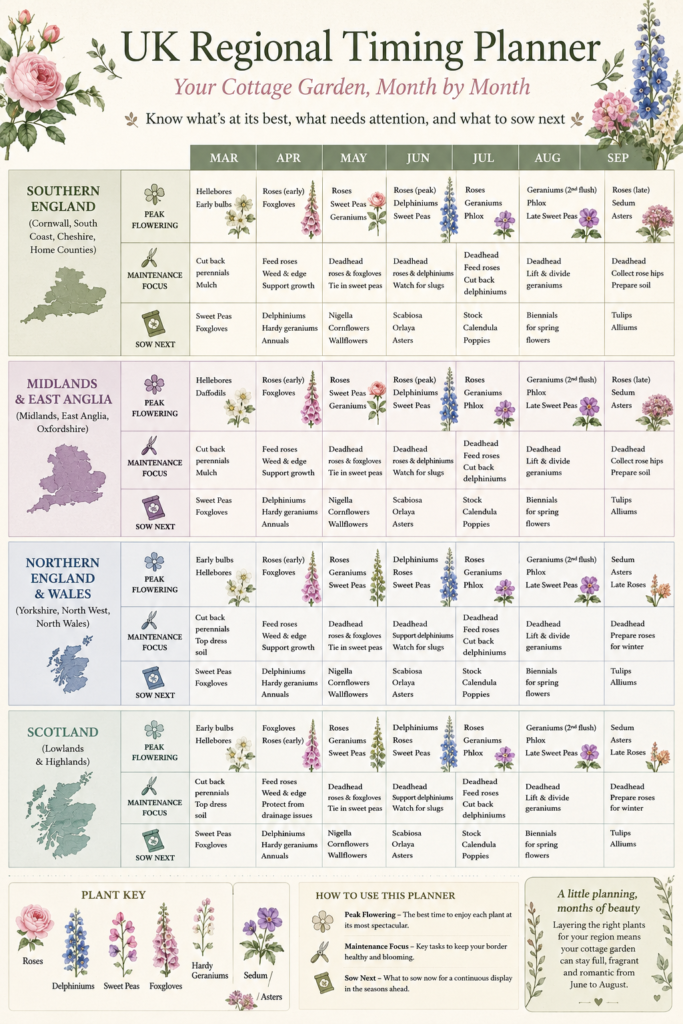
Southern England (Kent, Sussex, Somerset, Cornwall): Roses typically begin in late May, delphiniums peak in June, sweet peas are at their height through July, and phlox and late perennials carry the border through August into September. The longer, warmer season allows a full second flush from repeat-flowering roses and a strong second wave from cut-back geraniums.
Midlands and East Anglia (Nottinghamshire, Cambridgeshire, Worcestershire): Expect roses from early June, with delphiniums and foxgloves peaking in late June and early July. Sweet peas sown under cover in February will be performing through July. Hardy geraniums cut back after their June flush will be back in colour by early August.
Northern England and Wales (Yorkshire, Lancashire, Cumbria, North Wales): The season runs roughly two to three weeks behind the south. Roses come into their own in June, delphiniums peak in July, and the border is often at its most colourful in July and early August rather than June and July. Choose shorter, sturdier delphinium varieties and site sweet pea wigwams in the most sheltered spots.
Scotland (Central Belt and south): A June-to-August cottage garden is entirely achievable in Scotland, but plant selection and siting matter more. Stick to the hardier rose varieties — David Austin’s colder-climate selections, or old Scottish varieties like ‘Souvenir du Docteur Jamain’ on a sheltered south-facing wall — and grow delphiniums in the ‘Magic Fountains’ range.
Foxglove and hardy geranium combinations are the most reliable backbone for a Scottish summer border. Sweet peas sown under cover in February and planted out after the last frosts — typically late May — will perform well into August.
Frequently Asked Questions
How do I keep my cottage garden looking full from June to August without gaps?
The key is planting in layers — tall plants at the back, medium plants in the middle, low plants at the front — and using fast-growing annuals like cosmos and nigella to fill any bare patches that appear mid-season. Consistent deadheading and the Chelsea chop technique to stagger flowering are the maintenance habits that prevent the tired, patchy look that often appears by late July.
Which cottage garden plants are best for wildlife in the UK?
Foxgloves, single-flowered hardy geraniums, open-centred roses, sweet peas, and catmint are all outstanding for pollinators. Foxgloves are particularly valuable for bumblebees; sweet peas attract both bees and butterflies; single-flowered roses provide accessible pollen and nectar that double-flowered varieties do not. Avoid highly doubled forms of any flower if attracting bees and butterflies is a priority.
When should I cut back delphiniums after flowering?
Cut back the main flowering spike to the basal leaves immediately after it fades — typically in July for most UK regions. Apply a balanced liquid feed at the same time. In a warm season, secondary spikes should appear within four to six weeks.
Can I grow cottage garden plants in a smaller garden?
Absolutely. Many of the key players are available in shorter, more compact forms: ‘Magic Fountains’ delphiniums, bush sweet peas like ‘Patio Mixed’, and compact hardy geraniums like ‘Penny’s Pink’ and ‘Patricia’ all work well in smaller spaces. Use vertical space with obelisks for sweet peas and climbing roses on a wall or fence.
How do I stop sweet peas from stopping flowering?
Pick or deadhead every two to three days without exception. A single pod allowed to develop to maturity tells the plant its reproductive work is done, and flower production slows. Keep the plants well watered and fed — a weekly liquid feed with a high-potash fertiliser makes a visible difference to the duration and quantity of flowering.
Should I deadhead foxgloves?
Only if you don’t want them to self-seed. If you’re happy for foxgloves to spread and reappear throughout the border — which is very much in the spirit of the cottage garden — allow the seed heads to ripen and scatter before removing the spent stems. If you want to control where they appear, deadhead immediately after flowering.
Conclusion: The Art of Keeping the Border Full
A June-to-August cottage garden at its best is one of the most sustaining things a British garden can offer — a place where something is always happening, always arriving, always just coming or just going. It requires attention, but the attention it requires is pleasant: the morning walk with the snips, the weekly liquid feed, the satisfaction of a well-timed Chelsea chop producing a second flush when you need it most.
The five plants at the heart of this guide — roses, delphiniums, sweet peas, foxgloves, and hardy geraniums — are the foundation. Master them, learn the layering principles and the maintenance rhythms, and the cottage garden will reward you with three months of fullness that genuinely earns its reputation as the most beloved of all British garden styles.
Continue Your Journey
How to Create a Cottage Garden in the UK: The Complete Guide — everything you need to plan and plant a cottage garden from scratch, including border design principles and the best structure plants.
The New Cottage Border: Nostalgic Shrubs, Fruiting Plants, and the UK Gardens Getting It Right — how the cottage style is evolving in British gardens, with edibles and fruiting plants woven into the traditional border.
Ultimate Guide to Geranium Care for UK Gardeners — a deep dive into hardy geraniums and pelargoniums, covering varieties, care, and how to use them across different garden styles.
Starting a Cut Flower Garden: From Planning to First Harvest — many classic cottage plants double beautifully as cut flowers; this guide covers how to harvest and condition them for the vase.
How to Create a Wildlife Garden from Scratch: The UK Beginner’s Guide — a companion guide exploring how the plants in your cottage border can support bees, butterflies, and birds throughout the season.
Ready to plan your summer border? Join the Crafting Her Blooms community for seasonal planting guides, variety recommendations, and UK-specific timing delivered straight to your inbox.
What’s the star plant in your cottage garden this summer — and which combination are you most proud of? Share in the comments below.