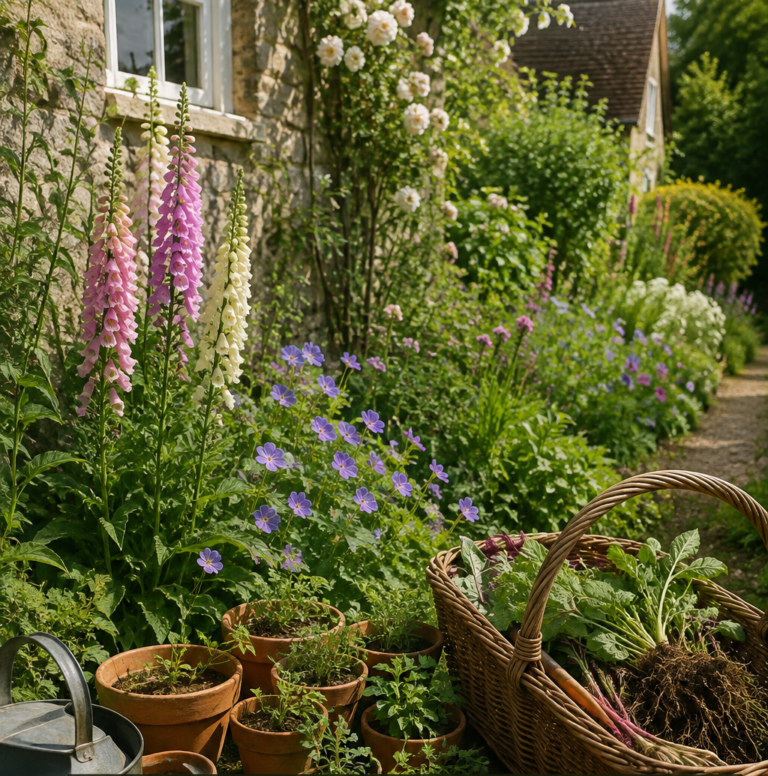
The Best Cottage Garden Plants for a UK Garden: 20 Classics for Year-Round Colour

I sometimes use affiliate links in content. This doesn’t cost you anything but I may make a commission payment from anything you buy through these links. As an Amazon Associate I earn from qualifying purchases. All opinions remain my own.
There is something quietly extraordinary about a well-planted cottage garden. It looks effortless — a happy tumble of colour and scent spilling over paths, tall spires jostling against soft mounds of foliage, bees moving from bloom to bloom with obvious purpose. In reality, that apparent chaos is the result of careful plant selection, and getting the planting list right makes all the difference between a border that sings from April to October and one that peaks in June and then quietly gives up.
British gardens are, it turns out, perfectly suited to this style. Our cool, moist summers suit many of the classic cottage garden stalwarts far better than the heat of continental Europe, and our long growing season rewards perennials that build slowly into impressive clumps. Whether you are starting a border from scratch, refreshing an existing planting, or simply looking to add a few new plants to fill in the gaps, this guide covers twenty of the best cottage garden plants for UK conditions — with seasonal notes, regional tips, and honest advice on what actually thrives.
For help thinking through the overall design, our guide to how to create a cottage garden in the UK covers structure, paths, and the layered planting approach in detail. Once you have your plant list sorted, the new cottage border explores how modern gardeners are blending traditional favourites with fruiting plants and structural shrubs.

Spring Stars: March to May
The cottage garden does not spring into life all at once — it builds, wave by wave, from the first tentative aquilegias of April through to the bold irises of late May. Getting this early-season layer right is essential, because it carries the border until the summer perennials take over.
Forged & Grown
Garden pieces, printed to order
3D printed planters and garden accessories, made in the UK. Self-watering designs, sculptural shapes, colour options — each one made when you order it.


Aquilegia (Granny’s Bonnet)
Aquilegias are the quintessential cottage garden self-seeders — and they are extraordinarily easy to establish in UK gardens. They begin flowering in late April in the south, often as late as May in Scotland and the north, bridging that awkward gap between spring bulbs and full summer perennials. The flowers — spurred, nodding, in shades ranging from deep purple and dusky pink to creamy white and bicoloured combinations — have an antique quality that suits the relaxed cottage aesthetic perfectly.
Plant them in drifts rather than rows, and resist the urge to deadhead every stem. Allowing a few seed heads to ripen means the plants naturalise freely, popping up between roses and beneath shrubs in that characteristic cottage-garden way. They cope well in part shade, making them useful in the shadier sections of a border where little else wants to flower.
Foxglove (Digitalis purpurea)
Foxgloves are the vertical exclamation marks of the cottage garden. Their tall spires — typically reaching one to two metres in the right conditions — provide height and drama at a time of year when most perennials are still building. As biennials, they need sowing one year to flower the next, but once established they self-seed prolifically enough that you effectively always have a supply.
They thrive in part shade and tolerate drier soils than many cottage garden plants, making them particularly useful beneath deciduous trees and shrubs where other plants struggle. In milder parts of the UK — the west of England, much of Wales, and lowland Scotland — they naturalise along woodland edges and in hedgerows, which tells you a great deal about their adaptability.
Bearded Iris (Iris germanica)
The brief, bold flowering season of bearded irises — typically three to four weeks in late May and early June — is one of those things that cottage gardeners plan their whole year around. The blooms are extraordinary: intricate, ruffled, often two-toned or with distinctive beards in contrasting colours. Plant the rhizomes shallowly with the top surface exposed to sun; they rot in wet, shaded conditions and perform poorly if buried too deep.
Good UK varieties include ‘Jane Phillips’ (clear blue), ‘Champagne Elegance’ (soft apricot and white), and the deep velvet purple of ‘Superstition’. They do best in the south and east of England, where summers are warm enough to ripen the rhizomes. In wetter, cooler regions, raised beds or exceptionally well-drained sites are advisable.
Peony (Paeonia lactiflora and hybrids)
Peonies are the romantic heart of the late-spring cottage garden. The flowers — sumptuous, often scented, ranging from simple singles to extravagant doubles — sit atop sturdy stems and last beautifully as cut flowers. They are extraordinarily long-lived once established; well-planted peonies can thrive in the same spot for decades.
Plant them in autumn in a sunny, well-drained position and resist any temptation to move them once settled. The golden rule is to plant them shallowly — eyes no more than 3–5cm below soil level — as deep planting prevents flowering. ‘Sarah Bernhardt’ remains one of the best-loved varieties in UK gardens for its reliable, fragrant, pink blooms in late May and June.
Alliums
Alliums occupy a particularly useful ecological niche in the cottage garden: they follow on naturally from tulips in late spring, their globe-shaped flower heads floating above lower plantings on long, leafless stems. The structural quality of that round, often violet-purple head works beautifully with the softer shapes of aquilegias and the emerging foliage of roses and geraniums.
‘Purple Sensation’, ‘Globemaster’, and the taller ‘Gladiator’ are all reliable in UK conditions. Plant bulbs in autumn at a depth of roughly three times their diameter. They attract pollinators well — bees and hoverflies visit them enthusiastically — which is one reason they feature prominently in the best plants for spring pollinators in a UK garden.
Early-Midsummer Mainstays: May to July
This is the season most people picture when they think of a cottage garden: the roses are out, the delphiniums are at their best, the air carries the warm sweetness of mock orange blossom, and the whole border seems to exhale into fullness.
Delphiniums
Few plants define the British cottage garden more firmly than delphiniums. Their tall spires — reaching one and a half to two metres in good conditions — are iconic back-of-border plants, and their blues in particular are a colour rarely achieved by any other garden plant. They need rich, moisture-retentive soil, a sheltered position (they are notoriously susceptible to wind damage), and reliable staking. In return, they deliver an extraordinary mid-June display.
After the first flush, cut the spent spikes back to encourage a second, smaller flush of flowers in late summer. They perform best in the cooler, moister conditions of northern and western Britain, where the summer heat is less likely to scorch their foliage and where rainfall is more reliable.
Roses — Climbers, Ramblers, and Shrubs
No cottage garden planting list is complete without roses, and the right varieties are what separate a genuinely beautiful cottage border from one that just looks like a garden centre. The most useful roses for cottage-style planting are the repeat-flowering shrub roses — varieties like ‘Gertrude Jekyll’ and ‘Olivia Rose’ — which combine the soft, blowsy bloom shape associated with old roses with the practicality of modern disease resistance and long season.
Climbers and ramblers bring vertical interest to walls, arches, and pergolas. ‘Albertine’ and ‘New Dawn’ are both widely loved in UK gardens. For detail on planting, pruning, and the best varieties for British conditions, our guide to growing roses covers everything you need to know.
Mock Orange (Philadelphus)
Mock orange earns its place in the cottage garden on scent alone. The heavy, sweet fragrance — carrying on warm early-summer evenings — is the smell of British summer at its most classic. It is a shrub rather than a perennial, providing year-round structure while the perennials around it die back and re-emerge.
Position it near a path, gate, or seating area where the fragrance will be encountered and appreciated. ‘Belle Étoile’ is a well-behaved choice for smaller gardens, staying at around two metres. After flowering, cut a third of the oldest stems back to the base to keep the plant productive.
Lavender (Lavandula angustifolia)
Lavender is one of the most searched-for topics in UK gardening, and for good reason: it is versatile, low-maintenance, pollinator-friendly, and beautiful. As a cottage garden plant, it works best as an edging plant along paths and borders, where its soft, grey-green mounds create a gentle transition between hard landscaping and planting. ‘Hidcote’, with its deep purple flowers and compact habit, is the most widely planted variety in British gardens; ‘Munstead’ is similarly compact and reliable.
For a full breakdown of varieties, pruning timing, and regional growing advice, the complete UK guide to growing lavender is the place to start.
Hardy Geraniums (Cranesbills)
Hardy geraniums — not to be confused with the tender pelargoniums commonly called geraniums — are the workhorses of the cottage garden. They fill space beneath roses and shrubs, knit together taller plants, and flower for extended periods with very little attention. Many produce a first flush in late spring, can be cut back hard immediately after, and reward this treatment with a fresh flush of flowers in late summer.
For comprehensive advice on varieties and care, our guide to geranium care for UK gardeners covers the full range from groundcover types to taller, border varieties.
High Summer Colour: June to August
Midsummer is when the cottage garden reaches its full, glorious complexity — a layered mix of heights, textures, and colours that rewards close examination and looks wonderful from across the garden.
Nepeta (Catmint)
Nepeta is one of the most useful cottage garden plants there is — not quite a feature plant in the way that a delphinium or a rose is, but the essential connective tissue that makes everything around it look better. Its hazy, soft-blue flowers and grey-green aromatic foliage seem to harmonise with almost everything, and it has a particular affinity with roses, softening their stems and filling the gaps between taller plants.

After the first flush, cut the whole plant back by about two thirds — a satisfying, five-minute job that results in a second, strong flush of flowers in late summer. ‘Six Hills Giant’ is the most generous variety for larger borders; ‘Walker’s Low’ (despite its misleading name, it does get to around 60cm) suits most UK garden sizes.
Border Phlox (Phlox paniculata)
Border phlox brings one of the pleasures of the mid-to-late summer cottage garden that is easy to overlook: scent. The domed flower heads — ranging from pure white and soft pink through to intense magenta and striped bicolours — carry a distinctive, sweet fragrance that is strongest in the evening. They flower in July and August, filling the gap as early-summer perennials begin to fade.
They need moisture-retentive soil and do not perform well in dry conditions — a point worth noting for gardeners in the east and southeast of England, where irrigation during dry spells will be needed. Divide congested clumps every three to four years in autumn to keep them vigorous.
Geum
Geums are reliably cheerful cottage garden plants — producing their bright, often saucer-shaped flowers in shades of orange, red, yellow, and soft apricot from late spring through to mid-summer. ‘Mrs J. Bradshaw’ has been popular in British gardens for over a century and remains excellent value; more recent introductions like ‘Totally Tangerine’ extend the colour range and the flowering season.
They are unfussy about soil and tolerate both sun and part shade, which makes them useful in mixed plantings where conditions vary along the border’s length.
Achillea (Yarrow)
Achillea brings a different texture to the cottage garden: flat-topped flower heads in warm shades of yellow, apricot, terracotta, and cream held above feathery, aromatic foliage. They are drought-tolerant once established, which makes them genuinely useful in free-draining, sunny positions where phlox or delphinium would struggle. The flat flower heads are also magnets for pollinators — hoverflies in particular.
The ‘Achillea millefolium’ cultivars are the most widely available and the best starting point for most UK gardens. Cut the stems for dried flower arrangements before they fully open, and they retain their colour remarkably well.
Ornamental Salvias
Ornamental salvias have become increasingly popular in UK cottage-style planting over the past decade, and it is not hard to see why. They are long-flowering, drought-tolerant, attractive to bees, and available in a range of heights from low mounding types to tall, border specimens. ‘Caradonna’ is a particularly beautiful form, with deep violet flowers on near-black stems; ‘Hot Lips’ brings a cheerful red-and-white bicolour to the mid-border.
Most ornamental salvias need a free-draining position and perform best in the south and midlands of England. In colder regions — parts of Scotland and exposed northern gardens — treating them as half-hardy and replacing annually may be more reliable.
Craftingherblooms.com
Which Cottage Garden Plant Suits Your Garden?
Answer four quick questions and we’ll suggest your perfect match.
1. How much sun does your border get?
Late-Season Interest: August to October
One of the marks of a well-designed cottage garden is that it does not simply peak in June and then decline. Planning for late-season interest keeps the border looking full and purposeful well into autumn.
Sedum / Hylotelephium ('Autumn Joy' Types)
The fleshy, glaucous foliage of sedums is attractive from the moment it appears in spring, but their real moment comes in late summer and autumn when the flat, domed flower heads turn from pale green to dusty rose to brick red. They are extraordinarily valuable plants for pollinators at a time of year when other nectar sources are declining, and they hold their structure into winter, providing seedheads that birds visit regularly.
Position them at the front to mid-border in full sun and well-drained soil. They tolerate poor soils better than almost any other cottage garden plant, which makes them useful in the drier, thinner spots that challenge more demanding perennials.
Asters (Michaelmas Daisies)
Asters extend the colour season into September and October with their cheerful, daisy-like flowers in shades of purple, mauve, pink, and white. Modern varieties have largely overcome the powdery mildew problems that affected older cultivars — 'Little Carlow', 'Monch', and the Symphyotrichum cultivars are all reliably healthy in UK conditions.
They combine beautifully with the warm yellows of rudbeckia and the fading seedheads of earlier perennials, creating the kind of naturalistic late-season planting that extends the cottage garden well into the cooler months.
Rudbeckia
Rudbeckia fulgida 'Goldsturm' is one of the most reliable late-season perennials in the UK cottage garden — producing clear yellow, black-centred daisies from late July through to October on compact, 60–70cm plants. It is tolerant of most soils, performs well in both sun and part shade, and self-seeds gently without becoming a nuisance.
The warm, golden tones of rudbeckia pair naturally with the purple of asters and the terracotta of sedums, creating the kind of harmonious late-season palette that rewards thoughtful planting.
Dahlias
Dahlias have undergone something of a renaissance in British gardens over the past decade, and rightly so. No other plant offers quite the same combination of diversity — from the dense, globe-like pompoms and decoratives to the simple, open-faced singles favoured by pollinators — and length of season. A single tuber planted in May can be producing flowers continuously from July until the first frosts.
In warmer parts of the UK — the south and west — tubers can often overwinter successfully in the ground with a thick mulch of compost. In colder, wetter regions, it is more reliable to lift and store them in a frost-free shed over winter. Our guide to growing edible flowers includes some of the decorative-yet-edible dahlia varieties worth including in a productive cottage garden.
Self-Seeding Annuals: Cosmos, Snapdragons, and Ammi
No cottage garden planting is complete without a layer of self-seeding annuals to fill the inevitable gaps. Cosmos bipinnatus is one of the most useful — producing feathery foliage and delicate, airy flowers in white, pink, and deep magenta from June until the first frosts. Snapdragons bring vertical interest and extraordinary longevity as cut flowers. Ammi majus (bishop's flower) produces elegant, white, umbellifer-type flowers that combine beautifully with almost everything and attract a wide range of beneficial insects.
Scatter seeds in autumn for the earliest plants the following year, or sow under cover in March and April for planting out after the last frosts. If you are interested in growing flowers specifically for cutting, our guide to starting a cut flower garden covers planning, harvesting, and conditioning in detail.
Making the Most of Your Cottage Garden Planting
The twenty plants listed here give you a working framework for a cottage border that delivers something interesting from March to October. The secret to making it feel genuinely cottage-like rather than simply eclectic is to plant in irregular groups, allow generous repetition of certain key plants throughout the border (nepeta and hardy geraniums, in particular, tie a planting together beautifully when repeated), and resist the urge to deadhead and tidy everything the moment it fades.

Soil preparation matters enormously. Most cottage garden plants prefer a well-drained, reasonably fertile soil — not too heavy, not too light. If you are working with clay, incorporating plenty of organic matter before planting will transform results; if your soil is very sandy, the same applies. Our guide to understanding soil types is a useful starting point for gardeners working with challenging ground.
Finally, remember that the cottage garden is a living thing that changes from season to season and year to year. Self-seeders move around, unexpected combinations emerge, some plants spread while others quietly fade out. The willingness to observe, adjust, and let the planting develop its own character over several seasons is what produces a cottage garden that feels genuinely alive — and genuinely your own.
Continue Your Journey
How to Create a Cottage Garden in the UK: The Complete Guide — Everything you need to know about structure, paths, and layered planting from the ground up.
The New Cottage Border: Nostalgic Shrubs, Fruiting Plants & the UK Gardens Getting It Right — How to blend traditional cottage garden favourites with contemporary planting ideas.
How to Grow Lavender in the UK: Complete Guide to Varieties, Pruning & Care — In-depth advice on the cottage garden's most indispensable edging plant.
The Best Plants for Spring Pollinators in a UK Garden — Extend the wildlife value of your cottage border with the best pollinator plants for early season.
Starting a Cut Flower Garden: From Planning to First Harvest — Many cottage garden plants double as exceptional cut flowers — here is how to make the most of them.
Which cottage garden plant do you find the most rewarding to grow — or the most challenging? Share your experience in the comments below.
Ready to grow a more beautiful garden? Sign up for the Crafting Her Blooms newsletter for seasonal planting guides, variety recommendations, and honest UK growing advice delivered straight to your inbox.