
Lemonading Your Garden: Why Embracing Imperfection Is This Year’s Smartest Trend
I sometimes use affiliate links in content. This doesn’t cost you anything but I may make a commission payment from anything you buy through these links. As an Amazon Associate I earn from qualifying purchases. All opinions remain my own.
There is a particular kind of guilt that comes with gardening in Britain. It is the guilt of the gappy border, the bolted lettuce, the self-seeded foxglove that has muscled its way into the middle of your carefully planned colour scheme.
For years, the instinct has been to fix it, dig it out, or quietly hope nobody notices before the next mow. This year, a different instinct is taking hold, and it has a name borrowed straight from a childhood saying: lemonading.
Lemonading is the gardening trend built on the old idea that when life gives you lemons, you make lemonade. Instead of treating a dead plant, a patch of moss, or an opportunistic seedling as a failure to correct, lemonading treats it as raw material for something more interesting.
It has been flagged as one of the defining ideas in this year’s most-watched garden trends report, and it is landing especially well in the UK, where unpredictable weather and time-poor schedules have made the chase for a flawless, show-home garden feel increasingly out of step with how people actually live.
Forged & Grown
Garden pieces, printed to order
3D printed planters and garden accessories, made in the UK. Self-watering designs, sculptural shapes, colour options — each one made when you order it.


This is not a trend about giving up on your garden. It is a trend about giving up on the idea that your garden has to look like it belongs on a glossy magazine cover by June.
Below, we will unpack exactly what lemonading means, why it has found such fertile ground in British gardens this year, and how to put the philosophy into practice without your plot tipping into actual neglect.
What Lemonading Actually Means
At its simplest, lemonading is a mindset shift rather than a specific technique. When something in the garden does not go to plan, whether that is a plant that keels over, a weed that muscles in, or a self-seeder that turns up somewhere you never sowed it, the lemonading response is to ask a single question: what can I do with this?
Rather than mourning the gap or rushing to restore order, you look for the opportunity hiding inside the setback.
From a Childhood Saying to a Garden Trends Report
The phrase itself is not new. “When life gives you lemons, make lemonade” has been a piece of everyday optimism for generations, the kind of thing parents say to children who have just dropped their ice cream.
What is new is its adoption as shorthand for a specific approach to growing things, one that treats resilience and creativity as more valuable than control. The framing has resonated because it captures something gardeners have quietly known for years but rarely had permission to admit out loud: a garden that bends with circumstance is often more alive, more interesting, and more useful to wildlife than one that is forced into submission.
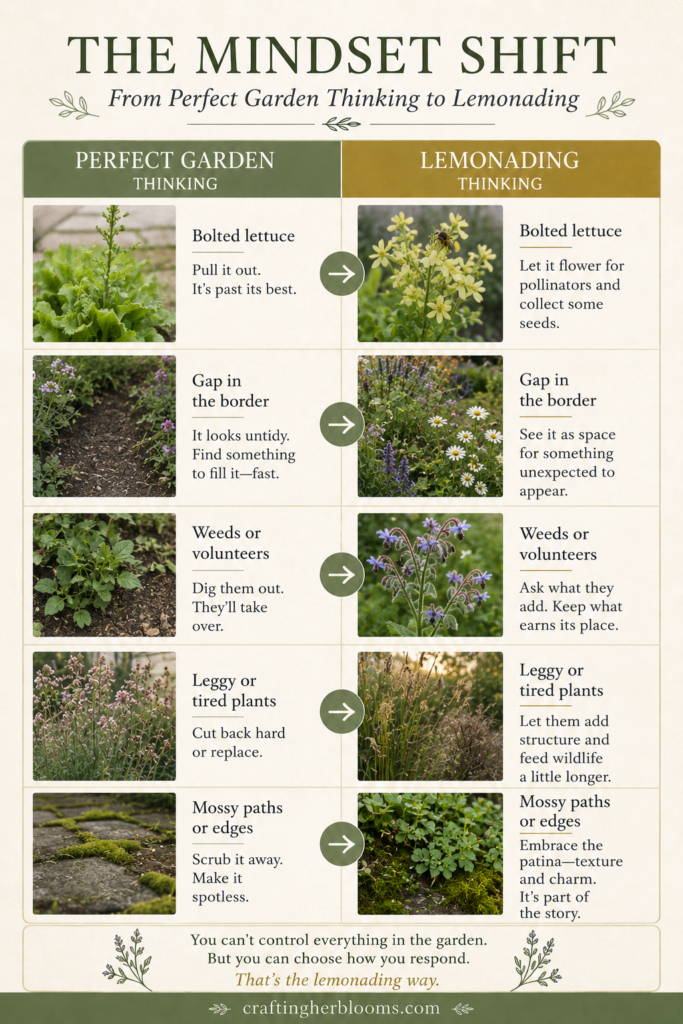
The Mindset Shift: From “What Went Wrong” to “What Can I Do With This?”
The practical heart of lemonading is a reframe rather than a technique. A border that has gone leggy by midsummer is not a failure of planning, it is an invitation to try a late-season filler you would never otherwise have planted.
A vegetable bed that bolted is a chance to let it flower for the pollinators instead of pulling it straight out. This is a meaningfully different posture from the usual gardening advice, which tends to assume that every problem has a correct fix waiting to be applied.
Lemonading assumes that some problems are simply prompts, and that the garden’s job is to keep evolving rather than to arrive at a finished state and stay there.
Why Lemonading Is Landing So Hard in British Gardens This Year
Garden trends rarely appear from nowhere, and lemonading is no exception. It has emerged at a moment when several cultural threads, wellbeing, time scarcity, and a general fatigue with curated perfection, have all converged on the same outdoor space.
Wellbeing, Self-Expression and the End of the Show-Home Garden
More people now treat their garden as an extension of their mental health toolkit rather than a status symbol to be judged against the neighbours. That shift changes what “success” looks like outside.
A garden that exists to soothe you after a stressful week has very different priorities to one that exists to impress visitors, and a relaxed, forgiving style suits the former far better. Where a show-home garden demands constant maintenance to stay camera-ready, a lemonading garden is allowed to have an off week, an odd corner, or a slightly chaotic August without anyone declaring it a disaster.
Bento Box Beds, Bark-itecture and the Bigger Shift Toward Real-Life Gardens
Lemonading has not arrived alone. It sits alongside other trends making waves this year, including compartmentalised “bento box” planting and pet-friendly “bark-itecture” features, all of which point toward gardens designed around how people genuinely live rather than how a show garden is staged.
If you have already read our piece on the botanical bento trend, you will recognise the same underlying instinct here: smaller, more playful, more personality-driven spaces are winning out over the polished perfection of garden makeover television. Lemonading simply takes that instinct one step further by extending it to mistakes as well as design choices.
Who Is Driving the Trend: Time-Poor and DIY-Minded Gardeners
It is worth noting who is embracing this approach most enthusiastically. Younger gardeners and those balancing demanding jobs with a desire to grow something are gravitating toward low-maintenance, character-led spaces over anything that demands hours of weekly upkeep.
DIY hacks, plant swaps with neighbours, and a generally thriftier approach to filling a garden all fit naturally within lemonading, because the trend rewards resourcefulness over budget. If your gardening time is genuinely limited, this is arguably the most realistic trend to have emerged in years.
The Wildlife Case for Imperfection
Lemonading would be a pleasant enough idea even if it only benefited the gardener’s stress levels, but its real strength lies in what a looser approach does for the creatures sharing your plot.
Why a Less Manicured Garden Naturally Supports Pollinators and Birds
A garden that is allowed to hold onto a few seedheads through winter, a patch of slightly longer grass, or an unplanned drift of flowers is, almost by accident, a better habitat. Pollinators need a continuous run of nectar and pollen rather than a single tidy flush, and birds rely on seedheads and shelter that a fastidiously deadheaded border simply does not provide.
This dovetails closely with the principles covered in our guide to creating wildlife habitats in a small UK garden, where the central message is much the same: a bit of mess, used thoughtfully, does more good than constant tidying.
Chaos Gardening and Letting the Lawn Go Its Own Way
One of the more playful expressions of lemonading is what some gardeners call chaos gardening, scattering a mixed packet of seeds across a bare patch and simply seeing what germinates. It is unpredictable by design, and that unpredictability is precisely the point, since a self-organised tangle of flowers tends to attract a far wider range of insects than a single bedding variety planted in rows.
The same philosophy applies to lawns. Letting moss and clover compete with grass, rather than chemically eliminating them, produces a softer, more resilient surface that copes better with drought and supports more life underfoot.
We covered the mechanics of this in detail in how to make your UK lawn more wildlife-friendly without digging it up, which pairs well with the lemonading mindset if you are ready to loosen your grip on lawn perfection.
Practical Lemonading Ideas for a British Garden
Theory is all very well, but lemonading earns its place as a genuine trend because it translates into things you can actually do this week. None of the following require a redesign or a big budget, which is rather the point.
Let the Self-Seeders Stay
Foxgloves, verbena, and nigella are all enthusiastic self-seeders, and the lemonading instinct is to let a few of them grow exactly where they have chosen to land rather than weeding them out on sight. You can always edit lightly later if a seedling turns out to be in an awkward spot, but giving them a season to prove themselves first often produces planting combinations far more interesting than anything you would have planned deliberately.
If you want a sense of which resilient perennials tend to self-seed gracefully rather than aggressively, our roundup of resilient perennials for a wobbling climate covers several reliable candidates, verbena included.
Relax the Lawn
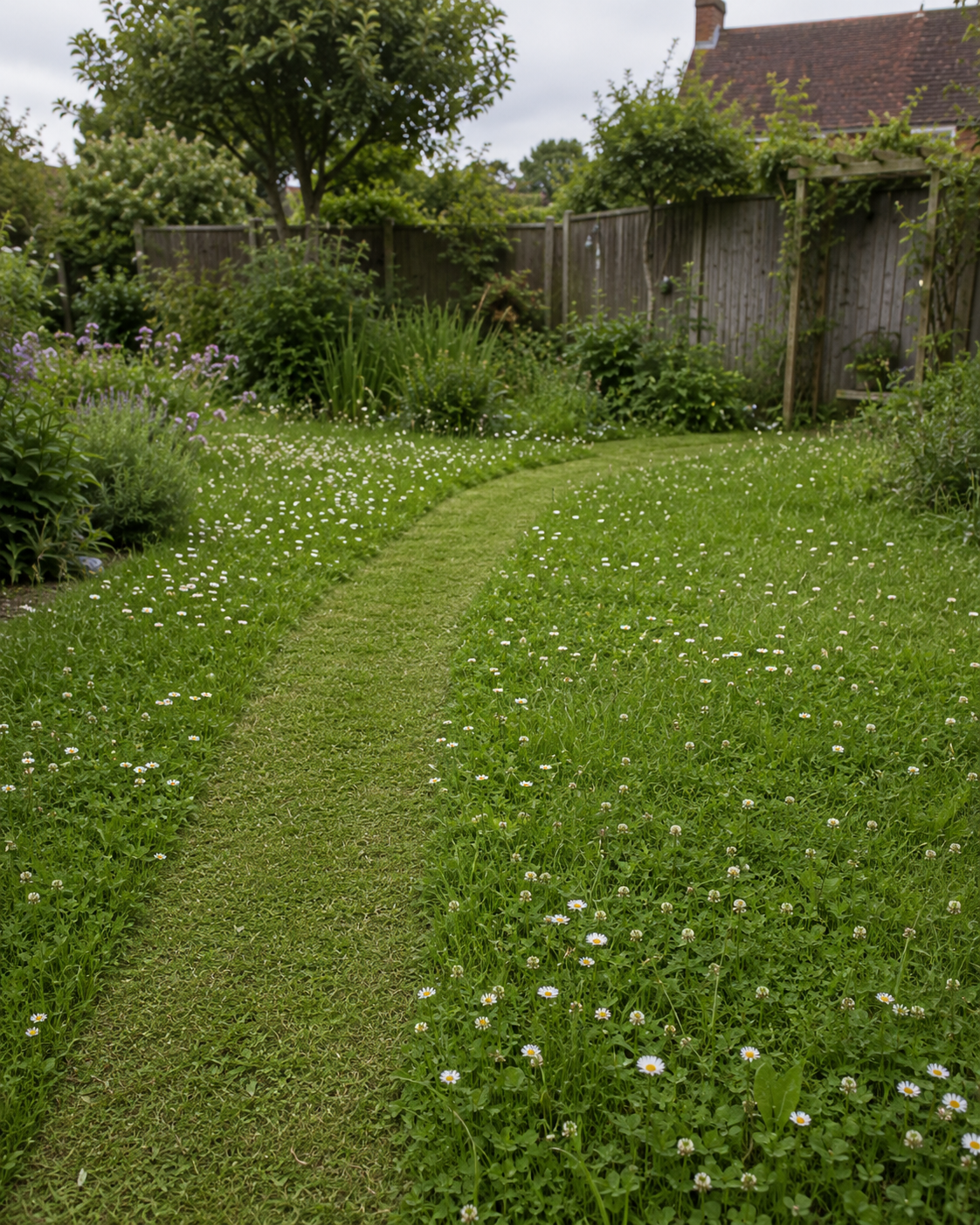
Rather than treating every patch of clover as a problem to be sprayed away, try trialling a longer, clover-rich lawn for a season. Mowing a single path through it gives you the practical access you need while leaving the rest to grow shaggier and more insect-friendly.
Even a single corner left deliberately wild can make a measurable difference to the number of bees and hoverflies visiting your garden over summer.
Turn Garden Flops Into Features
A dead seedling tray, a houseplant that has given up the ghost, or a perennial that simply did not take are not failures so much as opportunities in disguise. Repurpose the empty pot as a miniature wildlife container, fill the gap with something tougher suited to the conditions that clearly defeated the original plant, or use the space to trial something you have been curious about but never had room for.
This is the essence of lemonading in miniature: treating every setback as a small experiment rather than a closed door.
Mix Vegetables, Herbs and Ornamentals Together
One of the more visually striking lemonading habits is abandoning the strict separation between the vegetable patch and the flower border. Letting beans climb among dahlias, tucking parsley in beside roses, or allowing squash to sprawl through a gap in the perennials creates the kind of abundant, slightly tumbling look associated with classic cottage gardens, while also quietly improving pest resistance and pollination.
Our guide to companion planting in the UK is a useful starting point if you want this mixing to be more strategic than accidental, and if the cottage garden aesthetic appeals to you more broadly, our complete guide to creating a cottage garden in the UK builds on the same abundant, layered philosophy.
Upcycle With Abandon
Old buckets, cracked teapots, leftover bricks, and offcuts of timber all have a second life as planters, edging, or makeshift trellis, and lemonading actively encourages reaching for what you already own before buying something new. The slightly mismatched, thrifty look this produces is, in itself, part of the trend’s appeal, since it signals a garden built through accumulation and personality rather than a single coordinated shopping trip.
For a deeper dive into this approach, our roundup of upcycled garden projects using pallets, tins and old furniture is full of starting points.
Regional Lemonading: Adapting the Trend Across the UK
Because lemonading is really a mindset rather than a fixed planting list, it adapts easily to wherever you happen to garden, though the specifics of what “letting go” looks like shift a little by region.
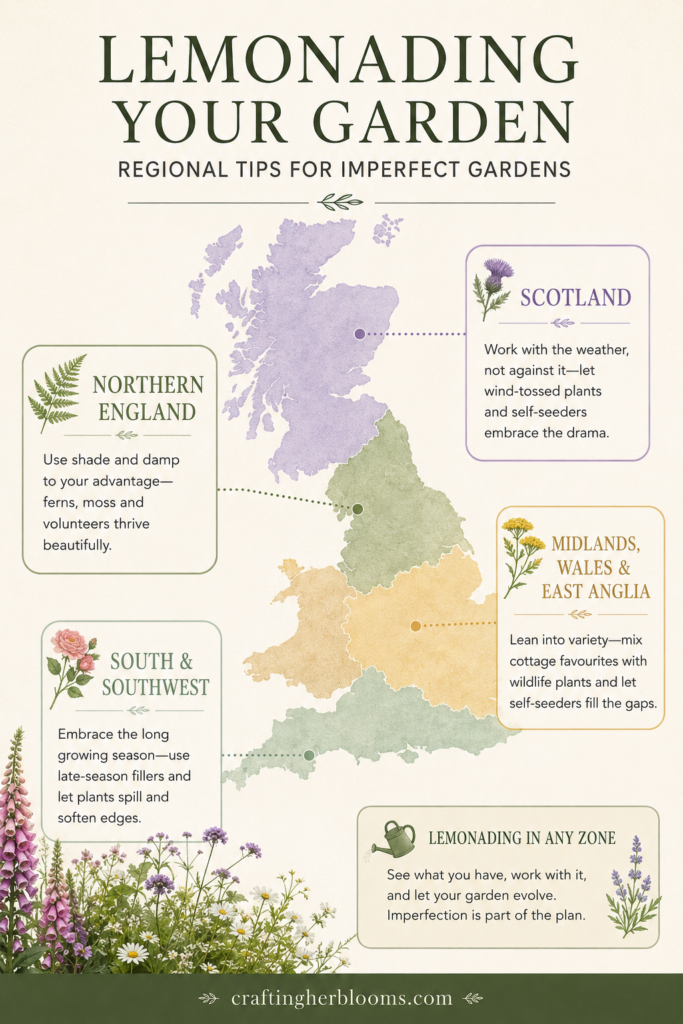
- South and Southwest England: Milder winters mean self-seeders like verbena and nigella often overwinter successfully, so a lemonading approach here can mean genuinely letting volunteer seedlings establish as permanent residents rather than treating them as a single-season experiment.
- Midlands, Wales and East Anglia: More variable rainfall makes chaos-sown wildflower patches a particularly forgiving choice, since a mixed seed scatter tends to cope better with an unpredictable season than a single specimen plant would.
- Northern England: A shorter growing season rewards leaning into structural “flops,” such as repurposing a tender plant that failed to thrive into a sheltered container experiment for next year, since timing windows are tighter and second chances matter more.
- Scotland: Cooler, wetter conditions make relaxed, moss-tolerant lawns an especially natural fit, since moss often thrives here regardless of intervention, so working with it rather than against it tends to be the more realistic choice.
Lemonading Through the Seasons
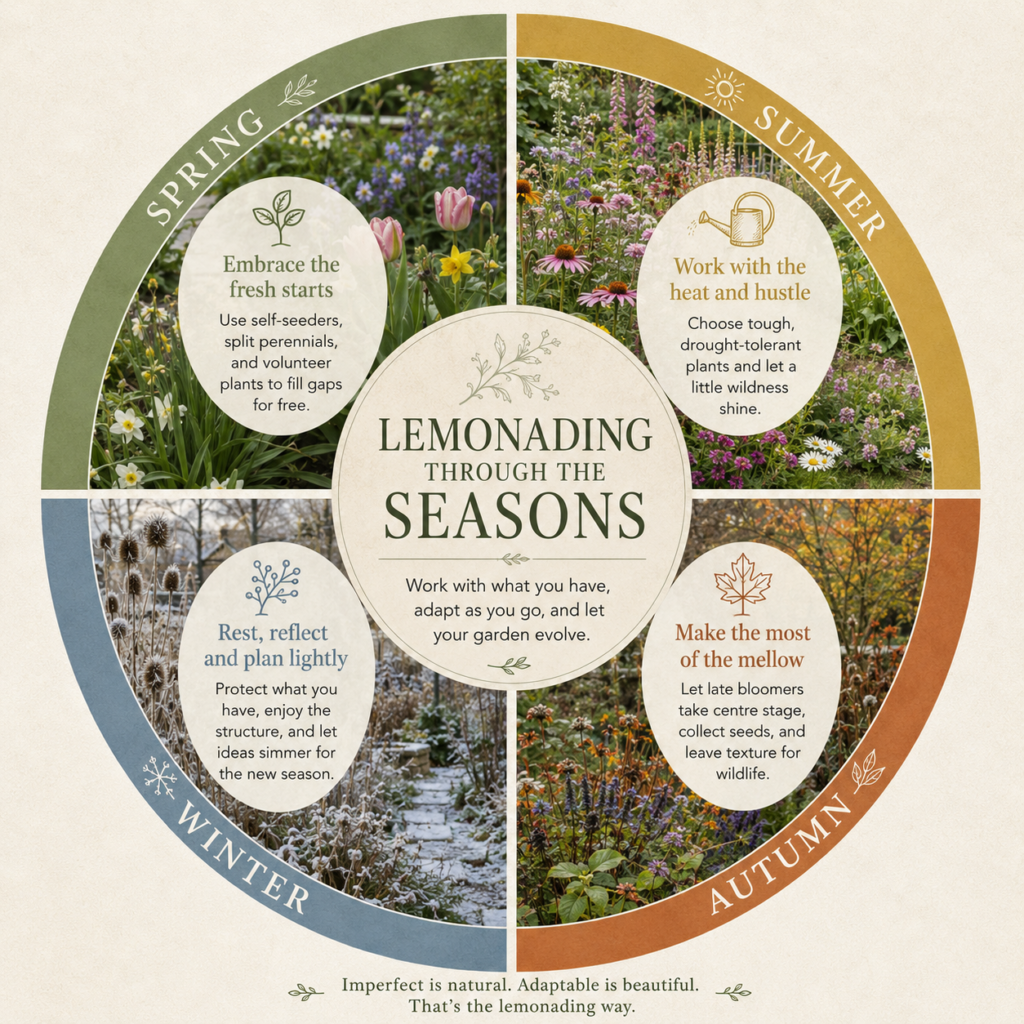
Because the trend is a mindset rather than a single task, it shows up differently depending on what the garden is doing at any given moment. Knowing what to look out for each season makes it far easier to spot a lemonading opportunity before the instinct to “tidy it away” kicks in.
- Spring: Resist the urge to weed out every volunteer seedling the moment it appears. Many will reveal themselves as something worth keeping, whether that is a self-sown poppy, a stray nigella, or a forget-me-not that has wandered from where you originally planted it.
- Summer: This is peak chaos-gardening season, when a mixed wildflower scatter or an accidentally abundant veg-and-flower bed comes into its own. It is also the point at which bolted lettuce, leggy sweet peas, and flopped delphiniums are most tempting to rip out, and most rewarding to leave for the pollinators instead.
- Autumn: Rather than cutting everything back to bare earth, leave seedheads on perennials standing through the colder months. They feed birds, shelter overwintering insects, and add structure to a garden that might otherwise look stark.
- Winter: A frost-blackened dahlia or a collapsed hosta can feel like the least lemonading-friendly sight in the garden, but even here there is an opportunity. Use the bare patch to plan next year’s experiment, or leave the dead growth in place a little longer than instinct suggests, since it often shelters ladybirds and other beneficial insects through the cold.
Lemonading in Small Spaces and Containers
You do not need a sprawling border to put any of this into practice. Lemonading translates just as readily to a courtyard, a balcony, or a single raised bed, and arguably matters more there, since every plant in a small space tends to get noticed, mistakes included.
A container that has clearly struggled, perhaps a herb that bolted or a bedding plant that never quite took, is an easy candidate for a quick lemonading edit rather than a full replacement. Swap in something tougher, let a self-seeder from a neighbouring pot move in, or simply leave the seedheads for a passing goldfinch rather than tidying the pot back to bare compost.
If you are working with a balcony or courtyard specifically, our guide to 25 must-have plants for UK container gardens is full of resilient options that cope well with this slightly improvisational approach, and pairs nicely with the mixed-planting spirit at the centre of lemonading.
From “Perfect Garden” to “Ongoing Story”
Perhaps the most useful thing about lemonading is the way it reframes what a garden is for. A garden treated as a finished product invites constant disappointment, because nature simply does not hold still long enough to stay finished.
A garden treated as an ongoing story, by contrast, has room for setbacks, surprises, and seasonal mess without any of it counting as failure.
Treating the Garden as a Narrative, Not a Finish Line
This shift matters most in how it changes your relationship to the bad weeks. A wilted plant in a “perfect garden” mindset is evidence that you have done something wrong.
The same wilted plant in a lemonading mindset is simply the next plot point, the moment that prompts you to try something new in that spot. Writers on garden wellbeing frequently note that gardening is linked to improved mood and resilience, and a trend that explicitly removes the guilt around weeds and losses only strengthens that connection.
Common Worries About Letting Go of Control
If the idea of a looser garden makes you faintly anxious, you are not alone, and that anxiety is worth naming rather than ignoring. The most common worry is that “relaxed” will slide into “neglected” without anyone noticing the difference.
The honest answer is that it can, which is why lemonading is best practised with light editing rather than total hands-off abandonment. Letting self-seeders stay does not mean never weeding again, and relaxing the lawn does not mean letting brambles take the patio.
The trend is about choosing where to loosen your grip, not abandoning it entirely, and a garden that has had a little structure deliberately built in, through paths, defined bed edges, or a single tidy focal area, can absorb a great deal more “lemonading” elsewhere without ever looking abandoned.
A second, quieter worry is social rather than horticultural: what will the neighbours, or the people scrolling past a photo online, actually think. It is worth remembering that the curated, weed-free perfection so often associated with “good” gardening is itself a fairly recent and fairly narrow standard, heavily shaped by a handful of televised makeover shows and a certain kind of show garden.
A border with a few opportunistic foxgloves and a slightly shaggy edge has rather more in common with the cottage gardens British gardeners have romanticised for centuries than a manicured municipal bedding scheme does. If you want a model for how structure and abundance can coexist, our piece on purposeful border planting that hums with life shows how a thoughtfully designed framework can support a much wilder planting style within it.
Bringing Lemonading Into Your Own Garden
Lemonading succeeds where so many garden trends fail, because it does not ask you to spend more, work harder, or follow a rigid template. It asks you to change how you respond when something does not go to plan, and to notice the opportunities that response opens up.
Start small if the idea feels unfamiliar: let one self-seeder stay this year, relax one corner of the lawn, or repurpose one failed planter instead of throwing it out. You will likely find that the garden which results, slightly wilder, slightly more improvised, and entirely your own, is considerably more rewarding to spend time in than the one you were trying so hard to perfect.
Continue Your Journey
- Wildlife-Friendly Gardening in 2026: The UK Trends Every Gardener Needs to Know — see how lemonading fits into the wider picture of wildlife-led garden trends this year.
- The Ultimate Guide to Creating a Wildflower Meadow in a UK Garden — a deeper dive into chaos-sown, self-organising planting.
- Bee and Butterfly Buffet Planters: How to Mix Nectar Plants in One Container — a small-scale way to put imperfect, mixed planting into practice.
- The New Cottage Border: Nostalgic Shrubs, Fruiting Plants, and the UK Gardens Getting It Right — for more on the abundant, tumbling look at the heart of lemonading.
- Eco-Friendly Garden Ideas for UK Gardens: How to Garden Sustainably in 2026 — practical sustainability ideas that pair naturally with a looser approach.
Has a “failed” plant ever turned into the best thing in your garden? We would love to hear your own lemonading moment in the comments.
Want more UK garden trends and honest, no-perfection-required growing advice delivered straight to your inbox? Subscribe to Crafting Her Blooms for monthly updates.


