
How to Grow Herbs in Pots: The UK Guide

I sometimes use affiliate links in content. This doesn’t cost you anything but I may make a commission payment from anything you buy through these links. As an Amazon Associate I earn from qualifying purchases. All opinions remain my own.
Growing herbs in pots is one of those garden pleasures that looks effortless from the outside — a terracotta pot stuffed with rosemary by the back door, a windowsill row of basil and parsley — but anyone who has watched a supermarket basil gasp its last by Thursday will know there’s a bit more to it than that. The good news is that once you understand why herbs in containers behave the way they do, the whole thing becomes genuinely straightforward. Better yet, British gardeners are in a fine position here: our cool, reliably moist summers suit many leafy herbs perfectly, and even our changeable springs are easier to navigate once you know which plants can take it and which cannot.
This guide covers everything that actually matters for pot-grown herbs in the UK — the right containers, the right compost, how to water without killing with kindness, which herbs to grow together and which to keep apart, and how to carry your pots through a British winter without losing everything to cold, wet compost. Whether you have a south-facing terrace or a damp north-facing balcony, there is a herb arrangement that will thrive.
Choosing the Right Container
The container you choose has a more direct influence on herb health than most people expect. It affects drainage, root temperature, moisture retention, and in the case of porous materials, even the chemistry of the growing environment. Getting this decision right means you are setting your herbs up for success from the very first watering.
Size and Depth
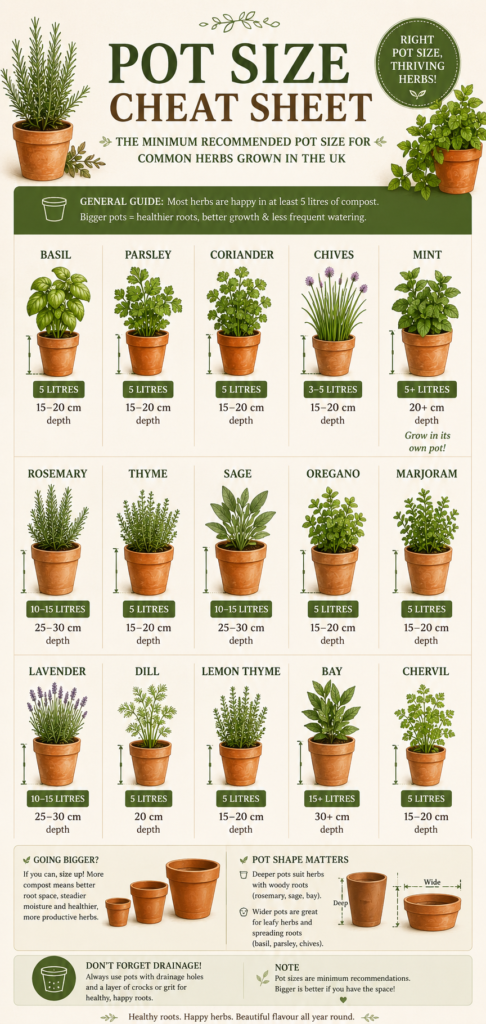
Most common culinary herbs are happiest in pots that sit somewhere around 5 litres in volume. This gives enough root space to prevent the plant from becoming pot-bound too quickly, and enough compost mass to avoid the dramatic dry-and-soak cycle that ruins more herbs than anything else. For herbs with a taproot or a naturally tall habit — think rosemary, bay, and mature sage — a larger pot of 10–15 litres or one of those taller “long tom” profiles will serve better. These give the roots room to go down rather than spiralling in on themselves.
Forged & Grown
Garden pieces, printed to order
3D printed planters and garden accessories, made in the UK. Self-watering designs, sculptural shapes, colour options — each one made when you order it.


Depth matters too. As a general guide, aim for at least 15 cm of depth for most annual herbs like basil, coriander, and parsley. Perennials with woodier stems — rosemary, thyme, lavender — prefer something closer to 25–30 cm. Mint is a law unto itself and needs its own container regardless of size (more on that later), but a 5-litre pot of reasonable depth keeps it under control for a season.
Material: What Actually Makes a Difference
Terracotta is the traditional choice for Mediterranean herbs like thyme, rosemary, and sage, and it earns that reputation on merit. The clay is porous, which means moisture can evaporate through the sides of the pot as well as from the surface — this keeps the compost aerated and reduces the risk of waterlogging. In wet British summers, that porosity is a genuine advantage. The trade-off is that terracotta dries out faster, which means more frequent watering during a warm spell. It is also vulnerable to frost cracking, so overwintering terracotta pots outdoors requires some thought.
Plastic and glazed ceramic retain moisture for longer, making them better suited to leafy, thirstier herbs like basil, coriander, and chives. They are lighter to move around — useful if you are reorganising a small patio as the seasons change — and modern plastic pots have improved considerably in both durability and appearance. Metal planters look smart but can overheat in direct summer sun, effectively cooking the roots of more delicate herbs; if you are using them, line the inside with horticultural fleece and pay close attention to drainage.
Whatever the material, one thing is non-negotiable: drainage holes. Herbs sitting in waterlogged compost will rot at the roots, often before any above-ground symptoms appear. If you love a particular pot that lacks drainage, drill holes or use it as a cachepot around a planted-up inner container with proper drainage.
Crocks and Drainage Layers
The old gardening habit of placing a layer of broken crocks (fragments of old terracotta) at the base of a pot before adding compost is still worth doing. It prevents the drainage holes from becoming blocked by compacted compost, particularly in heavier mixes. A handful of horticultural grit or a few larger pebbles works equally well if you are not in the habit of keeping broken pots around.
The Right Compost for Potted Herbs
Compost choice is where many herb-growers go wrong, and it is understandable: garden centres offer a bewildering array of options, and the word “compost” covers everything from free-draining sandy mixes to dense, moisture-retentive blends. For herbs in pots, the most important quality is drainage — but the specifics vary depending on which herbs you are growing.
Mediterranean Herbs: Sharp and Gritty
Rosemary, thyme, sage, and lavender all originate from dry, rocky terrain around the Mediterranean basin. Their roots evolved in ground that drains instantly after rain, and they have little tolerance for compost that holds water around the roots. In a UK context, this matters most during autumn and winter when our climate becomes reliably wet: a Mediterranean herb sitting in moisture-retentive compost through a British November is a Mediterranean herb in distress.
For these plants, a good approach is to start with a peat-free, loam-based mix — something like a John Innes No. 2 — and then improve the drainage by mixing in coarse horticultural grit or perlite at roughly one part grit to three or four parts compost. This opens up the structure, allows air around the roots between waterings, and gives a slightly neutral to alkaline pH which suits these plants well. Avoid multi-purpose composts for Mediterranean herbs unless you amend them significantly; most multi-purpose blends are formulated to retain moisture, which is the opposite of what these plants need.
Leafy Annual Herbs: Rich and Moisture-Retentive
Basil, coriander, parsley, and chives prefer a richer growing medium with reasonable moisture retention. A quality peat-free multi-purpose compost works well here, and unlike the Mediterranean types, these herbs benefit from a mix that does not dry out instantly between waterings. That said, they still need free drainage — roots sitting in truly waterlogged compost will rot regardless of the herb type — so ensure the pot has proper drainage holes and avoid over-compacting the compost when planting.
Basil in particular benefits from a warmer, richer compost with some added organic matter. It is a hungry feeder and will reward a liquid feed every fortnight during peak summer growth with noticeably more vigorous leaf production.
Feeding in Pots
Because pots cannot draw on the nutrients in garden soil, potted herbs exhaust the goodness in their compost relatively quickly. Most good compost will feed plants adequately for the first six to eight weeks, after which a liquid feed becomes useful — a balanced, all-purpose organic fertiliser applied every couple of weeks during the growing season is usually enough. Avoid over-feeding Mediterranean herbs; too much nitrogen encourages soft, lush growth that is less aromatic and more vulnerable to pests and cold. A gentle feed once a month is plenty for rosemary and thyme.
Watering Herbs in Pots: Getting It Right in the UK
Overwatering is the single most common cause of herb failure in containers, yet under-watering is a genuine risk too during a British summer that turns warm and breezy. The key is understanding what each herb needs, rather than applying one watering rule to all of them.
The Finger Test
The most reliable watering guide is also the simplest: push your finger a couple of centimetres into the compost. If it feels dry at that depth, water. If it still feels cool and damp, wait another day. This approach accounts for variations in pot size, material, compost type, and weather in a way that any fixed schedule simply cannot. It takes about ten seconds per pot and prevents both the bone-dry crisis and the slow root rot of a pot that never quite dries out.
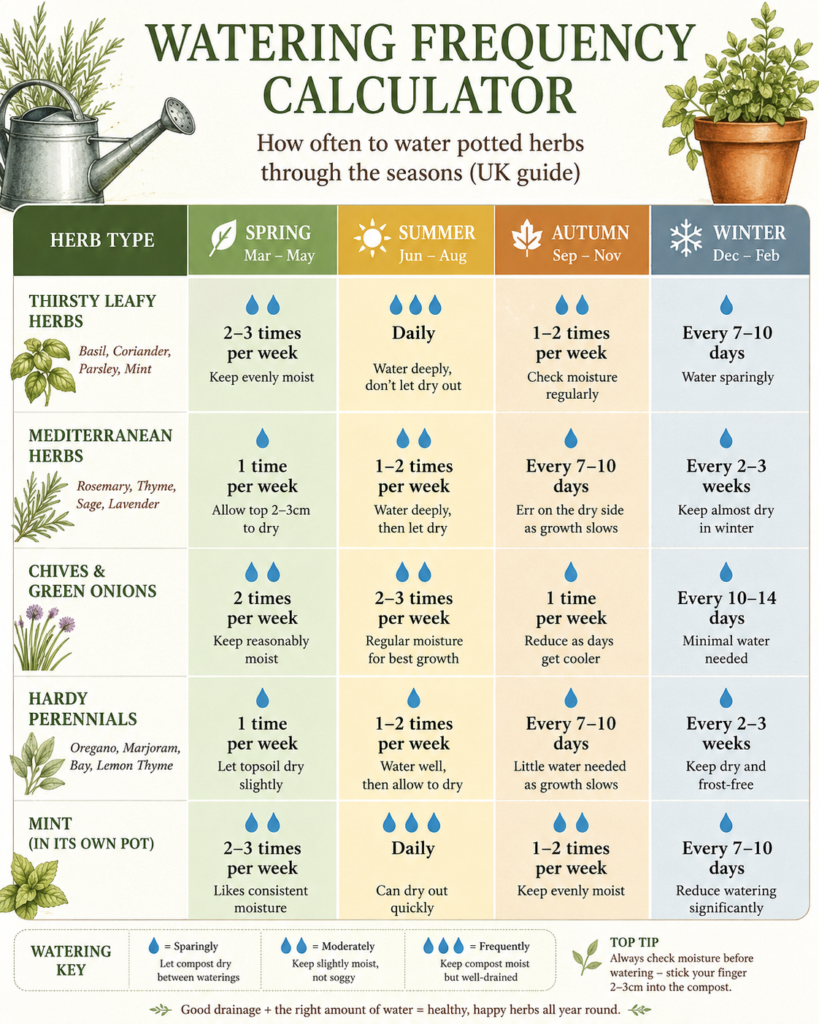
For Mediterranean herbs, allow the top couple of centimetres to dry out before watering again. For leafy annual herbs, aim to keep the compost evenly moist but never soggy. Water thoroughly when you do water — enough that moisture reaches the lower roots — rather than giving a little water every day that never penetrates below the surface.
Seasonal Adjustments
During warm summer weather, pots dry out remarkably quickly, particularly those in terracotta or positioned in a sunny, exposed spot. Basil, parsley, and chives may need watering every two or three days; in a heatwave, possibly more. Morning watering is preferable to evening: it gives the foliage time to dry before nightfall, reducing the risk of fungal issues, and delivers moisture to roots before the warmest part of the day.
In winter, the picture reverses. Most herbs need very little water from November through February, and sitting in cold, wet compost during this period is far more dangerous than drought. Reduce watering significantly, make sure pots are not standing in saucers of water, and check that drainage holes are clear. Cold, waterlogged compost is responsible for more herb losses over winter than frost.
Rainwater vs. Tap Water
If you have the space for a water butt, rainwater is preferable for most herbs — it is softer than tap water, slightly acidic, and free of the calcium that gradually alters the pH of compost over time. For lavender in particular, accumulated lime from hard tap water can shift the soil pH in a direction the plant dislikes. That said, tap water is perfectly adequate for most herbs, especially if you are refreshing the compost each spring. It is a nice-to-have rather than a necessity.
Which Herbs to Group Together in Pots
One of the most common herb-in-pot mistakes is creating a mixed planting based on what looks good together rather than what grows well together. A pot that pairs drought-tolerant rosemary with moisture-loving basil will always produce one thriving plant and one struggling one — because whichever watering regime you apply will be wrong for at least one of them.
The solution is to group herbs by their water and light requirements. This is easy once you understand the two main herb “personalities.”
Question 1 of 3
How much sun does your pot’s position get?
Question 2 of 3
How sheltered is your spot from wind and rain?
Question 3 of 3
What size pot are you working with?
The Mediterranean Pot: Sun-Lovers and Drought Tolerators
Rosemary, thyme, sage, and lavender belong together. They share a preference for full sun, sharp drainage, and a compost that dries out between waterings. Grouping them in a large trough or generous pot creates an attractive planting that requires the same care regime: regular sun, infrequent but thorough watering, and virtually no attention from October through March.
Oregano sits comfortably in this group too, though it spreads with enthusiasm and can eventually swamp smaller companions. In a pot, a regular trim keeps it in check. Marjoram — the sweeter, slightly less robust cousin of oregano — also belongs here, and the two can be planted together without tension.
These Mediterranean companions look particularly good in terracotta, and a cluster of them on a sunny patio or gravel area becomes something genuinely decorative as well as useful. Lavender grown in its own dedicated pot is happy alongside rosemary and thyme too, though it benefits from a slightly larger container given its eventual spread.
The Kitchen Herb Pot: Thirstier Leafy Growers
Basil, parsley, and chives form a natural second group. These are the herbs that need regular moisture, richer compost, and appreciate a feed through the growing season. They also tolerate partial shade better than the Mediterranean types — useful if your best-placed pots are not in full sun all day.
Chives and parsley together make a particularly handsome and practical pairing: both produce edible leaves across a long season, both appreciate similar conditions, and the chives' purple spring flowers are pretty enough to earn the pot a prominent position. Basil is more demanding than either — it needs warmth above all else — and in a UK summer, it thrives best on a south-facing windowsill or in a genuinely sheltered, sunny spot outdoors.
Coriander is best grown on its own, or with parsley, because it bolts to seed so readily in warm weather that it rarely keeps company long. Sow successionally from March through August in small quantities rather than attempting a large mixed planting.
The Herbs That Need Their Own Container
Some herbs are simply incompatible with container companions — not because of difficult growing requirements, but because of how aggressively they spread. Mint is the clearest example. Every variety of mint — spearmint, peppermint, apple mint, chocolate mint — will colonise a shared container within a season, muscling out whatever it was planted with and eventually becoming a pot-bound tangle of roots. Give mint its own container, which has the secondary benefit of allowing you to easily control its watering separately.
Lemon balm behaves similarly, and is worth containing in its own pot if you want to grow it at all — it seeds prolifically as well as spreading by root, and can become a nuisance. The wild side of both plants is part of what makes them useful for pollinators, as detailed in the guide to bee and butterfly buffet planters, but in the disciplined world of container gardening, a pot of their own suits them better.
Herbs That Do Double Duty
Several herbs sit happily in both the practical kitchen herb category and the ornamental garden. Chives produce globe-shaped purple flowers that attract pollinators and look beautiful in a cottage-style arrangement. Fennel — particularly the bronze variety — is structural and dramatic in a large pot, though it does not play well with most other herbs due to the allelopathic chemicals it releases. Grow fennel alone or with plants that are genuinely compatible with it (dill is not one of them — the two cross-pollinate and produce disappointing results from both).
Overwintering Herbs in Pots: UK Survival Guide
The British winter presents a specific set of challenges for containerised herbs that differ from the challenges facing herbs in open ground. Roots in pots have none of the insulating mass of garden soil; they are exposed on all sides to cold air and, more critically, to repeated cycles of freezing and thawing. Understanding which herbs are genuinely hardy and which need protection is the key to arriving at spring with everything intact.
Hardy Perennials: They Can Stay Outside
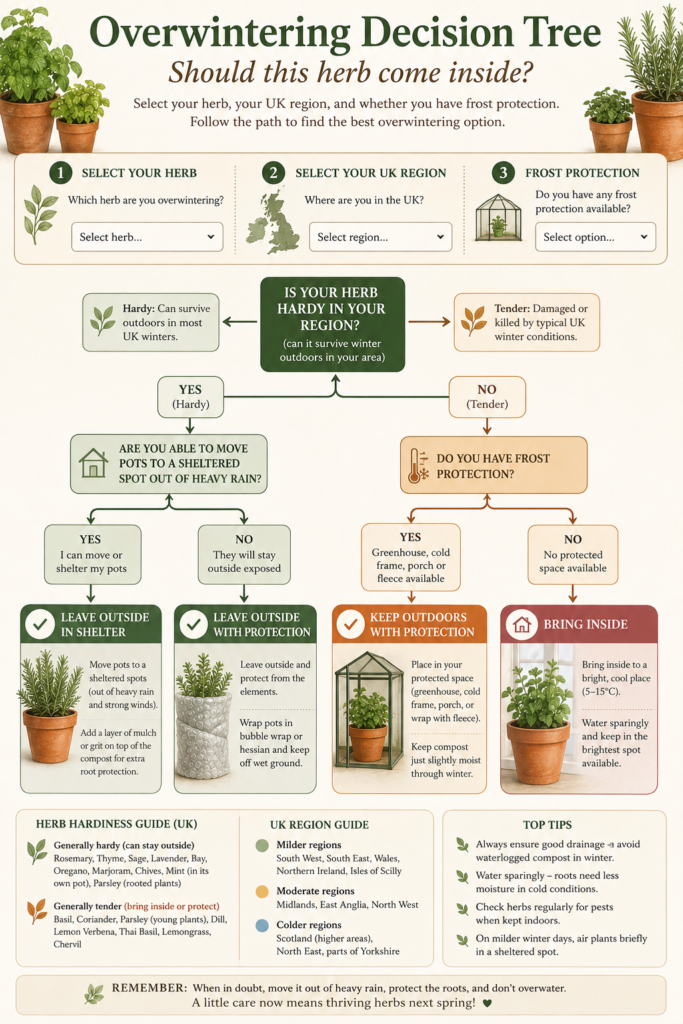
Rosemary, thyme, sage, and lavender are all hardy enough to overwinter outdoors in most parts of the UK, provided two conditions are met: the compost must drain well enough to prevent waterlogging, and the roots must not freeze solid for extended periods. In practice, both conditions are manageable.
Position pots against a house wall or in a sheltered corner for winter. This reduces wind exposure and keeps the pots marginally warmer — the thermal mass of a brick wall releases heat slowly overnight, creating a microclimate a degree or two warmer than the open garden. Raise containers on pot feet or bricks so that drainage holes are not in contact with cold paving, which can block drainage and allow water to pool around the base of the pot.
During particularly cold spells — extended frosts, or temperatures forecast to drop below -5°C — wrap the containers with bubble polythene or horticultural fleece, tucked in securely around the sides and base. This protects both the roots and the terracotta from frost cracking. The foliage of hardy herbs can usually be left unwrapped; it is the roots that need protection more than the tops.
Hardy Perennials That Die Back: Mint and Chives
Mint and chives are herbaceous perennials, meaning they lose their top growth in winter and regenerate from the roots each spring. Left in a pot outdoors with reasonable drainage, they largely look after themselves — the bare compost surface in winter is deceptive; beneath it, the roots are dormant and perfectly viable. The main risk is compost that freezes solid for weeks on end, or that becomes waterlogged. Both can be prevented by positioning pots in a sheltered spot and ensuring drainage is unimpeded.
Do not be tempted to chop back chives or mint too aggressively in autumn thinking you are doing them a favour. Let the foliage die back naturally, cut it down to a few centimetres once fully brown, and leave the pots alone until you see new growth emerging in March or April.
Tender Herbs: They Must Come Indoors
Basil is the most unambiguously tender of the common culinary herbs. It suffers as soon as temperatures approach 10°C and will collapse at the first frost. It must be brought indoors before autumn arrives properly — in most parts of the UK, this means early to mid-September at the latest. On a warm, bright windowsill it will continue producing leaves for several weeks before eventually deteriorating regardless of care.
Coriander, whilst not frost-hardy, is more resilient than basil and can often be kept going outdoors into October with a little protection. But the real answer for year-round coriander is successive sowing indoors under lights or on a warm windowsill through the winter months — it grows quickly enough from seed that you rarely need to maintain the same plant through cold weather.
Lemon verbena, a tender perennial that produces wonderfully fragrant leaves, can be overwintered indoors on a cool but frost-free windowsill, where it will shed its leaves and rest until spring. Do not be alarmed by the bare twigs; it generally regenerates reliably if the roots are kept just barely moist through winter.
Regional Timing Across the UK
Overwintering decisions vary meaningfully across Britain's four climate zones:
South and Southwest England (Cornwall, Devon, Sussex, Kent): Hardy herbs can generally stay outside without any wrapping in all but the hardest winters. Tender herbs come in by mid-October.
Midlands, Wales, East Anglia: Hardy herbs benefit from pot fleece during cold snaps from November onwards. Tender herbs come in by late September.
Northern England (Yorkshire, the Lake District, Lancashire): Wrap hardy herb pots from October. Tender herbs come in by early September. Mint and chives may need moving into a cold garage or shed during prolonged hard frosts.
Scotland: Hardy herb pots benefit from wrapping from September in upland areas. Move tender herbs indoors in late August. Consider overwintering even nominally hardy rosemary in a cold greenhouse or unheated conservatory in the far north.
Growing Herbs in Pots Year-Round: A Practical Rhythm
Once you have established the right containers, compost, and groupings, the ongoing rhythm of pot herb growing becomes intuitive. Spring is the time for refreshing compost — tip out the old growing medium, check roots, repot into fresh compost or a slightly larger pot if roots are circling — and for bringing tender herbs back outdoors once night temperatures are reliably above 10°C. For most of the UK, this means mid-May, after the last realistic frost date. This process of acclimatising plants to outdoor conditions gradually is covered in detail in the guide to hardening off seedlings.
Summer is the season of regular harvesting, which — counterintuitively — is what keeps herbs producing rather than flowering and setting seed. Harvesting little and often, always taking stems from the top rather than stripping lower leaves, encourages bushy, productive growth. Once a herb like basil or coriander bolts to flower, leaf production drops off sharply; regular trimming delays that moment significantly.
Autumn is the time to make decisions: what comes in, what gets wrapped, what gets divided and repotted before the cold arrives. A little time spent in October preparing your herb pots for winter pays off enormously the following spring.
For those wanting to expand beyond the classic kitchen herbs, growing herbs on a balcony explores how to adapt all of these principles to restricted space, while the beginner's guide to planning a herb garden is worth reading before committing to a larger container herb arrangement.
Harvesting and Storing What You Grow
The point of growing herbs is to use them, and growing them in pots means they are consistently at arm's reach. A few principles make harvesting both more productive and more sustainable for the plant.
Always harvest in the morning, once any dew has dried but before the heat of the day draws essential oils up into the air. This is when herbs are at their most fragrant and nutritious. Harvest no more than a third of any plant at one time — taking more than this sets the plant back significantly, and with container herbs that are already working within the constraints of limited root space and finite compost, this matters.
For herbs you cannot use immediately, the options are drying, freezing, or making infused oils and vinegars. The guide to storing fresh herbs from your garden goes into all of these methods in detail, but the short version is that soft herbs like basil and parsley freeze well (just wash, dry, and pop into ice cube trays with a little water or olive oil), while woody herbs like rosemary and thyme dry beautifully by hanging in a warm, airy spot.
The Best Herbs to Grow in Pots for UK Gardeners
Not all herbs suit container growing equally. Some are naturally well-adapted; others resent the constraints of pot life. Here are the strongest performers in British conditions:
Thyme is arguably the single best herb for pots in the UK. It is hardy, drought-tolerant, low-growing, evergreen, and produces a steady supply of intensely flavoured leaves year-round. It is almost impossible to kill with neglect, and a pot of common thyme or lemon thyme on a sunny windowsill will still be producing in January.
Rosemary is equally resilient once established, though young plants need some care in their first winter. It eventually outgrows smaller pots and benefits from being moved into a substantial container — a 15–20 litre pot is not excessive for a mature specimen.
Mint in any of its varieties is one of the most rewarding pot herbs precisely because containment is where it belongs. A large pot on the kitchen step, producing more mint than you can reasonably use, is a genuinely cheerful garden feature.
Chives are quiet achievers — unfussy, reliable, and pretty enough to earn a spot on the patio rather than being tucked away. Their spring flowers are edible too, and taste of mild onion scattered over salads.
Parsley performs well in pots given enough depth, moisture, and a position that gets some afternoon shade in the hottest weather. It is biennial, so it will bolt in its second year, but a fresh sowing each spring (or autumn for an early winter supply) keeps it going perpetually.
Basil is the most demanding herb on this list but also the most rewarding. Given warmth, shelter, rich compost, and consistent moisture, it produces handfuls of fragrant leaves all summer. The key insight is that British basil needs warmth more than anything else — a south-facing wall makes a meaningful difference. The complete guide to growing basil covers this in full.
Getting Started: A Simple First Container
If you are approaching pot herb growing for the first time, the simplest starting point is two pots rather than one. The first: a large terracotta pot (at least 30 cm wide) planted with rosemary, thyme, and sage in free-draining, gritty compost. The second: a plastic or glazed ceramic pot of similar size planted with parsley and chives in a good multi-purpose compost. These two arrangements give you coverage of the most-used culinary herbs, require very different watering regimes (which you now understand), and will continue producing from spring through to the following autumn with minimal intervention. From there, a dedicated mint pot, a summer basil pot, and a lavender container complete what feels like a genuinely well-stocked herb garden in only five containers.
Growing your own herbs is one of those habits that, once established, becomes hard to imagine abandoning — not just for the flavour of the food they improve, but for the small daily ritual of stepping outside with scissors and coming back with something alive and fragrant. Getting the basics right, as laid out above, means that ritual is rarely interrupted by failure.
Continue Your Journey
If this guide has you thinking about expanding your growing beyond basic pots, these are the natural next steps:
- How to Grow Your Own Herbs in the UK: The Complete Guide — a broader look at herb growing in UK conditions, including in-ground and raised bed approaches
- How to Grow Herbs on a Balcony in the UK — all the same principles adapted for restricted outdoor space
- 27 of the Best Grow Your Own Herb Plants — if you are wondering what to grow beyond the kitchen classics
- How to Store Fresh Herbs from Your Garden — making the most of a bumper herb harvest
- Beginner's Tips for Planning a Herb Garden — for when you are ready to think beyond individual pots
Which herb do you find most difficult to keep alive in pots — and which has surprised you by thriving? Share your experience in the comments below.
If you found this guide useful, you might enjoy the Crafting Her Blooms newsletter — practical, seasonal growing advice for British gardeners, delivered when it matters.


