
Ornamental Grasses for UK Gardens: When to Plant Them for Year-Round Movement

I sometimes use affiliate links in content. This doesn’t cost you anything but I may make a commission payment from anything you buy through these links. As an Amazon Associate I earn from qualifying purchases. All opinions remain my own.
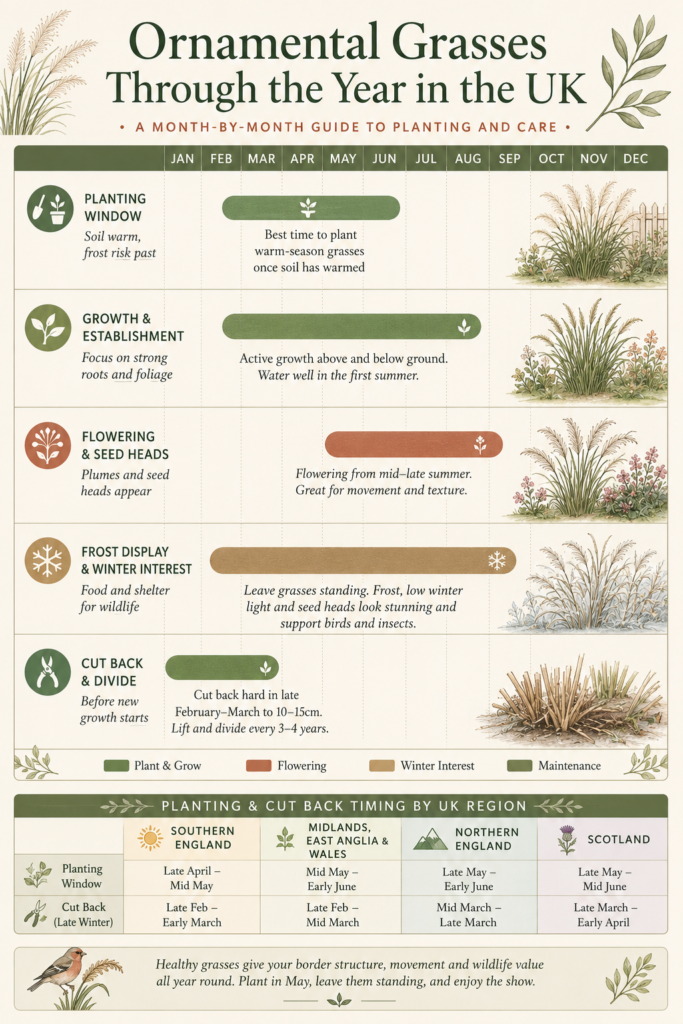
May is the best month to plant ornamental grasses in a UK garden. Frost risk has passed, the soil has warmed enough for roots to establish quickly, and the grasses have a full growing season ahead before their first winter. For a border that needs movement, texture and something interesting to look at from September through to March, this is the single most useful planting window of the year.
Most advice on ornamental grasses is either generic or written for a US climate, with recommendations that assume longer, hotter summers and different frost dates. This guide sticks to what actually performs in a British garden: which warm-season grasses are worth the space, when to get them in the ground, and how to manage them so they earn their keep across all four seasons rather than just late summer.
🌱 Why May Is the Best Time to Plant Ornamental Grasses in the UK
Warm-season grasses such as miscanthus, pennisetum and panicum are dormant over winter and slow to wake up in spring. Planting them too early, while the soil is still cold, sets them back rather than helping them along.
By May, last frosts have generally passed across most of the UK and soil temperature has climbed enough to trigger active root growth. A grass planted now spends the summer building a strong root system, which is what carries it through its first winter and determines how well it performs the following year.
Forged & Grown
Garden pieces, printed to order
3D printed planters and garden accessories, made in the UK. Self-watering designs, sculptural shapes, colour options — each one made when you order it.


If you’re gardening in a colder pocket, such as the Midlands, the north of England, or Scotland, it’s worth waiting until late May to be confident the last frost has genuinely gone. Southern England can often plant a couple of weeks earlier.
🌾 Three Reliable Grasses for UK Borders: Miscanthus, Pennisetum and Panicum
Not every grass sold as “ornamental” holds up well in British conditions. These three are dependably hardy, widely available from UK nurseries, and each does a different job in a border.
Miscanthus sinensis is the workhorse of the group. It reaches 1.5 to 2.5 metres depending on variety, forms an upright, arching clump, and produces feathery, silver-pink plumes from late summer. Use it as a screen, a backdrop for a mixed border, or a single specimen where you want height and structure.
Pennisetum (fountain grass) is smaller and softer, typically 60cm to 1 metre tall, with bottlebrush-like flower spikes that catch the light beautifully when backlit. It works well towards the middle of a border, planted in drifts rather than singly, where its fine texture can contrast against broader-leaved perennials.
Panicum (switch grass) offers the most airy, see-through habit of the three, with fine foliage that often takes on red or purple tones in autumn. It’s a good choice where you want movement without blocking the view of what’s behind it, and it copes well with poorer, drier soil than the other two.

🪴 How to Plant Ornamental Grasses: Site, Spacing and Watering-In
Ornamental grasses generally want full sun and reasonably well-drained soil. Waterlogged winter ground is the most common cause of losses, so if your soil is heavy clay, dig in some grit or well-rotted organic matter before planting to improve drainage.
Space plants according to their eventual spread rather than their current pot size. Miscanthus needs at least 75cm to 1 metre from its neighbours to reach full size without crowding. Pennisetum and panicum can go closer, around 40 to 60cm apart, particularly if you’re planting in drifts for a naturalistic effect.
Water thoroughly at planting time and keep new grasses watered through their first summer, especially during dry spells, even though most varieties become quite drought-tolerant once established. A first-year plant hasn’t yet built the root system to cope without help.
🐦 The Wildlife Value of Grasses: Seed Heads, Shelter and Overwintering Insects
Ornamental grasses do real ecological work in a garden, not just decorative work. Seed heads left standing through autumn and winter are a food source for finches and other seed-eating birds at exactly the point when other food is scarce.
The dense clumps at the base of the plant also provide shelter for overwintering insects, including ladybirds and various beetles that gardeners want around the following spring. Cutting grasses back too early removes this habitat before it’s done its job.
For a wildlife-friendly UK garden, ornamental grasses pair naturally with a wildflower area or a pollinator border, extending the food and shelter on offer beyond the summer flowering season into the leaner months.
❄️ Why You Should Leave Grasses Standing Through Winter
The instinct to tidy a border in autumn works against ornamental grasses. Their real display season is arguably winter, not summer: frost catches on the seed heads and foliage, and low winter light turns the whole clump into a feature rather than a leftover.
Standing growth also protects the crown of the plant from the worst of winter wet and cold, acting as its own insulation. Cutting back in autumn removes that protection right before the plant needs it most.
The only reason to intervene in autumn is if a grass has collapsed badly under wind or heavy rain and is smothering neighbouring plants. Otherwise, leave it until spring.
✂️ When and How to Cut Back Ornamental Grasses in Spring
Cut back in late February to March, before new growth starts to emerge from the base. Leaving it any later risks damaging the new shoots as you cut through old growth to reach them.
For most grasses, cut the whole clump down to 10 to 15cm above ground level using shears or a hedge trimmer for larger clumps. Wear gloves, since some grasses have edges sharp enough to cut skin.
This is also the moment to lift and divide congested clumps, particularly miscanthus, which can be split every three to four years to keep it vigorous and to create new plants for other parts of the garden.
📌 Quick Answer: Ornamental Grasses for UK Gardens
Plant warm-season ornamental grasses such as miscanthus, pennisetum and panicum in May, once the soil has warmed and frost risk has passed. Choose full sun and well-drained soil, space according to mature spread, and water well through the first summer.
Leave the plants standing over autumn and winter for frost interest and wildlife value, then cut back hard to 10 to 15cm in late February or March before new growth appears. Done this way, a small planting of grasses delivers movement and structure in a UK border across every season of the year, not just late summer.


