
Growing Herbs Indoors: A UK Window-by-Window Guide
I sometimes use affiliate links in content. This doesn’t cost you anything but I may make a commission payment from anything you buy through these links. As an Amazon Associate I earn from qualifying purchases. All opinions remain my own.
A herb garden on the windowsill sounds simple until the basil turns leggy, the mint sulks, and the parsley never makes it past its first true leaves. The plant is rarely the problem. Most of the time it comes down to the one thing nobody checks before buying seeds: which way the window faces.
This guide walks through growing herbs indoors in the UK, window by window, from a bright south-facing sill to a dim northern one that needs a grow light to earn its keep. Match your window and your region to the right herbs, and the rest gets a lot easier.
The window you have decides more than the herbs you buy
Most indoor herb advice starts with the plant. Buy basil, buy mint, buy a nice terracotta pot, and hope for the best. But the single biggest factor in whether an indoor herb garden thrives or slowly gives up is one thing most of us never think to check: which way the window actually faces.
A south-facing kitchen sill in Cornwall and a north-facing one in Aberdeen are not playing the same game, even in the same month. In a UK winter, the gap between six hours of direct sun and almost none is not something good compost or careful watering can close. Get the orientation right first, and the herb choice mostly sorts itself out.
Forged & Grown
Garden pieces, printed to order
3D printed planters and garden accessories, made in the UK. Self-watering designs, sculptural shapes, colour options — each one made when you order it.


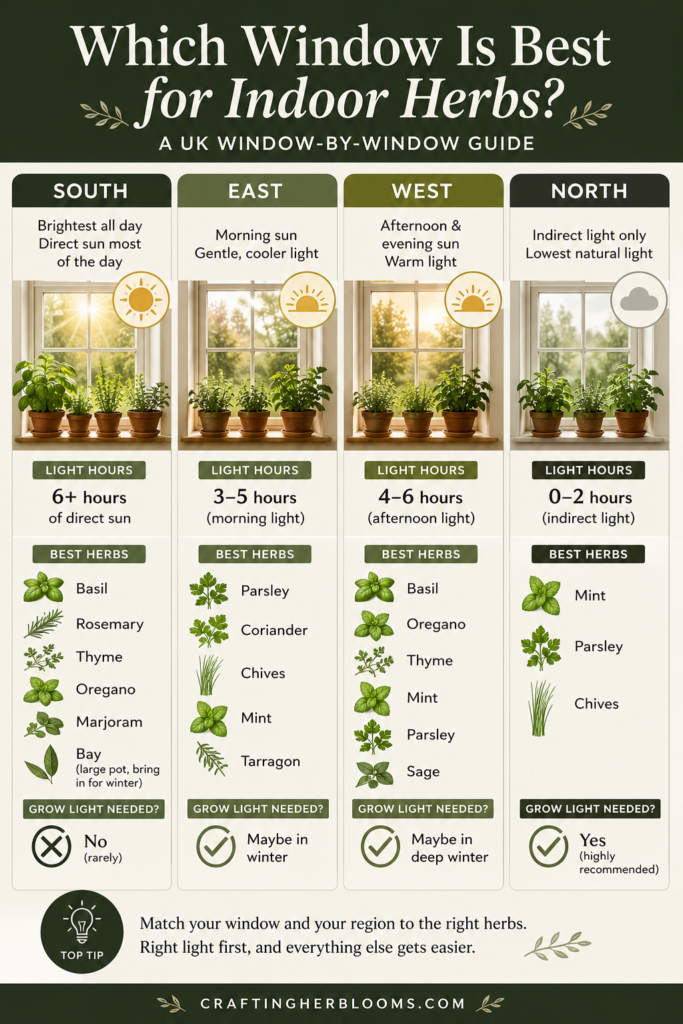
This guide works window by window rather than herb by herb. Find your window, find your region, and you will know within a few minutes which herbs are worth the pot space and which ones need a grow light to stand a chance.
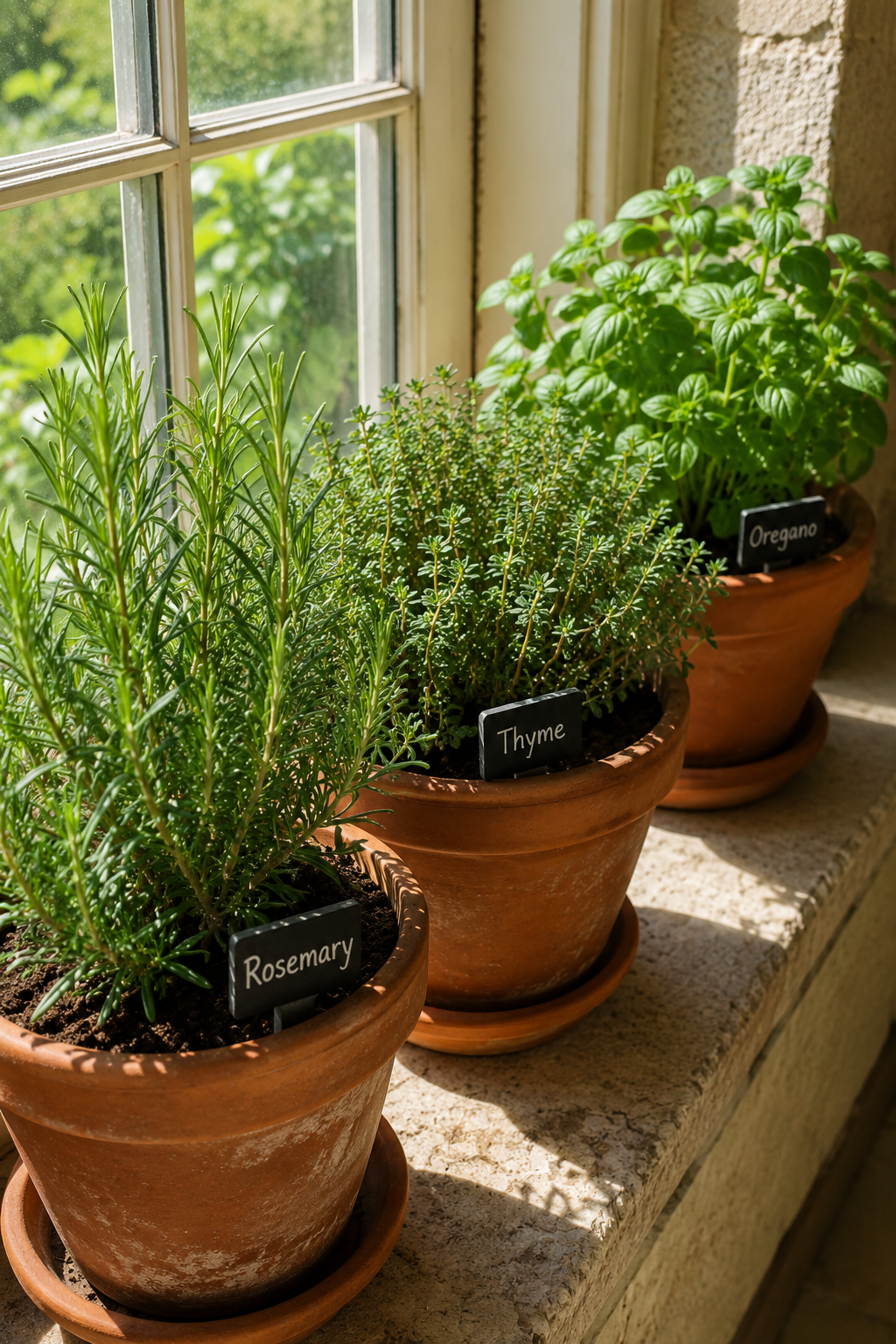
Growing herbs indoors: the basics
Before the window-by-window breakdown, a few fundamentals apply everywhere in the UK, regardless of orientation.
Light. Most kitchen herbs want 5 to 8 hours of strong natural light a day. Basil, rosemary, thyme and oregano are the most demanding. Parsley, chives and mint will tolerate less.
Temperature. Herbs are happiest between 18°C and 21°C, which is roughly normal room temperature. Keep them away from direct contact with cold glass overnight and away from radiators, both of which cause more indoor herb deaths than people expect.
Pots and drainage. Use containers with drainage holes and a free-draining, peat-free multipurpose compost. A saucer underneath protects windowsills, but never let a pot sit in standing water.
Watering. Check the top centimetre of compost with a finger before watering. Most herb failures indoors come from overwatering, not underwatering, particularly through darker months when growth slows and demand drops.
Feeding. A diluted liquid seaweed or general-purpose houseplant feed every two to four weeks through spring and summer is plenty. Skip feeding in the depths of winter when plants are barely growing.
Air. Herbs like airflow. A stagnant, humid kitchen corner encourages mildew, especially on basil and mint. Crack a window occasionally, even in winter, or run an extractor fan.
With that groundwork in place, here is what each window orientation actually offers, and which herbs make the most of it.
South-facing windows: the easiest option
A south-facing window is the closest thing to a greenhouse most of us have, and it is the only orientation that reliably delivers six or more hours of direct sun through a UK winter.
This is the window for the herbs that ask the most of the sun: basil, rosemary, thyme, oregano and marjoram all perform best here. These are Mediterranean natives, used to baking, well-drained hillsides, and they read a shaded kitchen as an insult.
The one risk with a strong south window is summer scorch, particularly behind glass that concentrates heat. Basil in particular can wilt and crisp at the leaf tips in a hot July sill. A sheer curtain or a few centimetres of distance from the glass on the hottest days solves this without sacrificing the light.
Rosemary and thyme are more forgiving of heat and are genuinely happy on a south sill twelve months of the year, which makes this orientation the best long-term home for woody, perennial herbs rather than the softer annuals.
Best for: basil, rosemary, thyme, oregano, marjoram, bay (in a large pot, brought in for winter if grown outdoors in summer).
East-facing windows: gentle morning light
East-facing windows catch the morning sun and lose it by early afternoon, which gives a cooler, gentler light than a south window without disappearing into shade.
This suits herbs that want good light but scorch or bolt in intense heat. Parsley and coriander both do noticeably better here than on a blazing south sill, where coriander in particular tends to bolt to seed faster than most people expect. Chives are equally at home in an east window, tolerating slightly lower light without losing much vigour.
Mint will also grow well here, and an east window has the added benefit of keeping mint’s enthusiastic root system a little less rampant than the growth spurts a hot south sill can trigger. Mint should always be in its own pot regardless of window, since it spreads and will out-compete anything sharing a container within a season.
Best for: parsley, coriander, chives, mint, tarragon.
West-facing windows: warm afternoon light
A west-facing window is the mirror of an east one: cooler mornings, then a longer stretch of warm afternoon and early evening sun. In practice it behaves close to a south window for a shorter part of the day, which makes it a solid middle-ground option.
Most of the herbs that do well in a south window will also do reasonably well here, just with slightly slower growth through the darkest months. Basil and oregano both cope with a west sill, and it is often the better choice in high summer if a south window is running too hot for comfort.
Chives, parsley and mint are equally happy in a west window as an east one, so if choosing between the two based on which room the window is in, the herb itself matters less than convenience.
Best for: basil, oregano, chives, parsley, mint, sage.
North-facing windows: the hardest option, and where grow lights earn their keep
North-facing windows rarely get direct sun in the UK, and in winter the light levels can drop close to unusable for anything but the most shade-tolerant houseplants. This is the one orientation where relying on natural light alone through October to February is a losing proposition for most kitchen herbs.
Parsley and chives are the most shade-tolerant true herbs and can limp through a north window in the brighter months, but even these will grow slowly and leggily once the days shorten. Mint tolerates more shade than most herbs too, though it will stretch and thin without enough light.
For a north-facing kitchen, a small LED grow light is not a luxury purchase, it is close to a requirement for keeping a productive herb garden through winter. Position a full-spectrum grow light 15 to 30cm above the plants and run it for 14 to 16 hours a day during the darkest months. Under decent grow lighting, basil, mint, parsley, chives and coriander all produce usable harvests even in a north-facing room, which genuinely widens what is possible regardless of which way the kitchen happens to face.
A grow light on a north-facing shelf with good airflow around it often outperforms a naturally bright but stagnant, poorly ventilated south-facing room, so orientation is not always destiny once supplemental light is in the mix.
Best for (with a grow light): parsley, chives, mint, basil, coriander. Without supplemental light: treat as a resting or low-yield window through winter, and consider it a spring and summer only spot instead.
Indoor herb growing across UK regions
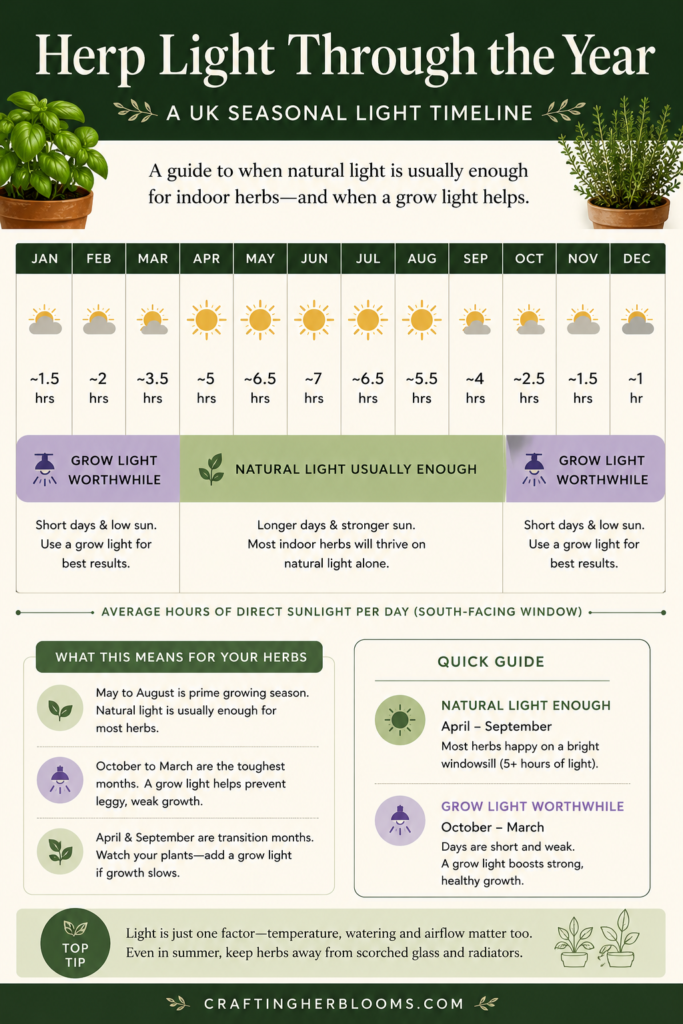
Window orientation is the biggest lever, but where in the UK that window sits changes the maths too. A south-facing sill in Kent is not working with the same day length or light intensity as a south-facing sill in Inverness, especially between November and February.
Southern England. The longest winter days and the mildest light levels of anywhere in the UK. A south or west window here can often carry basil and rosemary through winter with minimal or no supplemental light, though a grow light still helps on the shortest, greyest days around the solstice.
Midlands and East Anglia. Slightly shorter winter days than the south, with East Anglia in particular benefiting from being one of the drier, brighter regions overall. South and west windows still perform well, and grow lights become worthwhile for anything on an east or north window from November onward.
Northern England and Wales. Winter daylight hours drop further, and cloud cover tends to be more persistent, particularly in upland and western areas of Wales and the Pennines. A grow light is a sensible year-round backup on anything other than a strong south window, and close to essential on east or north windows through winter.
Scotland. The most dramatic seasonal swing in the UK, with some areas seeing under seven hours of daylight around the winter solstice. Even a good south-facing window will benefit from a grow light through December and January. Tender herbs like parsley and coriander that might survive an unheated space further south often need to come fully indoors, and starting some herbs fresh from seed each spring rather than expecting them to overwinter is common practice this far north.
The pattern across all four regions is the same: the further north or the more overcast the local climate, the more a grow light shifts from optional to close to necessary for a productive herb garden through the darker months, regardless of which way the window faces.
Growing herbs indoors through a UK winter
Winter is where most indoor herb gardens quietly fail, not from a single mistake but from a stack of small ones: less light, cooler rooms, less frequent watering that tips into either drought or drowning, and growth so slow that a struggling plant looks the same as a resting one until it is too late.
A few adjustments make winter growing realistic rather than optimistic.
Move pots to the brightest available spot, even if that means relocating from a usual kitchen sill to a brighter hallway or spare room window for the darkest months. Light matters more than convenience of location for these three months.
Reduce watering frequency. Growth slows dramatically, and a compost that needed watering twice a week in July might only need it once every ten days in January. Overwatering in winter is the single most common cause of indoor herb death.
Add supplemental light where the window cannot deliver enough on its own. A clip-on or small shelf-mounted full-spectrum grow light is the standard fix, run for 14 to 16 hours daily positioned close to the foliage without touching it.
Group plants with similar needs together rather than spreading a single grow light across pots with very different light demands. A basil and a parsley under the same light will do fine together; a sun-hungry rosemary sharing a dim corner with a shade-tolerant mint means one of them is being short-changed.
Expect slower harvests, not none. A realistic winter goal is steady, modest picking rather than the abundance of a July windowsill. Trying to harvest at a summer pace through December stresses the plant and shortens its winter lifespan.
Quick herb-by-herb reference
A short-form summary for anyone who wants the answer without reading the full window breakdown again.
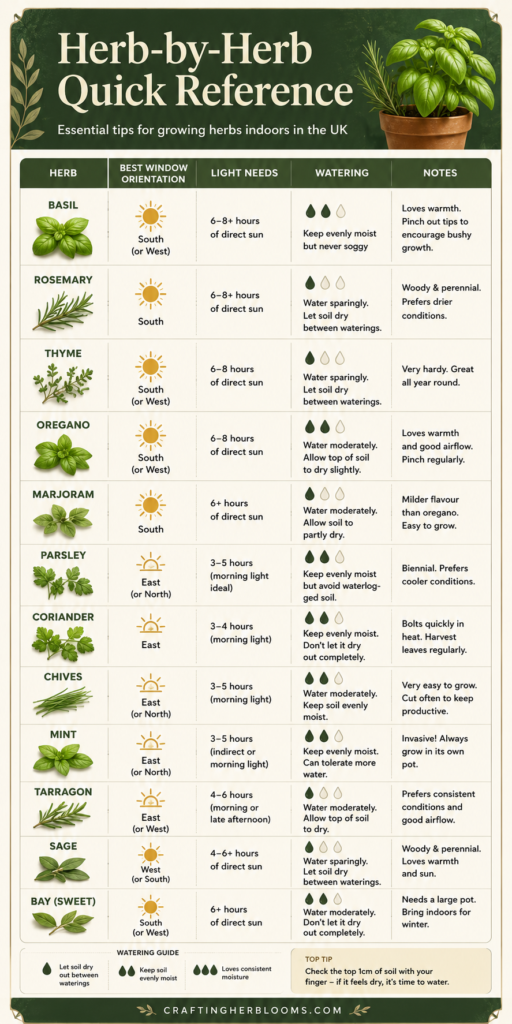
Basil. Needs the most light of any common kitchen herb. South or west window, or a grow light on anything less. Hates cold draughts and cold glass contact overnight.
Rosemary. Loves a hot, bright south window and copes with less water than most herbs assume. One of the most forgiving herbs for beginners once light is sorted.
Thyme. Similar profile to rosemary: bright, warm, on the drier side. A south or strong west window suits it well.
Parsley. More shade-tolerant than most herbs, doing well in east, west or even a reasonably bright north window with supplemental light in winter.
Coriander. Prefers cooler light, so east is often better than a scorching south sill, where it tends to bolt to seed faster.
Chives. One of the easiest and most shade-tolerant herbs, suited to almost any window, including a grow-light-assisted north one through winter.
Mint. Tolerant of a wide light range but needs its own pot to stop it overwhelming neighbours. East or west windows suit it well.
Oregano and marjoram. Similar to thyme, wanting a bright, warm spot, ideally south or west.
Sage. Appreciates good light and, like rosemary, tolerates a slightly drier compost between waterings.
Tarragon. Does best with good but not scorching light, making east or west windows a solid match.
Common problems when growing herbs indoors
Leggy, stretched growth. Almost always a light problem. Move to a brighter window or add a grow light rather than assuming the plant simply needs more space.
Yellowing leaves. Usually overwatering, particularly in winter. Let the compost dry out more between waterings and check the pot has proper drainage.
Mildew on leaves. A humidity and airflow issue, common on basil and mint in a steamy, poorly ventilated kitchen. Space plants apart and improve ventilation before reaching for anything else.
Herbs bolting to flower quickly. Common with coriander and basil in strong, hot light. Regular pinching out of flower buds and, for coriander, a slightly cooler window extends usable leaf growth.
Slow or stalled growth in winter. Often normal rather than a fault. Confirm light levels are adequate and reduce expectations for growth rate rather than assuming something is wrong.
Frequently asked questions
Can herbs really grow well on a north-facing windowsill?
Not reliably on natural light alone through a UK winter. With a full-spectrum LED grow light run for 14 to 16 hours a day, parsley, chives, mint, basil and coriander can all produce a usable, steady harvest even in a north-facing room.
Do I need a grow light for indoor herbs in the UK?
It depends on the window and the region. A strong south-facing window in southern England may not need one at all outside the darkest weeks of December and January. An east, west or north window, or anywhere from the Midlands northward, benefits noticeably from one through autumn and winter.
Which herbs are easiest for a beginner to grow indoors?
Chives, mint and parsley are the most forgiving, tolerating a wider range of light and watering mistakes than basil or coriander, both of which are less forgiving of underwatering, cold draughts or insufficient light.
Can I grow herbs indoors all year round in the UK?
Yes, with realistic expectations. Growth is faster and harvests are larger from spring through early autumn, and winter growing is about steady, modest picking rather than a continuation of summer abundance, especially without supplemental light.
How close should a grow light be to the herbs?
Around 15 to 30cm above the foliage for most small full-spectrum LED grow lights, adjusted slightly closer for lower-powered lights and further for stronger ones to avoid leaf scorch.
Why does my basil keep dying on the windowsill?
Basil is the most light-hungry of the common kitchen herbs and is also sensitive to cold, particularly cold glass contact overnight and draughts from an opened window in winter. Confirm it is on a south or bright west window, or add a grow light, and keep it a few centimetres clear of the glass.
Do herbs need different pots for indoor growing versus outdoor?
Not fundamentally, though good drainage matters more indoors since there is no natural runoff. Any pot with drainage holes and a saucer works, and mint should always have its own container regardless of location.


